
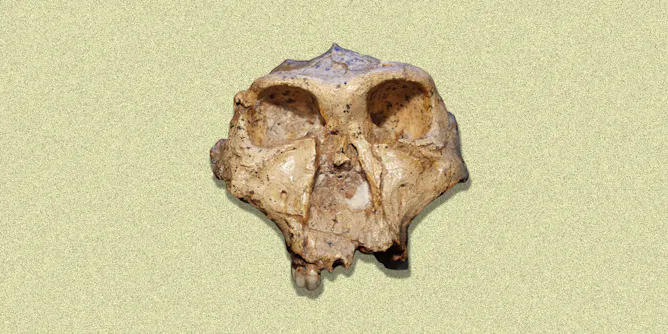
The way we classify humanity’s ancient relatives is a mess. But there’s a simple fix.
Articles on Hominins
Displaying 1 - 20 of 53 articles
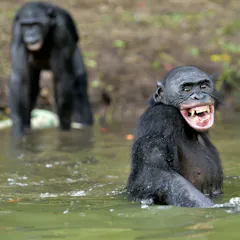
A new study of great ape laughter also gives clues about how humans’ ancient ancestors started speaking.
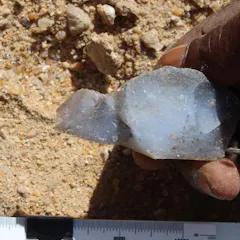
The age of the oldest known Oldowan stone tools from east Turkana has been pushed back by 700,000 years.
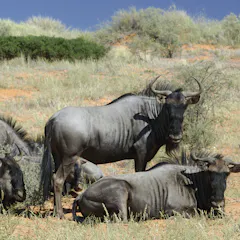
By studying antelope fossils, researchers can revisit long-standing questions about how the Cradle of Humankind’s environment evolved through time.

Global cooling associated with the impact of supernova remnants may have affected plants and animals, including species related to humans.

It’s the first evidence that early humans made a formidable sea crossing from the mainland to Sulawesi at least 1 million years ago.
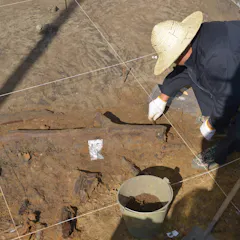
300,000-year-old wooden tools found in southwestern China reveal surprising sophistication from the ancestors of modern humans.
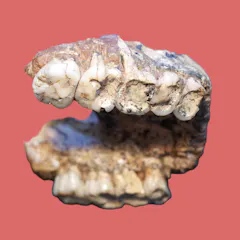
Curiously uniform dimples on the teeth of ancient hominins may give scientists a new way to trace their origins and relationships.

With a little guidance and a lot of practice, even you can make stone tools the way our oldest ancestors did – and learn to recognize the signs of a deliberately made tool.

Researchers reexamining fossils identified telltale marks made by human ancestors cutting meat from bones. The discovery pushes back the date hominins started living in Europe by 200,000 years.
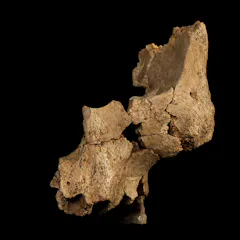
Western Europe appears to have been difficult territory for early human relatives to settle in.

A fossil face reveals that a prehistoric human species reached Western Europe much earlier than anybody thought.

Not knowing exactly when regular meat consumption became part of our ancestors’ diets is a gap in our understanding of human evolution.
The history of human origins research is intimately intertwined with the prevalent socio-political landscape.
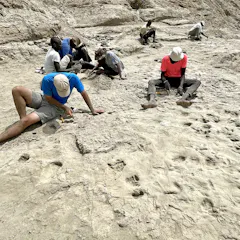
Ancient fossil footprints are the first evidence of two different hominin species − Homo erectus and Paranthropus boisei − living in the same place at the same time.
On the 50th anniversary of the discovery of ancient hominin Lucy, a leading Ethiopian scientist on why we need to ‘decolonise’ paleo research – and what it’s like to find the oldest human ancestor.

At a global level it is rare to find fossilised hominin tracks.

What do the world’s fastest creatures on land, sea and air all have in common? My colleagues and I have taken a key step towards solving this mystery.

New 700,000-year-old fossils from island east of Bali hint at ancient shrinking of extinct miniature humans.

Using a method applied directly to ancient hominin teeth, researchers have calculated the age of several important fossils.
Top contributors
-

Research Associate, African Centre for Coastal Palaeoscience, Nelson Mandela University
-
Professor, Palaeontology, Griffith University
-
Honorary Research Associate, Evolutionary Studies Institute, University of the Witwatersrand
-
Associate professor, University of Cape Town
-
Professor of Archaeology, Griffith University
-
Research Fellow in Biological Anthropology, Monash University
-
Director, Australian Research Centre for Human Evolution, Griffith University
-
Associate professor in Vertebrate Palaeontology, University of the Witwatersrand
-
Senior Research Scientist, National Museums of Kenya
-
Research Scientist and Museum Educator, Smithsonian Institution
-
Associate Professor of Anthropology, Binghamton University, State University of New York
-
Professor, Environmental Futures Research Centre, School of Science, University of Wollongong
-
Researcher in Palaeontology, University of Wollongong
-
Professor of Archaeological Theory and Method, University of Liverpool
-
Curator of Human Evolution of the Cleveland Museum of Natural History and Research Assistant Professor of Anthropology, Stony Brook University (The State University of New York)