
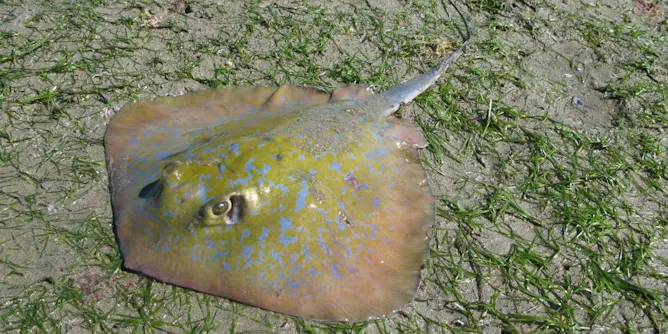
The sculpture might have begun with tracing a blue stingray specimen in the sand.
Articles on Hominins
Displaying 21 - 40 of 53 articles

Animals that hibernate live longer, so could hold clues on how to slow down ageing.
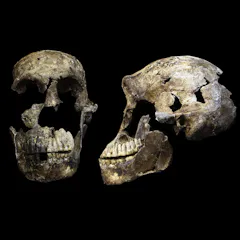
Homo naledi had a brain less than half the size of our own. Yet the new research claims it had cognitive abilities far beyond what we might expect.

This was an area in which early anatomically modern humans survived, evolved and thrived, before spreading out of Africa to other continents.

Signs of controlled fire use from Spain are at least 50,000 years older than previous evidence.
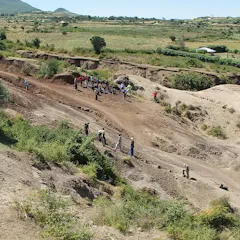
The findings suggest we weren’t the first advanced carnivore among the hominins, as has been previously assumed.
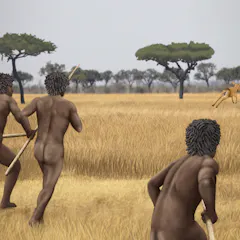
Africa’s large mammal heritage has formed a deep cultural legacy for all of humankind.
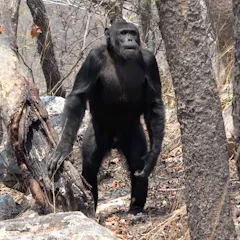
Almost all theories of human bipedalism explain it as a terrestrial adaptation. A new study does not support that view.
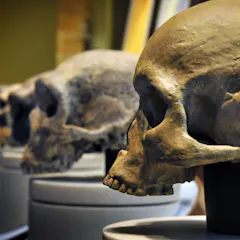
Ancient DNA helps reveal the tangled branches of the human family tree. Not only did our ancestors live alongside other human species, they mated with them, too.

Cutting-edge analysis of fossil ape teeth reveals ancient seasonal change in Africa, long before human ancestors appeared. The method will be crucial for the future study of early hominins.
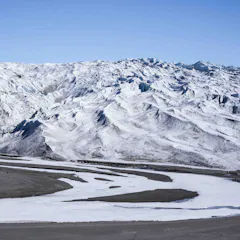
The Earth has had at least five major ice ages, and humans showed up in time for the most recent one. In fact, we’re still in it.

Stone artifacts and a fossil tooth point to Homo sapiens living at Grotte Mandrin 54,000 years ago, at a time when Neanderthals were still living in Europe.
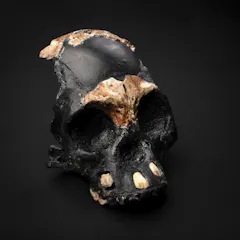
The fossil material was recovered from the surface of a tight, narrow passage that can only be accessed with difficulty by one person at a time.
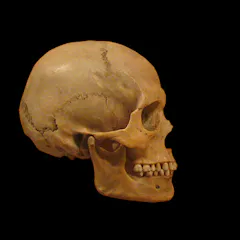
What looks like a bright, sharp dividing line between humans and other animals is really an artefact of extinction.
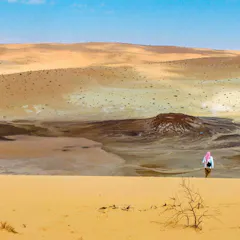
The new work presents the oldest dated evidence for hominins in Arabia, in the form of an ancient handaxe tool uncovered from the Nefud Desert.
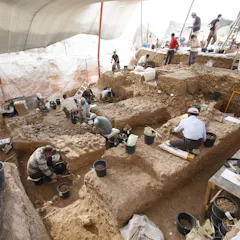
The 140,000-year-old skull fossils are leading to more questions than answers. Also found was the oldest intact campfire ever found in the open air.

It appears that the South African Cape south coast’s dunes and beaches formed a vast canvas of sand on which our ancestors could leave their mark.

The ancestors of modern-day people living on Southeast Asian islands likely interbred with a prehistoric species called Denisovans - raising the possibility of fresh and intriguing fossil discoveries.
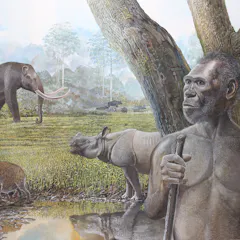
Several theories have suggested either humans, climate change or both drove megafauna extinctions in Southeast Asia. Our newest work suggests otherwise.
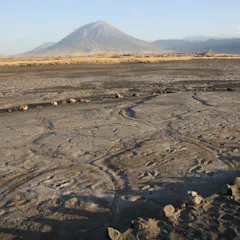
The footprints of over 20 different prehistoric people, pressed into volcanic ash thousands of years ago in Tanzania, show possible evidence for sexual division of labor in this ancient community.
Top contributors
-

Research Associate, African Centre for Coastal Palaeoscience, Nelson Mandela University
-
Professor, Palaeontology, Griffith University
-
Honorary Research Associate, Evolutionary Studies Institute, University of the Witwatersrand
-
Associate professor, University of Cape Town
-
Professor of Archaeology, Griffith University
-
Research Fellow in Biological Anthropology, Monash University
-
Director, Australian Research Centre for Human Evolution, Griffith University
-
Associate professor in Vertebrate Palaeontology, University of the Witwatersrand
-
Senior Research Scientist, National Museums of Kenya
-
Research Scientist and Museum Educator, Smithsonian Institution
-
Associate Professor of Anthropology, Binghamton University, State University of New York
-
Professor, Environmental Futures Research Centre, School of Science, University of Wollongong
-
Researcher in Palaeontology, University of Wollongong
-
Professor of Archaeological Theory and Method, University of Liverpool
-
Curator of Human Evolution of the Cleveland Museum of Natural History and Research Assistant Professor of Anthropology, Stony Brook University (The State University of New York)