
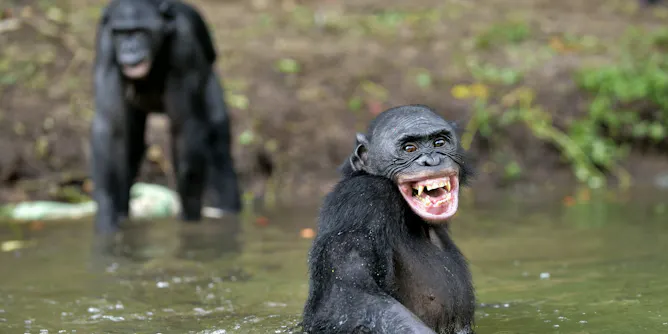
A new study of great ape laughter also gives clues about how humans’ ancient ancestors started speaking.
Articles on Hominin evolution
Displaying all articles
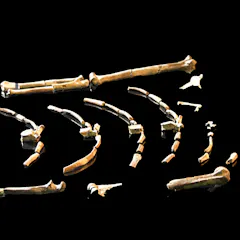
More than any other ancient relative, Lucy has challenged us to think deeply about what it means to be human.
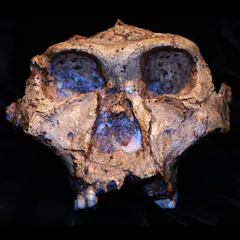
Researchers have extracted 2-million-year-old protein remains from Paranthropus robustus teeth to reveal biological sex and genetic variability.

A fossil face reveals that a prehistoric human species reached Western Europe much earlier than anybody thought.
The history of human origins research is intimately intertwined with the prevalent socio-political landscape.
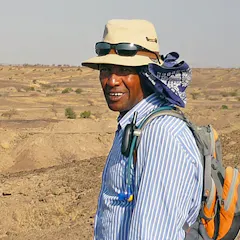
On the 50th anniversary of the discovery of ancient hominin Lucy, a leading Ethiopian scientist on why we need to ‘decolonise’ paleo research – and what it’s like to find the oldest human ancestor.

New 700,000-year-old fossils from island east of Bali hint at ancient shrinking of extinct miniature humans.

Using a method applied directly to ancient hominin teeth, researchers have calculated the age of several important fossils.
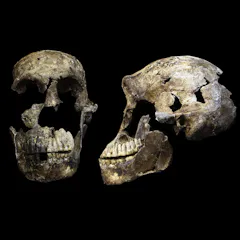
Homo naledi had a brain less than half the size of our own. Yet the new research claims it had cognitive abilities far beyond what we might expect.

This was an area in which early anatomically modern humans survived, evolved and thrived, before spreading out of Africa to other continents.
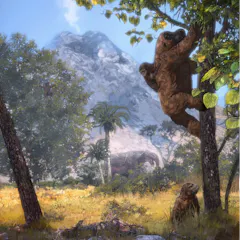
Contrary to the idea that apes evolved their upright posture to reach for fruit in the forest canopy, the earliest known ape with this stature, Morotopithecus, lived in more open grassy environments.
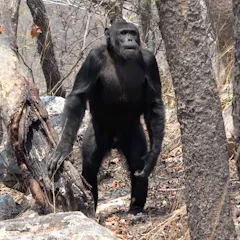
Almost all theories of human bipedalism explain it as a terrestrial adaptation. A new study does not support that view.

Cutting-edge analysis of fossil ape teeth reveals ancient seasonal change in Africa, long before human ancestors appeared. The method will be crucial for the future study of early hominins.
Top contributors
-

Honorary Professor, Archaeology, The University of Queensland
-
Asso. Professor in Anthropology, University College London, UCL
-
Honorary Research Associate, Evolutionary Studies Institute, University of the Witwatersrand
-
Professor of Anthropology, University of Michigan
-
CENIEH Director, Atapuerca Research Team and author of "Homo imperfectus" (Ed. Destino), Centro Nacional de Investigación sobre la Evolución Humana (CENIEH)
-
Professor in the Australian Research Centre for Human Evolution & Griffith Centre for Social and Cultural Research, Griffith University
-
Director, Australian Research Centre for Human Evolution, Griffith University
-
Professor of Anthropology, University of Minnesota
-
Associate Professor of Geosciences, Baylor University
-
Senior Lecturer, University of Leicester
-
Postdoctoral Research Scientist, Columbia University
-
Lecturer in Wildlife Conservation
-
Research Associate, African Centre for Coastal Palaeoscience, Nelson Mandela University
-
Senior Research Scientist, National Museums of Kenya
-
Professor of Archaeology, Griffith University