
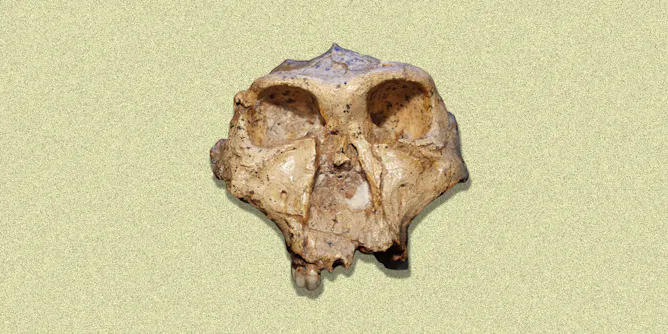
The way we classify humanity’s ancient relatives is a mess. But there’s a simple fix.
Articles on Homo sapiens
Displaying 1 - 20 of 124 articles

Tiny triangular-shaped flints from arrowheads found in Uzbekistan shed light on how the first settlement of ‘Homo sapiens’ – our modern human ancestors – came to Europe.

The discovery points to a long evolutionary history in north Africa, much earlier than modern Homo sapiens.

People were creating cave art in Indonesia 67,800 years ago – before modern humans reached Australia.
Why human testicles are so different to chimpanzees’ and gorillas’.
A space physicist has suggested that a reversal of the Earth’s magnetic poles may have wiped out the Neanderthals.
We may have complex brains but evolution hasn’t dealt us the best hand when it comes to genetics.

Flint tools carried across the Pyrenees reveal the routes prehistoric humans took.

New research presents evidence of a wet forest environment 150,000 years ago in Côte d'Ivoire.

In The Decline and Fall of the Human Empire, science writer Henry Gee considers how long we’ve got, and how we can extend our time on Earth.

Not knowing exactly when regular meat consumption became part of our ancestors’ diets is a gap in our understanding of human evolution.

Our understanding of human ancestry has changed dramatically since the discovery of Lucy the ancient hominin 50 years ago. Here is the history of humanity as we know it today.

At a global level it is rare to find fossilised hominin tracks.
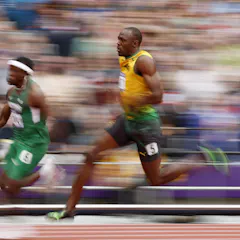
What do the world’s fastest creatures on land, sea and air all have in common? My colleagues and I have taken a key step towards solving this mystery.
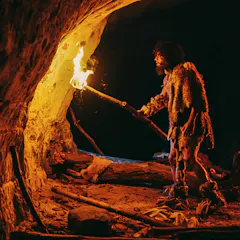
Most animals retreated to small, warmer enclaves. But some, like humans, seemed to have stayed where they were.

Named after the writings of J.R.R. Tolkien, Thorin is the first Neanderthal body to be found in France since 1978. He is forcing us to rethink almost everything we knew about early humanity.
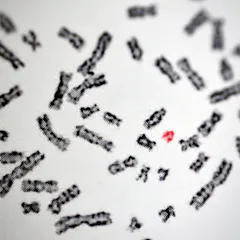
A mysterious century-old law of genetics may explain the puzzling genetic legacy of our extinct Neanderthal cousins.
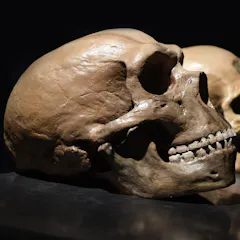
The two human species had many similarities but their communication would have been different.
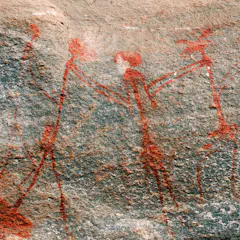
Neanderthals and humans may have been equally smart and skilled, but some evidence points to humans living in larger groups.
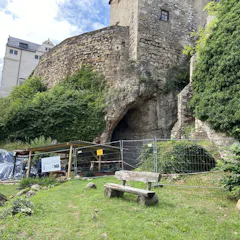
New discoveries of bone fragments at Ranis cave in Germany prove the early presence of cold-adapted Homo sapiens in northern Europe
Top contributors
-

Research Associate, African Centre for Coastal Palaeoscience, Nelson Mandela University
-
Honorary Associate Professor, UNSW
-
Senior Lecturer in Paleontology and Evolutionary Biology, Life Sciences at the University of Bath, University of Bath
-
Associate Professor of Archaeology, Griffith University
-
Archéologue et chercheur au CNRS, Auteurs historiques The Conversation France; Université de Toulouse
-
Director, ARC Centre of Excellence for Australian Biodiversity and Heritage (CABAH), University of Wollongong
-
Professor of Archaeology and Biological Anthropology, School of Social Science, The University of Queensland
-
Senior Research Associate in Translational Genomics, University of Oxford
-
Associate professor in Vertebrate Palaeontology, University of the Witwatersrand
-
Professor in Geochronology and Geochemistry, Southern Cross University
-
Professor of Earth System Science, UCL
-
Associate Professor of Anthropology, Binghamton University, State University of New York
-
Researcher, Centre for Archeological Science, University of Wollongong
-
Emeritus Professor, University of Cape Town
-
Professor of Evolutionary Studies, Professor of African Prehistory, University of Bergen