

Two Denisovan leg bones from Taiwan came from tall individuals. But we can’t generalise to a whole species just yet.
Articles on Human evolution
Displaying 1 - 20 of 237 articles
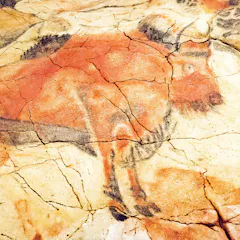
A new study has retrieved human genetic material from the walls of caves with ancient rock art.
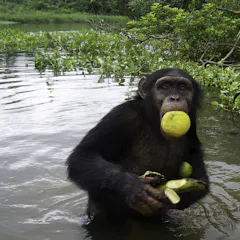
Intelligence is an energetically expensive luxury. And a new study in Science shows meat has never been the main fuel source for our ancestors.
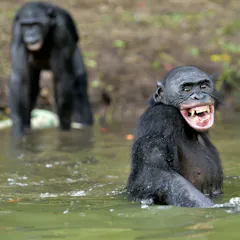
A new study of great ape laughter also gives clues about how humans’ ancient ancestors started speaking.

Your fingers’ lengths are just one feature of many that let your hands grasp, press, pull and otherwise interact with the world.

Survival depends on information and social networks.

Studies of Chinese Homo erectus suggest that it was no evolutionary dead end, but contributed genes to modern people in the region.
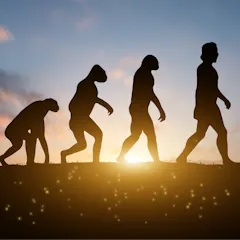
Many aspects of human anatomy are just “good enough” solutions – functional, but far from perfect.

The discovery points to a long evolutionary history in north Africa, much earlier than modern Homo sapiens.

Compared to other great apes, human penises are mysteriously large, hinting they act as a signal to mates.

What muscles feet have, how your brain controls them, and how humans evolved all play a part in why people can’t easily move individual toes.

Studying ancient genes can tell us more about the evolution of humans’ anatomy, behaviour and thinking.
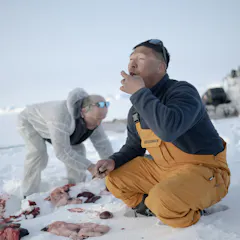
We are indeed still evolving, though it can be hard to tell because it happens over generations and often involves things you can’t see, such as what foods different people are able to digest.
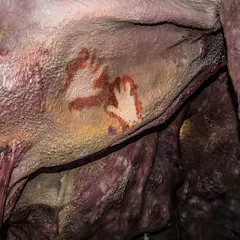
Art has sometimes thought to be exclusive to modern humans.
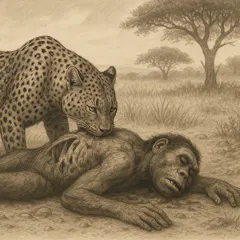
Paleoanthropologists have thought that Homo habilis was the first stone-tool maker and meat-eater in our genus. But new research suggests H. habilis might not have been so advanced.
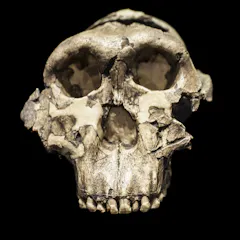
The fossils from Kenya belong to a species called Paranthropus boisei.
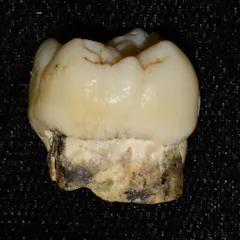
Long before industry, our ancestors faced toxic metals, including lead. This exposure may have shaped the evolution of human intelligence.

The large, naturalistic engravings are a striking symbol for survival in the desert.
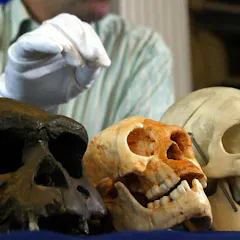
New research on the size relationship between brains and wisdom teeth suggests that bigger brains aren’t necessarily the driving force in human evolution.

Global cooling associated with the impact of supernova remnants may have affected plants and animals, including species related to humans.
Top contributors
-

Honorary Associate Professor, UNSW
-
Professor of Earth System Science, UCL
-
Emeritus Strategic Professor in Palaeontology, Flinders University
-
Professor of Archaeology and Biological Anthropology, School of Social Science, The University of Queensland
-
Director, ARC Centre of Excellence for Australian Biodiversity and Heritage (CABAH), University of Wollongong
-
Associate Professor of Archaeology, Griffith University
-
Director, Australian Research Centre for Human Evolution, Griffith University
-
Professor in Geochronology and Geochemistry, Southern Cross University
-
Wood Jones Professor of Anthropological and Comparative Anatomy, Adelaide University
-
Postdoctoral fellow, Australian National University
-
Group Leader, Genomics and Bioinformatics, Australian Centre for Ancient DNA, Adelaide University
-
Senior Lecturer in Paleontology and Evolutionary Biology, Life Sciences at the University of Bath, University of Bath
-
Research Fellow in Biological Anthropology, Monash University
-
Jenny Graves is a Friend of The Conversation.
Distinguished Professor of Genetics and Vice Chancellor's Fellow, La Trobe University
-
Scientia Professor of Evolution, UNSW