
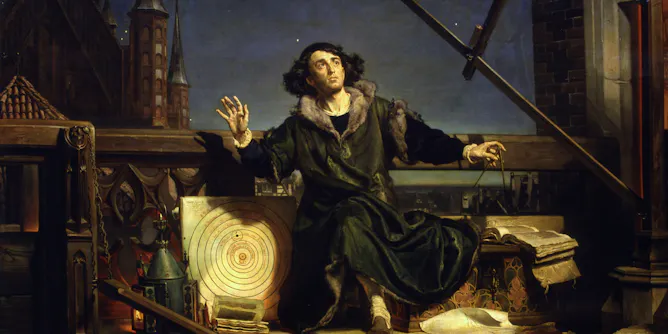
A team of archaeologists discovered the remains of the 16th-century father of modern astronomy, who demonstrated that the Earth orbits the Sun.
Articles on Astronomy
Displaying 241 - 260 of 989 articles
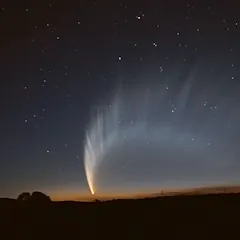
In 2024 we will see meteor showers, Saturn disappearing behind the Moon, and – if we’re lucky – a comet bright enough to see with the naked eye.

The Peregrine and Nova-C landers are due to carry out valuable science at two diverse lunar locations.
A telescope can reveal so much of the night sky, including Saturn’s rings and the Moon’s craters. But choosing the right telescope is a difficult decision – here’s what you need to know.

People have been looking up at the stars for thousands of years. Here’s where to start if you want to learn more about the night sky – from spotting easy-to-find constellations to using the best apps.
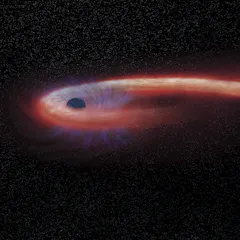
Pictures of black holes have a white outline around them when photographed, due to one of black holes’ unique and key features.
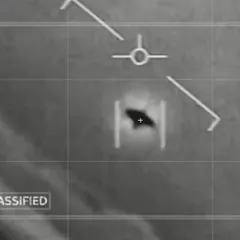
Several scientific projects are aiming to investigate UFO sightings.
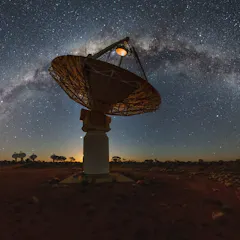
Do all big black holes in very massive galaxies emit radio waves? We used the latest radio telescopes to find out.
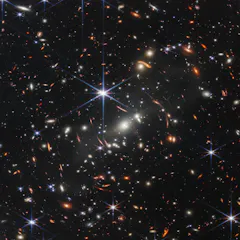
Sound needs matter to propagate, so the vast vacuum of space is not just empty − it’s silent.

A newly discovered planet that should be too big to have formed around a tiny star is throwing into question what researchers know about planet formation.
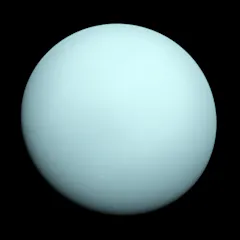
Five of the Uranus moons might be ocean worlds − and if there’s water, there might be life.

With an evidence-based strategy and careful evaluation, gender parity in science is achievable.
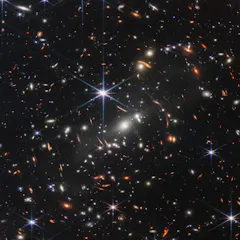
The universe is expanding faster than physicists would expect. To figure out what processes underlie this fast expansion rate, some researchers are first trying to rule out what processes can’t.
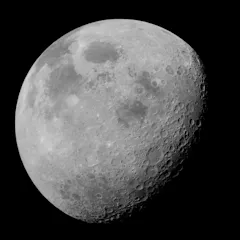
Some dark craters on the Moon are never exposed to light − ice could be hiding in these permanently shadowed regions, and India’s Chandrayaan-3 mission marked a big step toward finding it.
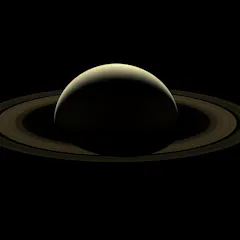
Viral headlines would have you think Saturn’s rings will vanish in just 18 months. Here’s what that really means and why you don’t need to worry.
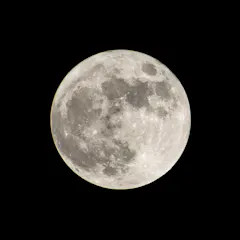
Despite the distances involved, people as far apart as the UK and Australia can see the Moon at the same time.
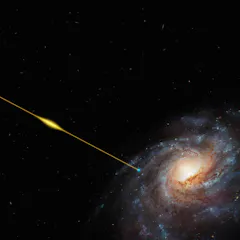
A record-breaking discovery of an extreme ‘fast radio burst’ opens a window into the early universe.
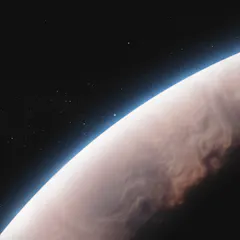
The atmosphere is a reflection of extreme conditions on the super-heated planet.
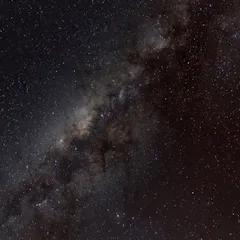
An astronomer explains why space looks so dark despite containing 200 billion trillion stars.
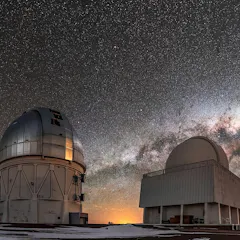
Controlled experiments are impossible in astronomy, as are direct measurements of physical properties of objects outside our solar system. So how do astronomers know so much about them?
Top contributors
-

Professor (Astrophysics), University of Southern Queensland
-
Senior Curator (Astronomy), Museums Victoria Research Institute; The University of Melbourne
-
Associate Professor in Astronomy, Monash University
-
University Distinguished Professor of Astronomy, University of Arizona
-
Associate Professor, School of Physics, The University of Melbourne
-
Professor of Astrophysics, University of Sydney
-
Professor, Radio Astronomy, University of Sydney
-
Pro Vice-Chancellor Flagship Initiatives, Swinburne University of Technology
-
Honorary Fellow, Space and Astronomy, CSIRO; Western Sydney University
-
John Curtin Distinguished Professor (Radio Astronomy), Curtin University
-
Postdoctoral Researcher in Radio Astronomy, University of Sydney
-
Lecturer in Astronomy, Nottingham Trent University
-
Senior Lecturer in Physics, Nottingham Trent University
-
Associate Dean of Innovation and Engagement, Swinburne University of Technology
-
Associate Professor, Astronomy, University of Regina