
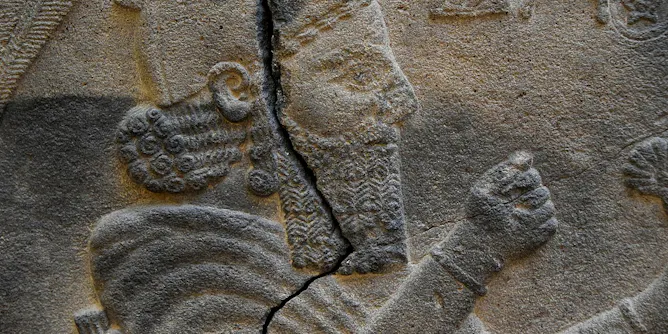
To protect their kings, ancient Mesopotamians discovered how to predict eclipses, which were associated with the deaths of rulers. This eventually led to the birth of astronomy.
Articles on Astronomy
Displaying 201 - 220 of 989 articles
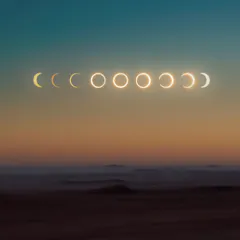
Eclipses have long fascinated and intrigued people, and anticipation of the total solar eclipse on April 8 is no exception. The beauty, history, mythology and science of eclipses justify the hype.
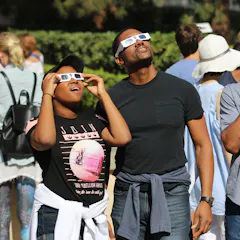
A total solar eclipse is a beautiful phenomenon worth seeing, but worth seeing safely.
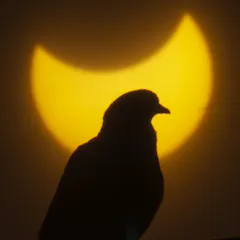
Since an eclipse only lasts a few minutes, you need more than just a handful of scientists running around collecting data on bird activity. That’s where a new app comes in.
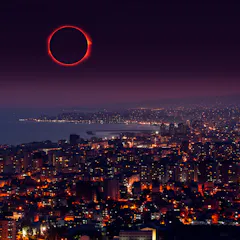
The sky is becoming more cluttered with satellites and space junk. This is affecting astronomical study, but will only have a minor effect — if any — on the viewing of the solar eclipse.
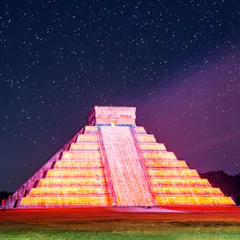
The skies and the gods were inseparable in Maya culture. Astronomers kept careful track of events like eclipses in order to perform the renewal ceremonies to continue the world’s cycles of rebirth.

Some ancient texts record what were likely dying stars, faintly visible from Earth. If close enough, these events can disturb telescopes and even damage the ozone layer.
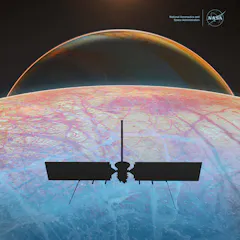
Europa Clipper will contain a plaque that celebrates humanity’s relationship with water and a decades-old tradition of searching for life outside Earth.
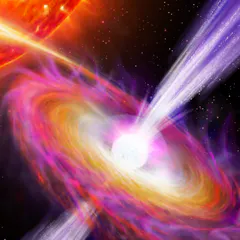
Powerful jets are launched from the most massive objects in our universe, but we don’t fully understand how. This measurement gets us a step closer to solving the mystery.
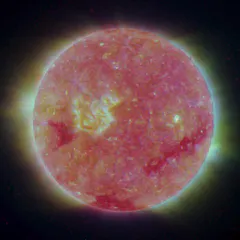
The solar corona can be seen during the solar eclipse on April 8. Astronomers are still trying to figure out the mysteries of the corona, including why it’s so hot.
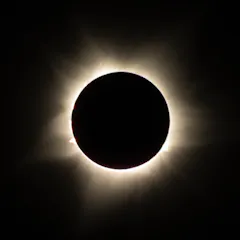
The eclipse will allow scientists to get rare measurements of the Sun’s atmosphere.
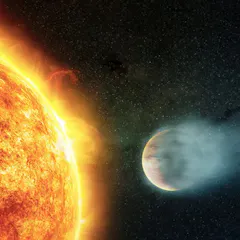
There are several ways in which stars can destroy and swallow their own planets.

Eclipses are rare, fantastic celestial events. Here’s how educators can help visually impaired students enjoy eclipses alongside their sighted peers.

The largest study yet of ‘twin stars’ shows planetary orbits may be less stable than we thought.
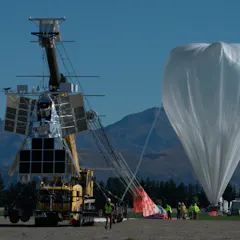
Giant helium balloons are a cheap, more environmentally friendly alternative to rocket launches – and you get the satellite back.
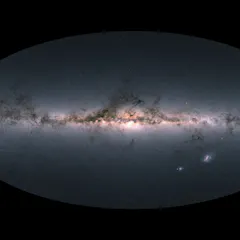
Floating crystals can pause the stellar aging process, providing a final energy source to otherwise dead stars.
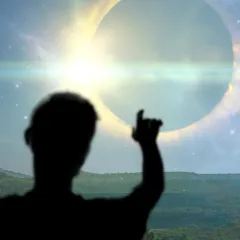
Eclipses have inspired myths, predictions and scientific discoveries. The total solar eclipse occurring on April 8 provides a once-in-a-lifetime opportunity to engage with science and the cosmos.

Deep-sea sediments show how the changing orbits of Earth and Mars are linked to past global warming and the speeding up of deep-ocean eddies.
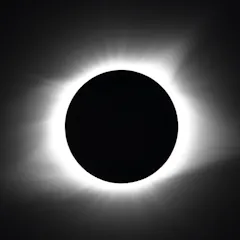
Many people will see a dazzling eclipse this April, but these events are possible only because of the sizes and precise distances between Earth, the Moon and the Sun.
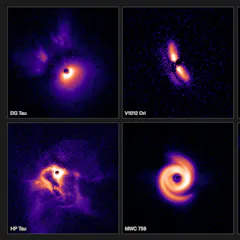
Astronomers have spotted a surprisingly diverse set of planet-forming disks.
Top contributors
-

Professor (Astrophysics), University of Southern Queensland
-
Senior Curator (Astronomy), Museums Victoria Research Institute; The University of Melbourne
-
Associate Professor in Astronomy, Monash University
-
University Distinguished Professor of Astronomy, University of Arizona
-
Associate Professor, School of Physics, The University of Melbourne
-
Professor of Astrophysics, University of Sydney
-
Professor, Radio Astronomy, University of Sydney
-
Pro Vice-Chancellor Flagship Initiatives, Swinburne University of Technology
-
Honorary Fellow, Space and Astronomy, CSIRO; Western Sydney University
-
John Curtin Distinguished Professor (Radio Astronomy), Curtin University
-
Postdoctoral Researcher in Radio Astronomy, University of Sydney
-
Lecturer in Astronomy, Nottingham Trent University
-
Senior Lecturer in Physics, Nottingham Trent University
-
Associate Dean of Innovation and Engagement, Swinburne University of Technology
-
Associate Professor, Astronomy, University of Regina