
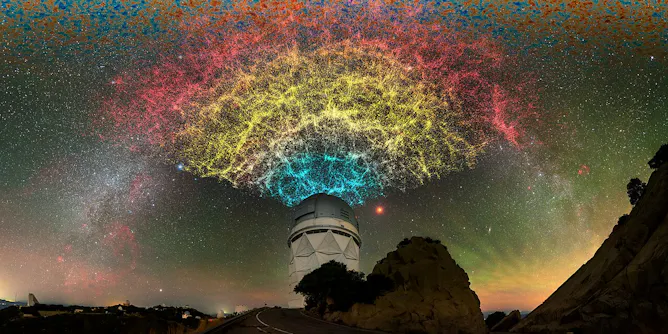
Sometimes, mapping the whole universe starts with getting thousands of tiny robots to move in exactly the right way.
Articles on Galaxies
Displaying 1 - 20 of 137 articles
It turns out these little red dots might actually be evidence of supermassive black holes.
Black holes are a mainstay in sci-fi movies. How do these massive black holes, spread throughout our universe, actually work in real life?
Scientists have discovered the most distant hydroxyl megamaser ever detected. This is a natural space laser.
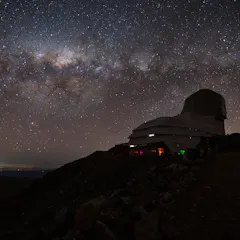
Scientists study small galaxies to look for hints of dark matter in the universe.
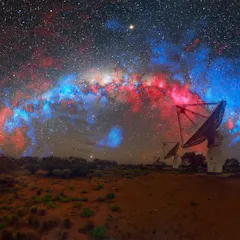
The best map yet of cosmic magnetic fields has been created with Australia’s most powerful radio telescope.
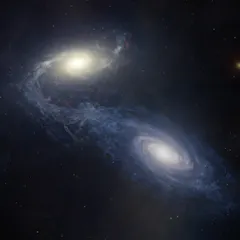
Astronomers want to understand how spiral galaxies form and get their massive spiral arms.
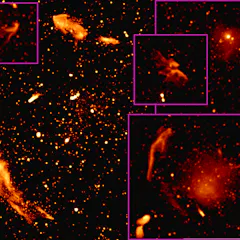
South Africa is using homegrown technology to answer questions about where our universe came from and where it is going.
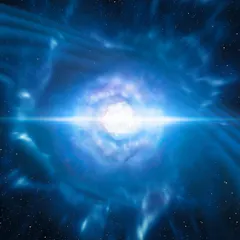
Gold and platinum are found in space, created when two stars collide. Astrophysicists can even trace this process further back, to the merger of galaxies.

The Rubin Observatory in Chile has the largest camera ever built – and is set to find objects never before seen by human eyes.

Dark matter doesn’t seem to interact with the matter we can see and touch, so scientists look for it in unusual places, like faraway galaxies and underground detectors.
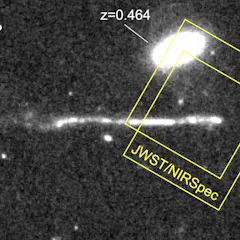
Astronomers have spotted runaway black holes screaming through space, leaving trails of stars in in their wake.
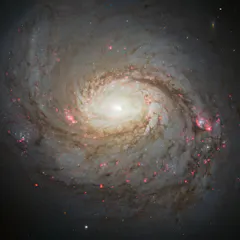
Normal matter – which makes up everything we see and touch – isn’t the only type of matter present in the universe.

New radio astronomy results reveal how galaxies exchange gas with the intergalactic medium – the raw material for stars and the key to galactic evolution.
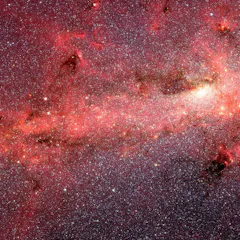
As the universe expands, it feels like it must be spreading out from some initial point. But a physicist explains why that’s not how it works. Hint: space-time is involved.
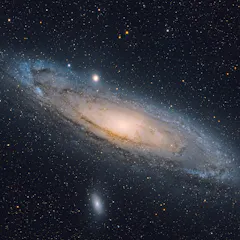
The odds of a galactic collision in our distant future are much lower than we thought, according to new simulations.
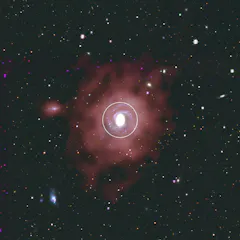
A new, more detailed study of 1,000 distant galaxies explains why some gas-rich galaxies don’t produce as many stars as you’d expect.

The SKA-Low radio telescope in Western Australia is slowly coming online. It will probe the shape of the universe and study cosmic mysteries.
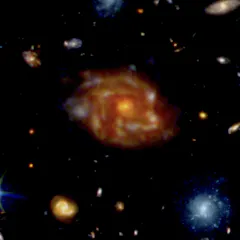
This enormous disk object formed soon after the Big Bang, challenging what we know about how galaxies grow.
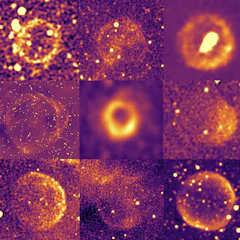
The newest generation of radio telescopes can detect objects so faint, we’ve never seen them before.
Top contributors
-

Associate Professor in Astronomy, Monash University
-
Professor of Astrophysics and Royal Society University Research Fellow, University of Hertfordshire
-
Senior Curator (Astronomy), Museums Victoria Research Institute; The University of Melbourne
-
Post-doctoral researcher in Astrophysics, University of the Western Cape
-
Honorary Fellow, Space and Astronomy, CSIRO; Western Sydney University
-
Senior research scientist, CSIRO
-
Associate Dean of Innovation and Engagement, Swinburne University of Technology
-
University Distinguished Professor of Astronomy, University of Arizona
-
Professor of Astronomy, Liverpool John Moores University
-
Professor and Director of the Centre of Excellence for Data Science, AI and Modelling, University of Hull
-
Professor (Astrophysics), University of Southern Queensland
-
ARC DECRA Fellow in Astronomy, University of Sydney
-
Professor, The University of Queensland
-
ARC DECRA Fellow in Astronomy, University of Sydney
-
SKA Postdoc in Observational Cosmology, University of the Western Cape