
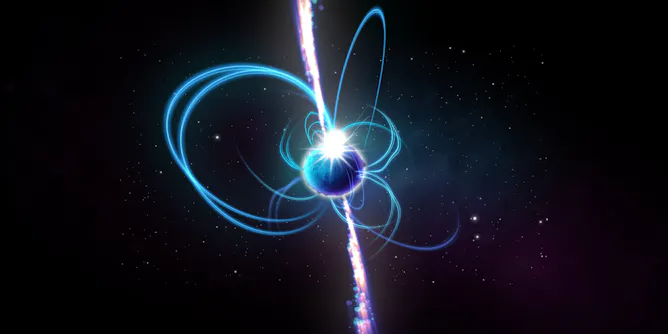
A mysterious repeating signal from our galactic backyard is a reminder the universe is full of unexpected surprises, if only we should look.
Articles on Radio astronomy
Displaying 61 - 80 of 130 articles

Despite the name, some black holes effectively “shine” as they suck up nearby material with such force that it begins to glow. New research reveals a new method for detecting these active black holes.
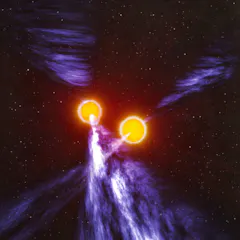
Astronomers watched a pair of pulsars for 16 years to test the theory of general relativity, which has stood unchallenged for over a century.
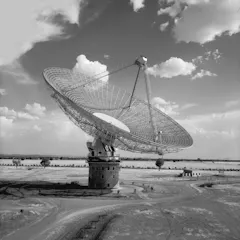
After six decades during which it tracked lunar missions, spotted distant pulsars and quasars, and even expanded our concept of the size of the Universe, the Parkes telescope is still going strong.
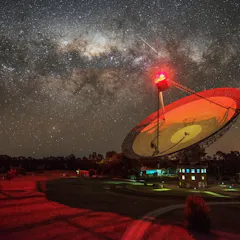
Astronomers hunting extraterrestrials were excited to discover an intriguing signal, but closer inspection has revealed it wasn’t aliens.

Fluctuating radio waves that appear to come from near the heart of the Milky Way are a new puzzle for astronomers.

Technology is allowing astronomers to study and analyse galaxies in far more detail than was previously possible.
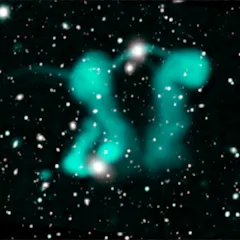
Australia’s ASKAP radio telescope probes the Universe more deeply than ever before, revealing unseen features of the cosmos.

Astronomers have taken a close-up look at the jets of plasma streaking away from a supermassive black hole - one of the strangest and most energetic features of galaxies.
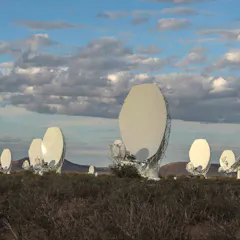
The pandemic has underscored that the world requires agility for survival. That makes blue skies science, which encourages curiosity and nimble thinking, perhaps more important than ever.
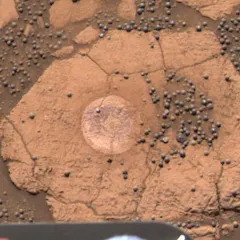
No conclusive evidence that extraterrestrial life exists has been found…yet.
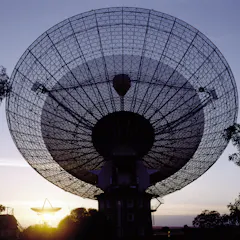
Australian astronomers are part of a prize-winning team that was the first to pinpoint the location of a fast radio burst. But there is much we still don’t know about these mysterious bursts.
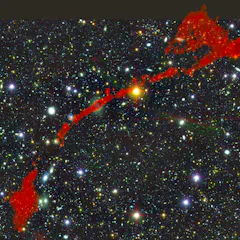
Based on what we currently know about the density of giant radio galaxies in the sky, the probability of finding two of them in this region is extremely small.
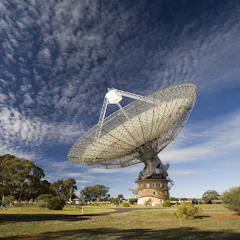
One way forward would be to abandon the traditional approach of using single-dish telescopes for SETI.
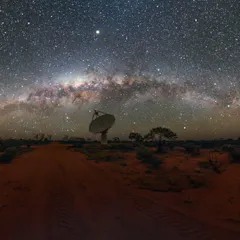
Visitors are discouraged from the remote desert location where powerful telescopes are listening to the universe.
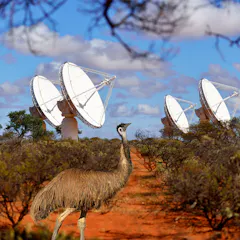
A collaboration between Australian and German scientists gives an unrivalled view of the structure of the Universe.
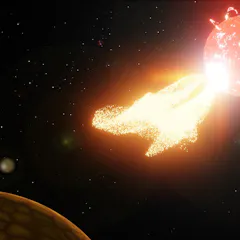
We observed a powerful flare and a huge burst of radio waves from our nearest stellar neighbour, Proxima Centauri, indicating violent space weather around the star.
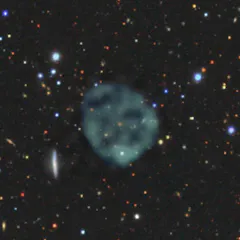
When astronomers started using the new ASKAP radio telescope, they discovered mysterious circular blobs of unknown size and distance in the sky.
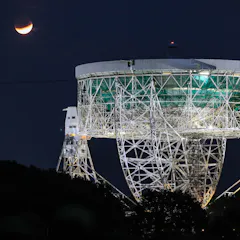
Radio telescopes are incredibly sensitive to phone network interference.
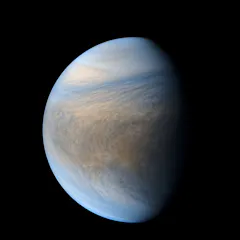
The discovery of phosphine in the acidic clouds of Venus can’t be explained by any known chemical or geological processes.
Top contributors
-

Professor, Radio Astronomy, University of Sydney
-
Honorary Fellow, Space and Astronomy, CSIRO; Western Sydney University
-
CSIRO
-
John Curtin Distinguished Professor (Radio Astronomy), Curtin University
-
Professor in Physics and Astronomy, UNSW
-
Professor at the International Centre for Radio Astronomy Research (ICRAR), The University of Western Australia
-
Postdoctoral Researcher in Radio Astronomy, University of Sydney
-
Senior research fellow, Curtin University
-
Radio Astronomer, Curtin University
-
Sir Bernard Lovell chair of Astrophysics, University of Manchester
-
Professor of Physics, University of Wisconsin-Milwaukee
-
Professor of Extragalactic Astronomy, Head of the Astrophysics Group, University of Bath
-
Senior Lecturer in Astrophysics, University of Sydney
-
Lecturer, University of Cape Town
-
Director, Astronomy and Space Science, CSIRO