
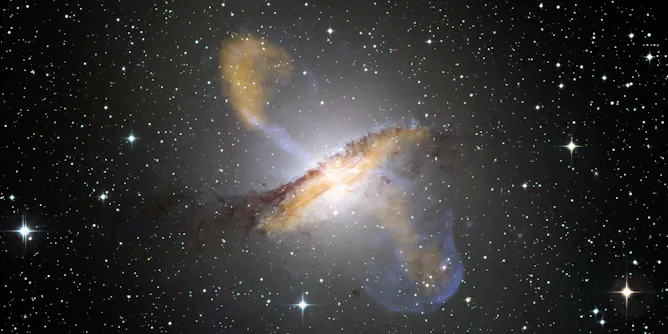
New analysis of radio telescope data links the shape of galaxies to the supermassive black holes they host.
Articles on Radio astronomy
Displaying 21 - 40 of 130 articles
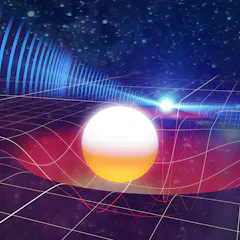
Neutron stars contain some of the universe’s most exotic states of matter – but there’s no easy way to peek inside.
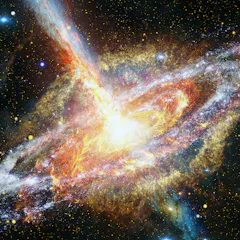
A slowly flickering source of radio waves that changes over time might be a neutron star or a white dwarf – but its behaviour doesn’t quite fit any of our theories.

MeerKAT has made remarkable contributions to South African and international science.

Astronomers caught the bizarre ‘awakening’ of an incredibly rare magnetic star.
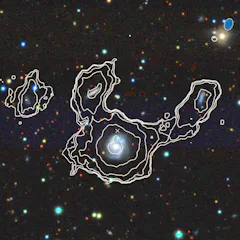
An attempt to study gas in one galaxy with the MeerKAT radio telescope detected 49 other galaxies instead.
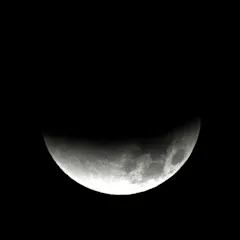
Projects under NASA’s CLPS program – including the Odysseus lander that made it to the lunar surface – will probe unexplored questions about the universe’s formation.
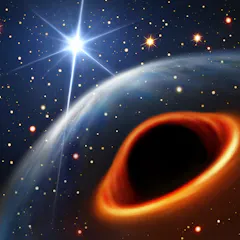
It’s too heavy to be a neutron star and too light to be a black hole. So what is it?
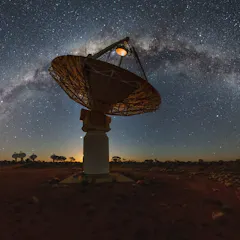
Do all big black holes in very massive galaxies emit radio waves? We used the latest radio telescopes to find out.

Previous searches for extraterrestrial life have included only the radio band above 600 MHz, leaving lower frequencies virtually unexplored.
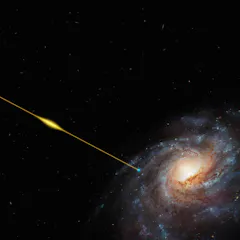
A record-breaking discovery of an extreme ‘fast radio burst’ opens a window into the early universe.
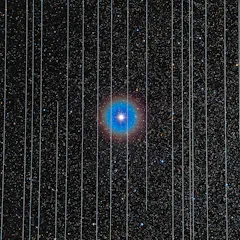
Starlink satellites emit bright, unintended and unexpected signals that can be detected by radio telescopes.
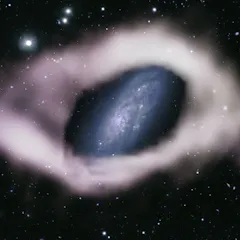
New ASKAP images reveal a giant hydrogen ring around the spiral galaxy NGC 4632.
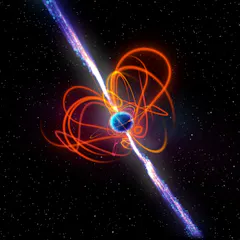
Astronomers have detected a long-running source of slow, repeating radio pulses that can’t be explained by current theories – but it’s probably not aliens.
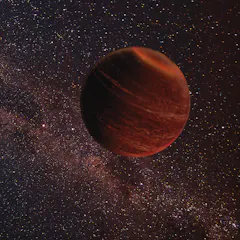
Astronomers have detected the coldest star ever found to emit radio waves using the Australian SKA Pathfinder telescope.
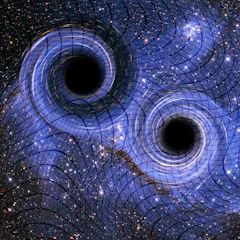
Astronomers have for the first time detected the background hum of gravitational waves likely caused by merging black holes.
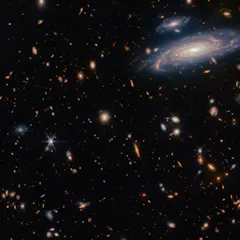
The darkness of the night sky seems so obvious as to need no explanation – yet it has intrigued and baffled scientists for centuries.
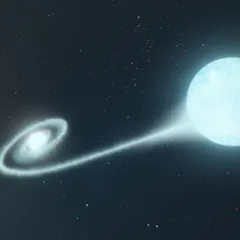
Our Sun will likely go out quietly – but not all such stars do. A new radio detection of a supernova can help us better understand these cosmic cataclysms.
The accumulated radio emission from mobile phones on Earth is beginning to become quite significant.
Magnetic fields billions of light years away offer clues to the nature of intense flashes from the sky known as fast radio bursts.
Top contributors
-

Professor, Radio Astronomy, University of Sydney
-
Honorary Fellow, Space and Astronomy, CSIRO; Western Sydney University
-
CSIRO
-
John Curtin Distinguished Professor (Radio Astronomy), Curtin University
-
Professor in Physics and Astronomy, UNSW
-
Professor at the International Centre for Radio Astronomy Research (ICRAR), The University of Western Australia
-
Postdoctoral Researcher in Radio Astronomy, University of Sydney
-
Senior research fellow, Curtin University
-
Radio Astronomer, Curtin University
-
Sir Bernard Lovell chair of Astrophysics, University of Manchester
-
Professor of Physics, University of Wisconsin-Milwaukee
-
Professor of Extragalactic Astronomy, Head of the Astrophysics Group, University of Bath
-
Senior Lecturer in Astrophysics, University of Sydney
-
Lecturer, University of Cape Town
-
Director, Astronomy and Space Science, CSIRO