
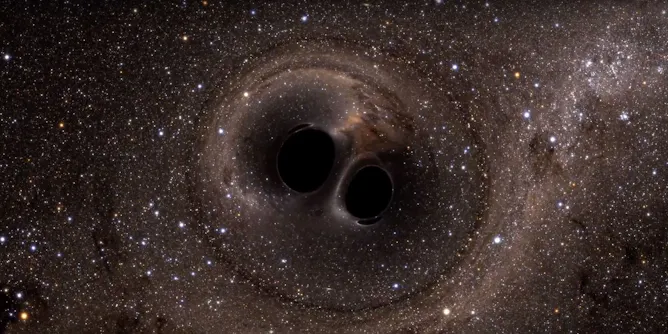
The OzGRav Centre of Excellence for Gravitational Wave Discovery will enable Australian researchers to be at the forefront of gravitational wave astronomy.
Articles on Astrophysics
Displaying 201 - 220 of 286 articles
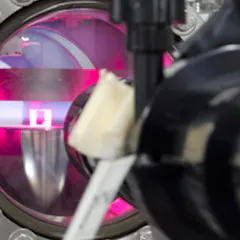
The vast majority of matter in the universe is plasma: electrically charged gas. Scientists are untangling how dust interacts with plasma both in space and experimentally closer to home.
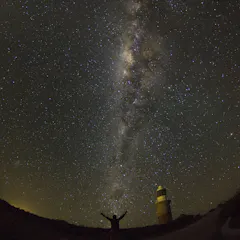
The drive the get more women involved in science should start at an early age. But as one space researcher found out, girls can get nudged out of science at school.
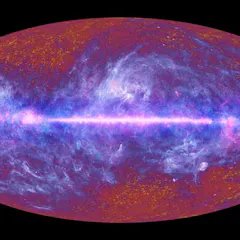
The universe is expanding faster than expected, but we don’t know what’s driving it. Here are a few of the possible explanations, from dark energy to a modification of general relativity.

CC BY-ND31.9 MB (download)
A podcast on time: telling it, perceiving it, doing it and travelling through it.
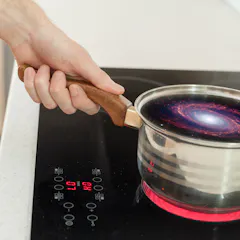
From supernovae explosions to the expansion of the universe and why the sky is blue: you can learn a lot about the universe in the kitchen.
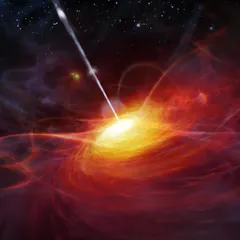
A burst of neutrinos detected deep under the Antarctic ice may have originated from a distant quasar on the edge of the visible universe.
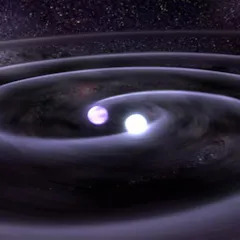
The long awaited discovery of gravitational waves has sent ripples through the scientific world. Here top experts respond to the historic announcement.
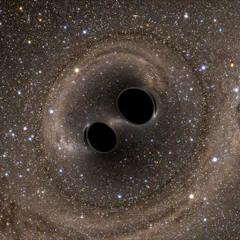
Here’s a LIGO insider’s description of how he got the news of a phenomenon that had first been theorized 100 years ago.
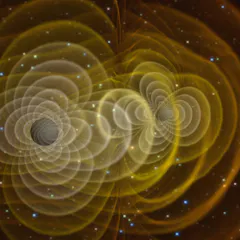
The detection of gravitational waves is the final confirmation of Einstein’s theory of general relativity, and opens up a new window into the cosmos.
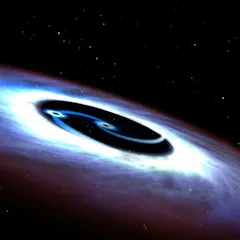
It takes something as stupendous as the merger between two black holes to generate detectable gravitational waves. Here’s how such incredible cosmic objects form.
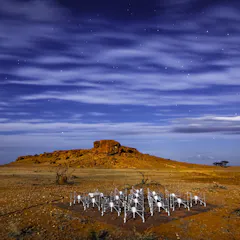
The Murchison Widefield Array sits in remote Western Australia far from noisy civilisation so it can help us understand the universe by tuning into radio waves from the distant cosmos.
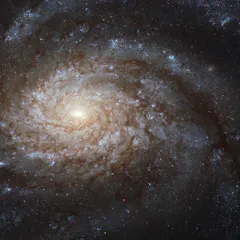
Extragalactic astrophysicists want to know how and why galaxies stop forming stars, change their shape and fade away. With help from citizen scientists, they’re figuring it out.

Four decades later, I find myself surveying 13 billion years of cosmic history and mapping events that really did happen a long time ago in galaxies far, far away.

On the journey to discovery with the ‘gifted mentor’ Takaaki Kajita, one of this year’s Nobel Prize winners, from some one who studied with him.
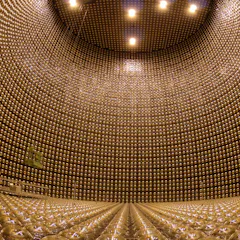
They’re beyond tiny and super mysterious. Neutrinos are an elemental particle that might just help us understand the structure and evolution of the universe.

One of tiniest particles in physics has won the biggest prize in science – for the fourth time.
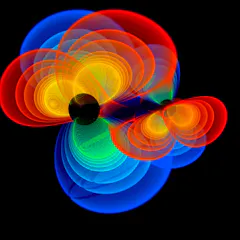
A new study has failed to find evidence of gravitational waves, but that doesn’t mean Einstein was wrong about their existence.
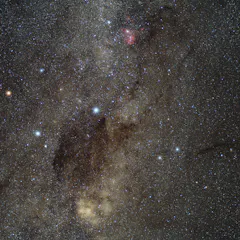
The next decade will be an exciting one for Australian astronomy, as we probe the heavens for answers to age old questions.
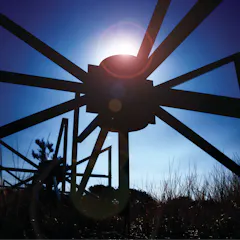
The night sky is part of the shared heritage of all people on Earth. A project to bring Indigenous Australians and astrophysics together reveals our common wonder at the mysteries of the universe.
Top contributors
-

Professor (Astrophysics), University of Southern Queensland
-
Professor of Astrophysics, University of Sydney
-
University Distinguished Professor of Astronomy, University of Arizona
-
Associate Dean of Innovation and Engagement, Swinburne University of Technology
-
ARC Laureate Fellow, Swinburne University of Technology
-
John Curtin Distinguished Professor (Radio Astronomy), Curtin University
-
Emeritus Professor, ARC Centre of Excellence for Gravitational Wave Discovery, OzGrav, The University of Western Australia
-
Professor of Physics, Penn State
-
Professor, Radio Astronomy, University of Sydney
-
ARC Australian Laureate Fellow, School of Physics, The University of Melbourne
-
Professor of Astrophysics, UNSW
-
Professor of Astrophysics, Macquarie University
-
Senior Lecturer and ARC Future Fellow, Monash University
-
Reader in Astrophysics, Keele University
-
Pro Vice-Chancellor Flagship Initiatives, Swinburne University of Technology