
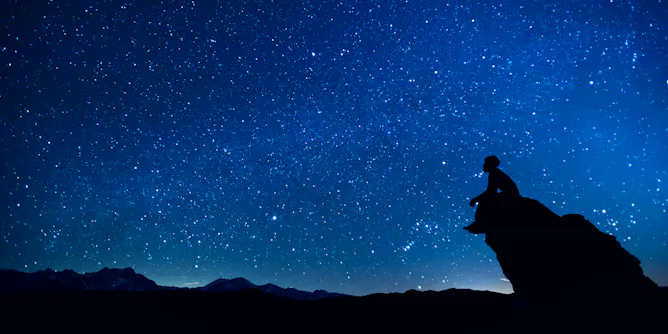
Astronomers know a lot about what’s in outer space – and think it’s possible it never ends.
Articles on Astrophysics
Displaying 141 - 160 of 287 articles
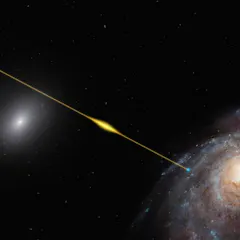
Fast radio bursts are the focus of a young and fascinating field of astronomy. Researchers just released data on more than 500 new bursts, quadrupling the total number of detected events.
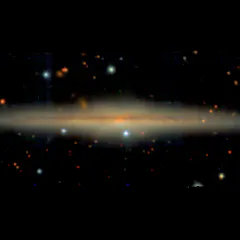
A galaxy 320 million light-years away has a surprisingly similar structure to the Milky Way, suggesting our galaxy isn’t as unique as it once seemed to astronomers.

Astronomers just measured the largest flare ever from Proxima Centauri, humanity’s closest neighboring star. These flares could be bad news for life trying to develop on a planet orbiting the star.

Plus new research finds a way to speed up the search for dark matter. Listen to episode 4 of The Conversation Weekly.

A small add-on to existing gravitational wave detectors could reveal what happens to matter as it becomes a black hole, a process like the big bang in reverse.
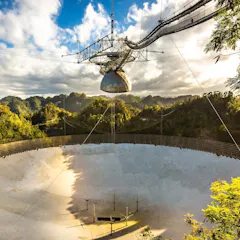
The Arecibo radio telescope has collapsed but its amazing discoveries will live on.
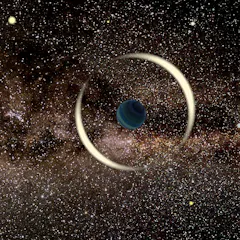
Not all planets orbit stars. Rogues float through the galaxy in darkness and are almost impossible to see.
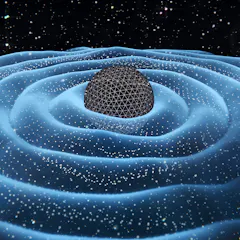
The 2020 Prime Minister’s Prizes for Science have recognised momentous achievements in astrophysics, sustainability innovation, epigenetics and primary and secondary teaching excellence.
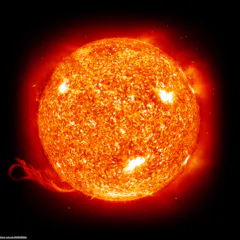
Astronomers have discovered that stars like the Sun produce huge amounts of lithium late in their lives.
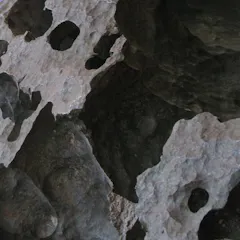
Tomanowos, aka the Willamette Meteorite, may be the world’s most interesting rock. Its story includes catastrophic ice age floods, theft of Native American cultural heritage and plenty of human folly.
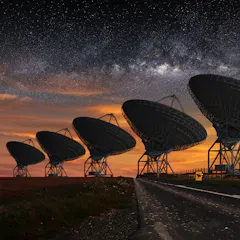
We asked astronomers: are we alone in the Universe? The answer was surprisingly consistent
The Conversation33.5 MB (download)
'I think that we will discover life outside of Earth in my lifetime. If not that, then in your lifetime,' one astronomer told us.
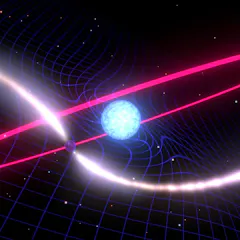
One of Einstein’s weirder predictions is that massive, spinning objects exert a drag on space-time itself. Now an orbiting pair of unusual stars has revealed this effect in action.
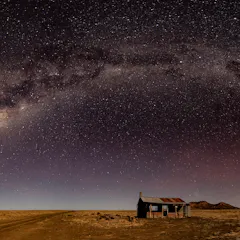
‘The size, the grandeur, the peacefulness of being in the dark’: what it’s like to study space at Siding Spring Observatory
The Conversation, CC BY54.3 MB (download)
Three hours north-east of Parkes lies a remote astronomical research facility, unpolluted by city lights, where researchers are trying to unlock some of the biggest questions about our Universe.

There is a massive black hole in the center of the Milky Way galaxy. Measurements of star orbits near this black hole suggest that there may be a second companion black hole nearby.
A recent experiment with atomic nuclei is hard to square with our current understanding of physics.
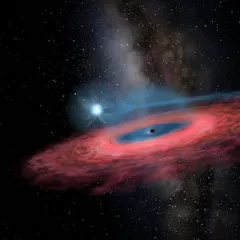
Astronomers using a new technique to hunt black holes found one 70 times as heavy as the Sun

Little bits of Jupiter’s Great Red Spot seem to be flaking off. Is it a sign of the demise of this enigmatic red cloud, or just a consequence of atmospheric chaos we can’t see from above?

Radio flare may be the result of a giant star orbiting some unusual object – a combination we have never seen before.
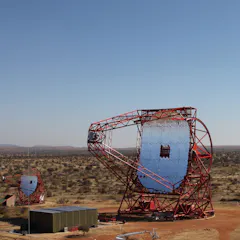
Mysterious cosmic flashes known as gamma-ray bursts are caused by the death throes of massive stars.
Top contributors
-

Professor (Astrophysics), University of Southern Queensland
-
Professor of Astrophysics, University of Sydney
-
University Distinguished Professor of Astronomy, University of Arizona
-
Associate Dean of Innovation and Engagement, Swinburne University of Technology
-
ARC Laureate Fellow, Swinburne University of Technology
-
John Curtin Distinguished Professor (Radio Astronomy), Curtin University
-
Emeritus Professor, ARC Centre of Excellence for Gravitational Wave Discovery, OzGrav, The University of Western Australia
-
Professor of Physics, Penn State
-
Professor, Radio Astronomy, University of Sydney
-
ARC Australian Laureate Fellow, School of Physics, The University of Melbourne
-
Professor of Astrophysics, UNSW
-
Professor of Astrophysics, Macquarie University
-
Senior Lecturer and ARC Future Fellow, Monash University
-
Reader in Astrophysics, Keele University
-
Pro Vice-Chancellor Flagship Initiatives, Swinburne University of Technology