
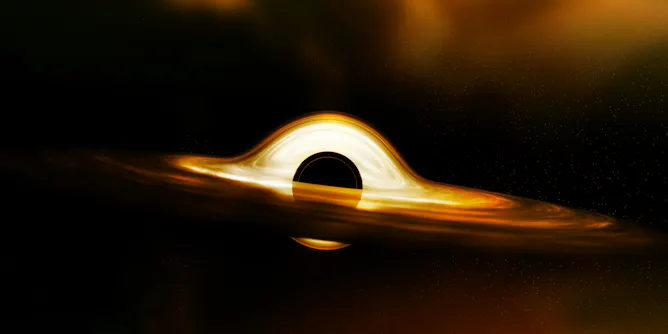
For the first time, scientists have gained information from the very surface of a newborn black hole.
Articles on Gravitational waves
Displaying 1 - 20 of 96 articles
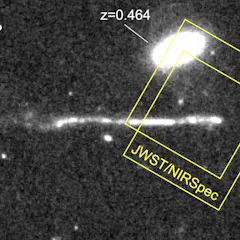
Astronomers have spotted runaway black holes screaming through space, leaving trails of stars in in their wake.
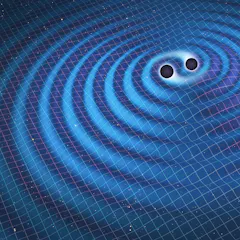
A decade after the first discovery, scientists have used these waves to find a unique merger, a massive binary system and a crystal-clear gravitational wave signal.
First, gravitational waves proved Einstein correct. Now, they’ve confirmed Stephen Hawking was right about black holes.
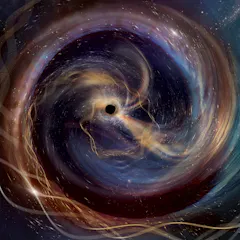
Stephen Hawking’s prediction about what happens when two black holes merge has finally been verified.
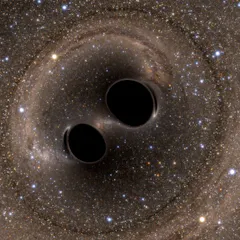
Too big to come from a dying star and too small to inhabit the center of a galaxy, these black holes are a puzzle that scientists are using LIGO to investigate.
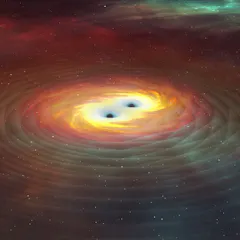
Gravitational waves carry information about massive cosmic events and help scientists to ‘listen’ to space.
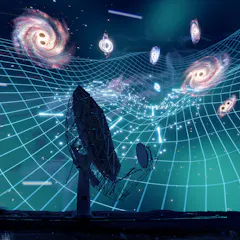
A new effort to map the rumblings in spacetime caused by enormous black hole collisions paints a surprisingly loud and lopsided picture of the universe.
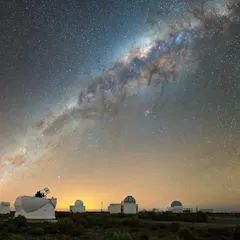
The first International Astronomical Union General Assembly was held just over 100 years ago, in Rome, Italy.
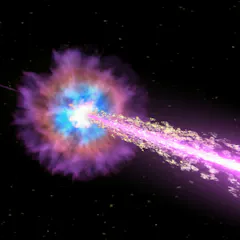
Analysis of two major cosmic blasts deepens the mystery of where the universe’s ‘heavy’ elements come from.
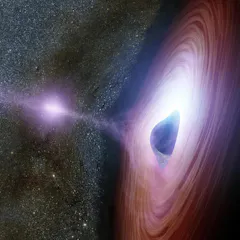
Studying theoretical, fast-spinning black holes is helping physicists understand more about the elusive black holes out in the universe.
Massive flashes of energy known as ‘fast radio bursts’ have puzzled astronomers for years – and a new search for links to gravitational waves has so far found no connection.
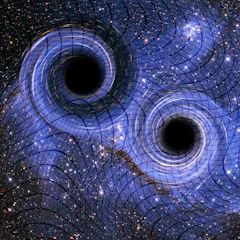
Astronomers have for the first time detected the background hum of gravitational waves likely caused by merging black holes.
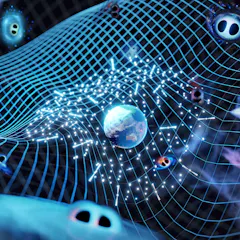
By timing radio pulses from an array of galactic pulsars, scientists see hints of gravitational waves from supermassive black hole pairs in a breakthrough that may reveal hidden details of galaxy evolution.
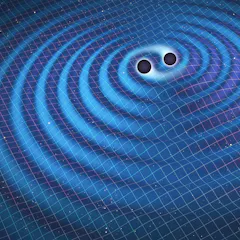
Upgrades to the hardware and software of the advanced observatory should allow astrophysicists to detect much fainter gravitational waves than before.

For years, astronomers have been detecting incredibly powerful pulses from the cosmos, without a confirmed source. Recent advances in astronomy are getting us closer to the solution.
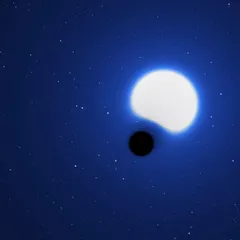
Astronomers have discovered the first dormant black hole outside of the Milky Way. These black holes are not absorbing matter from a nearby star, making them incredibly hard to find.
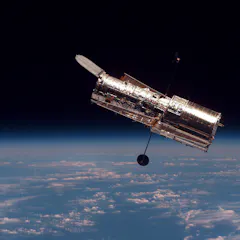
The astronomy and astrophysics decadal survey for the 2020s lays out plans to search for life on distant planets, understand the formation of galaxies and solve deep mysteries of physics.
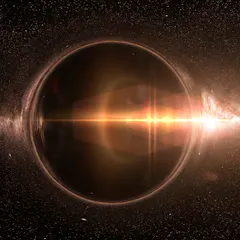
Some black holes are isolated in space and therefore near impossible to detect.
How scientists are planning to listen to the sound of the big bang with a gravitational wave detector that would fit in a kitchen.
Top contributors
-

Emeritus Professor, ARC Centre of Excellence for Gravitational Wave Discovery, OzGrav, The University of Western Australia
-
Senior Lecturer and ARC Future Fellow, Monash University
-
Pro Vice-Chancellor Flagship Initiatives, Swinburne University of Technology
-
Professor of Physics, Penn State
-
Professor, Monash University
-
Professor, Radio Astronomy, University of Sydney
-
Reader in Physics, University of Sheffield
-
Professor of Gravitational Astrophysics and Cosmology, University of Glasgow
-
Cosmologist, University of Tasmania
-
South African Research Chair in Physical Cosmology, Department of Mathematics and Applied Mathematics, University of Cape Town
-
OzGrav Associate Investigator; Research Fellow in Astrophysics, The University of Western Australia
-
Professor of Physics, University of Wisconsin-Milwaukee
-
Research fellow, The University of Western Australia
-
Professor of Physics and Mathematics, Queen's University Belfast
-
Professor of Mathematical Physics, University of Cape Town