
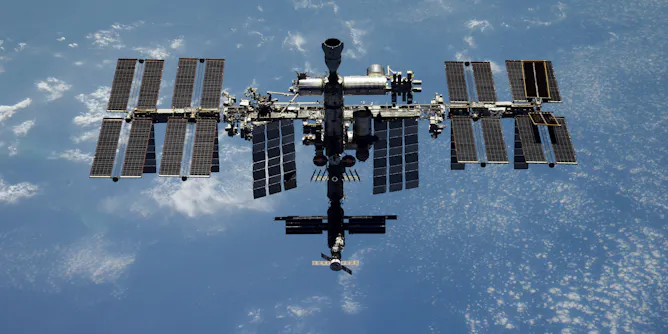
Yes, astronauts have to drink water that used to be pee – but their urine is treated extensively, until it is safer to drink than some tap water on Earth.
Articles on Space
Displaying 161 - 180 of 1098 articles
Some observatories that used to be dark and remote are now adjacent to bright urban centers. And sending all telescopes into space isn’t a viable solution.
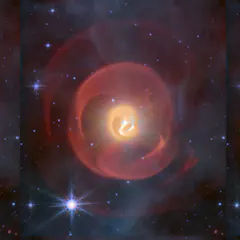
The stars are wreathed in a huge spiral of dust, like a snake eating its own tail.
Growing a baby in space sounds like science fiction. Here’s why it might stay that way.

As more countries look to space, experts argue that it’s worth asking why we want to go at all, and who should lead the charge.
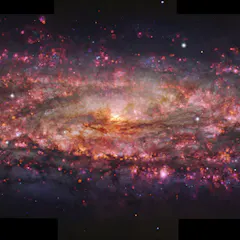
Researchers stitched together hundreds of images from the Very Large Telescope to form a breathtaking photo of a nearby galaxy.
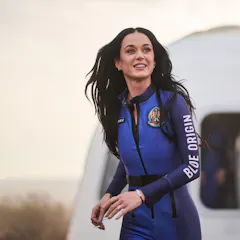
The all-women crew of Blue Origin reinforced the enduring connection between style symbolism, and space travel.
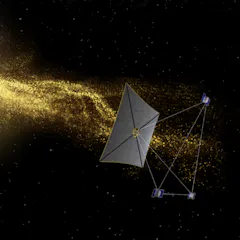
As more satellites are launched into orbit, space agencies are looking at how to predict space weather events that could harm them.

Understanding the similarities and differences of the deserts on Earth and Mars will help space travelers survive future missions to the red planet.
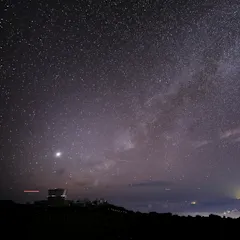
Over the next few days, astronomers will pull together evidence to determine whether the object is a comet.
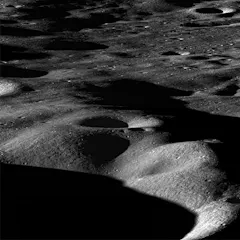
As humanity moves closer to extracting and using space resources, the need for a cohesive and responsible global governance system has never been greater.
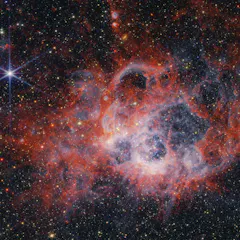
The James Webb Space Telescope has 2 powerful instruments that see light the human eye can’t.
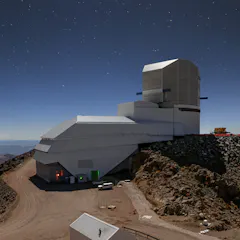
Vera C. Rubin’s research into stars in galaxies led to the modern understanding of dark matter.
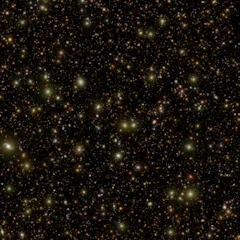
To make a truly realistic fake picture of a galaxy, you can model exactly how light particles travel through the atmosphere and telescope to reach its sensor.
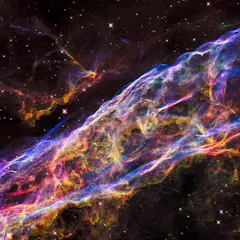
Almost everything on Earth is made up of atoms, but where do these fundamental building blocks come from?
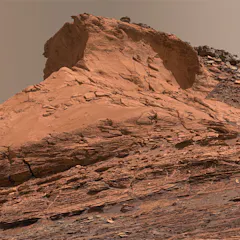
Mars isn’t a bright, fire-engine red, but the iron oxide in its rocks makes it appear redder than other planets, especially from afar.
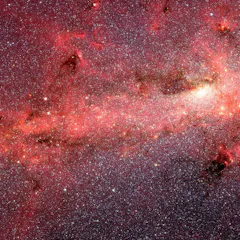
As the universe expands, it feels like it must be spreading out from some initial point. But a physicist explains why that’s not how it works. Hint: space-time is involved.
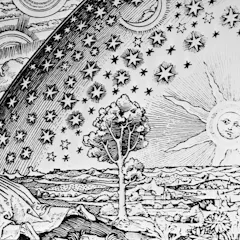
In the 19th century, astronomers could see Mars through telescopes, but not clearly. Some used their imaginations to fill in what the blurry images couldn’t convey.
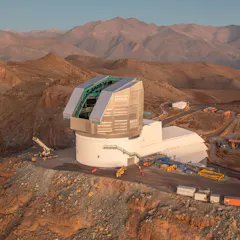
The Vera C. Rubin Observatory will capture enough detail to see a golf ball from 25km away.
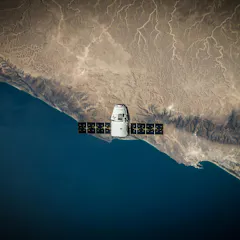
Salvage is a heartbreaking, life-affirming Australian dystopia that centres human connection – as the rich search for ways to escape and the poor salvage what they can.
Top contributors
-

University Distinguished Professor of Astronomy, University of Arizona
-
Professor of Strategy and Security Studies, Air University
-
Professor (Astrophysics), University of Southern Queensland
-
Professor of Planetary and Space Sciences, The Open University
-
Associate Professor in Archaeology and Space Studies, Flinders University
-
Associate Professor in Astronomy, Monash University
-
Reader in Astrophysics, Keele University
-
Emeritus Professor of International Law, Western Sydney University
-
Senior Lecturer in Physics, Nottingham Trent University
-
Associate Dean of Innovation and Engagement, Swinburne University of Technology
-
Professor of Air and Space Law, University of Mississippi
-
Associate Professor, Astronomy, University of Regina
-
Kevin Orrman-Rossiter is a Friend of The Conversation.
Sterrenkenner, History & Philosophy of Science, The University of Melbourne
-
Professor of Physics and Astronomy, USC Dornsife College of Letters, Arts and Sciences
-
Lecturer in Astronomy, Nottingham Trent University