
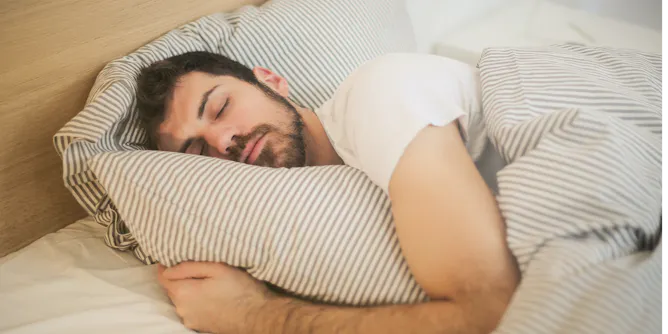
Most people sleep on their side, which is good because those who sleep on their backs are more likely to be poor sleepers or have breathing difficulties at night.
Articles on Sleep
Displaying 241 - 260 of 567 articles
Even during periods of restricted sleep, people who report good sleep quality are three times less likely to get a respiratory infection.

Telling new parents to do mindfulness tasks with their five minutes of free time might not be realistic – but adding mindfulness to tasks you’re already doing is just a good use of time.

Adolescent biology, early morning classes and too much evening screen time are a few of the key drivers behind teen sleep deprivation.

College students hit the hay earlier and sleep longer when they’re offered a modest monetary incentive. But can a little extra cash really make good sleeping habits last?

Brown noise sounds like the ocean and some people say it helps them sleep. Here’s what the science actually says.

Family routines can provide stability during times of stress. Here are four strategies for building resilience against stress and family challenges to put into place as children head back to school.

Why your eyes move during the REM stage of sleep has puzzled scientists for years. Researchers measured mice brains to look for a possible explanation.

A new study found the amount of sleep you had last night can even overwhelm people who have a tendency for kindness.
Clueless star Alicia Silverstone sparked furious debate by revealing she co-sleeps with her 11-year-old son.

A veteran school administrator offers insights on how children’s caretakers can better prepare them for a new school year.

The strongest signal of our changing climate flares while most of us are asleep.

The clue is in exercise’s ability to control levels of our “stress” hormone, cortisol.
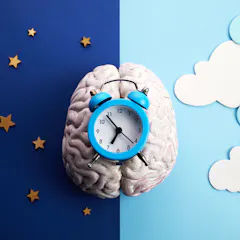
Your body follows a circadian rhythm that influences everything from how well your medications work to the best time for exercise.

Advice to put your baby down ‘drowsy but awake’ is an attempt to form good sleep associations.
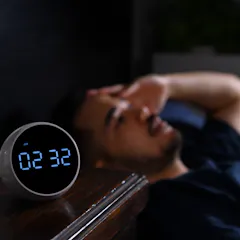
Some people report insomnia symptoms, where they struggle to fall or stay asleep. Others report feeling constantly fatigued, and seemingly can’t get enough sleep. So what’s going on?

Understanding why the two are connected could be key in finding treatments – or even a cure – for tinnitus

Participants who woke up fewer times during the night performed better on memory tasks the next day.

Although medication and therapy can be effective treatments for ADHD, they’re not the only way to manage the disorder or its symptoms. Creating a daily routine is critical too.

Supporting mothers’ and infants’ sleep can decrease the stressors of motherhood, improve maternal mood and mental health and promote better infant development.
Top contributors
-

Emeritus Professor of Psychology, Adelaide Institute for Sleep Health, Flinders University
-
Sleep Researcher, Appleton Institute, HealthWise Research Group, CQUniversity Australia
-
Conjoint Senior Lecturer, School of Medicine and Public Health, University of Newcastle
-
Professor of Sleep Health, University of the Sunshine Coast
-
Associate Professor of Neurology, University of Pittsburgh
-
Research Professor and Director of the Behaviour-Brain-Body Research Centre, Adelaide University
-
Professor and Head of Paediatric Sleep Research, CQUniversity Australia
-
Associate Professor at Turner Institute for Brain and Mental Health, School of Psychological Sciences, Monash University
-
Sleep & Circadian Scientist, CQUniversity Australia
-
Professor of Sleep and Physiology and Director of Surrey Sleep Research Centre, University of Surrey
-
Senior Lecturer in Psychology, CQUniversity Australia
-
Professor Emeritus of Nursing, University of British Columbia
-
Lecturer in Psychology, University of York
-
Lecturer, University of Cambridge; Anglia Ruskin University
-
Royal Holloway, University of London