
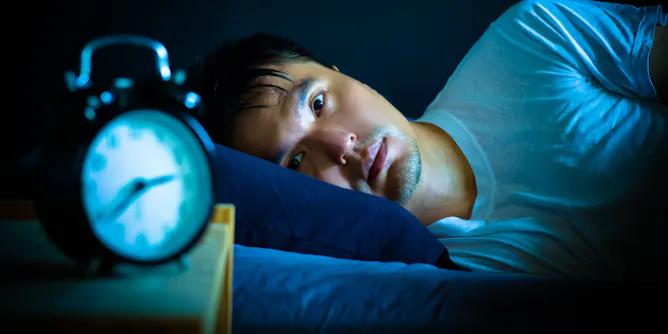
Make it stop! Six ways to stop your racing mind and get the sleep you need.
Articles on Sleep
Displaying 201 - 220 of 567 articles

Our study revealed that people who nap frequently have larger brain volume.

Parents spend more time actively engaged with their kids – such as helping with homework or reading together – during the school year than during summer. But the difference is almost three times greater for moms than for dads.

The issue of poor sleep needs particular attention in the context of Aboriginal and Torres Strait Islander teenagers who have high rates of poor health, social and emotional well-being and education.

Wakefulness drugs like Modafinil point to a new frontier of technosleep driven by personal goals rather than medical need.

Nighttime is much more than a source of danger or an occasion to party – it’s a portal into a different world, with rhythms, challenges and lifestyles of its own.

REM sleep behavior disorder is characterized by acting out dreams, which may include shouting, kicking and punching during sleep.

Edwina Preston reflects on the lost art of hanging out – which feeds creativity – and the need to reclaim time from the pressures of productivity. She draws on new books by Jenny Odell and Sheila Liming.

People with aphantasia are unable to deliberately bring to mind mental images. Understanding the mechanisms of aphantasia reveals that different types of cognition exist.

A raft of horror films remind us of the grip troubled sleep once had on our imaginations.

Our long-term research project found commutes over 3km were associated with a greater likelihood of being overweight.

A short nap during the working day can boost productivity as much as a pay rise, according to research.

There are a few reasons melatonin, a medication commonly taken for sleep difficulties, might have this effect.

Research shows having a good night’s sleep is important for being effective at work. But not all of us can manage that all of the time.

Sleep is one of the most important things we do.

A good night’s sleep is important for a well-functioning body and mind, but the best time for you to get that sleep depends on a number of factors.

Disturbed sleep can worsen depressive symptoms of health care workers whose jobs come with high levels of emotional labor and work-family conflict.

Almost half of the participants in a study of bedrooms said they have or might have a sleep problem and they would prefer not to use the room for multiple activities.

Americans are divided on their preference for daylight saving time versus standard time. But research shows that our bodies fare better when aligned with the natural light of standard time.

We live in a world where we frequently do not get enough sleep, but we need sleep if our brains are going to stay healthy and function efficiently.
Top contributors
-

Emeritus Professor of Psychology, Adelaide Institute for Sleep Health, Flinders University
-
Sleep Researcher, Appleton Institute, HealthWise Research Group, CQUniversity Australia
-
Conjoint Senior Lecturer, School of Medicine and Public Health, University of Newcastle
-
Professor of Sleep Health, University of the Sunshine Coast
-
Associate Professor of Neurology, University of Pittsburgh
-
Research Professor and Director of the Behaviour-Brain-Body Research Centre, Adelaide University
-
Professor and Head of Paediatric Sleep Research, CQUniversity Australia
-
Associate Professor at Turner Institute for Brain and Mental Health, School of Psychological Sciences, Monash University
-
Sleep & Circadian Scientist, CQUniversity Australia
-
Professor of Sleep and Physiology and Director of Surrey Sleep Research Centre, University of Surrey
-
Senior Lecturer in Psychology, CQUniversity Australia
-
Professor Emeritus of Nursing, University of British Columbia
-
Lecturer in Psychology, University of York
-
Lecturer, University of Cambridge; Anglia Ruskin University
-
Royal Holloway, University of London