
From the subatomic to the cosmic, don’t think for a second that we’re at the end of scientific history.
Articles on Dark matter
Displaying 61 - 80 of 120 articles
A study has suggested that the universe is curved like a sphere rather than flat, which may unleash a major crisis in cosmology.

The Princeton cosmologist helped pioneer our current model of the universe and began a whole new branch of physics.
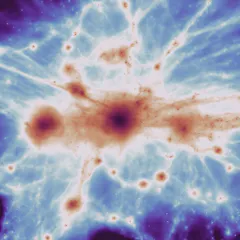
Maps of the long filaments of gas that hold the universe together may one day help us trace and unveil ‘dark matter’.
Why do astronomers believe there’s dark matter when it cannot be directly detected? Let’s look at the evidence, and see what dark matter’s presence means for our universe.
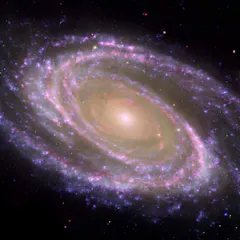
New research does away with dark matter by putting ‘entropy’, a measure of disorder, at the heart of the universe.
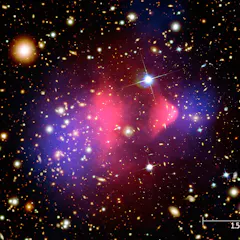
New research suggests we may be able to forget about dark matter if we tweak the laws of gravity according to imaginary bubbles in space.
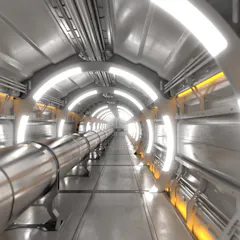
A new collider at CERN could push particle physics deep into an unexplored microscopic realm.
Forget about dark matter and dark energy, new research suggests that the existence of ‘dark fluid’ may solve some of the biggest mysteries in physics.
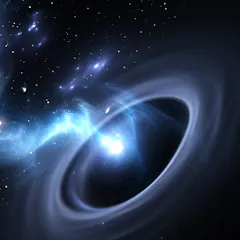
The pull created by a black hole is so strong that if you get too close to one – even if you are travelling away from it at the fastest speed it is possible to go – you will never be able escape.

A wormhole is like a tunnel connecting two places in space. They would be incredibly useful and are great for science-fiction stories.
The problem is we haven’t found any evidence of them existing.

Exactly 99 years after Einstein’s theory of general relativity was proven right in our own solar system, scientists show that it also holds true for entire galaxies.
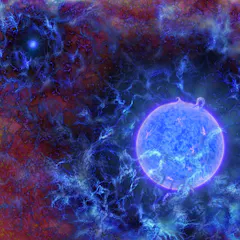
Signals from the first stars to form in the universe have been picked up by a table-sized detector in a west Australian desert. The find also hints at an early interaction with dark matter.
New radio technology has managed to detect the first light in the universe.
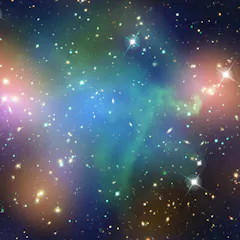
Controversial new study challenges contemporary thinking about what the universe is made of.
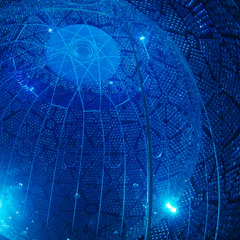
Deep underground, scientists research subatomic particles from space in a bid to understand the building blocks of our universe.
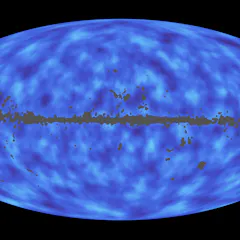
Cosmologists are heading back to their chalkboards as the experiments designed to figure out what this unknown 84 percent of our universe actually is come up empty.

Both systems are dangerous in the wrong hands.
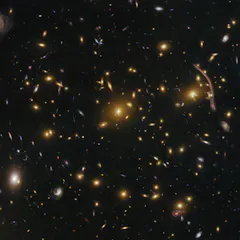
Galaxies evolve in mysterious way. But a new study offers a fresh approach to understand them.
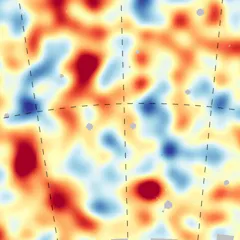
We still can’t see the dark matter thought to make up about a quarter of the universe, but at least now we have a map of its structure.
Top contributors
-

Professor of Astronomy, Liverpool John Moores University
-
Pro Vice-Chancellor and Executive Dean, University of Surrey
-
Professor of Astrophysics, University of Sydney
-
Senior Lecturer, School of Mathematics and Physics, University of Surrey
-
Associate Professor in Astronomy, Monash University
-
Postdoctoral Fellow in Quantum Physics, University of Colorado Boulder
-
Astronomer, CSIRO
-
Professor of astrophysics (dark matter and cosmology), Durham University
-
Pro Vice-Chancellor Flagship Initiatives, Swinburne University of Technology
-
Professor of Astrophysics, Swinburne University of Technology
-
Royal Society University Research Fellow and Lecturer in Particle Physics, UCL
-
Professor of Astrophysics and Royal Society University Research Fellow, University of Hertfordshire
-
Postdoctoral Research Fellow in Astrophysics, University of Portsmouth
-
Professor, Physics & Astronomy, Bishop's University
-
University Distinguished Professor of Astronomy, University of Arizona