
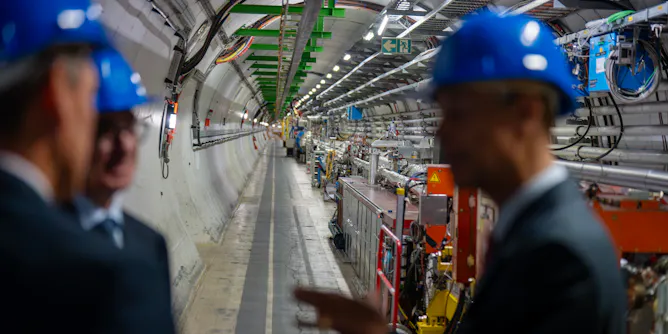
Particle accelerators aren’t just for testing the Standard Model. They’re also used to diagnose and treat disease and study world history.
Articles on Particle physics
Displaying 1 - 20 of 106 articles
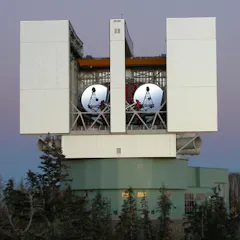
The early universe was kind of like a big game of musical chairs – scientists are figuring out how many particles were able to find ‘seats’ to understand the cosmos.

Scientists recreated cosmic rays in a massive underground particle collider.

Major upgrade works may allow the LHC to uncover signs of new physics.
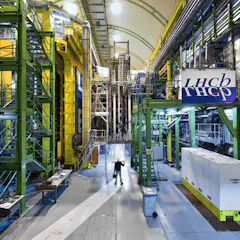
The behaviour of sub-atomic particles in the LHC seems to disagree with the Standard Model.

Dark matter doesn’t seem to interact with the matter we can see and touch, so scientists look for it in unusual places, like faraway galaxies and underground detectors.
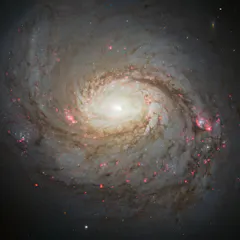
Normal matter – which makes up everything we see and touch – isn’t the only type of matter present in the universe.

2025’s Nobel Prize in Physics is a tribute to the scientists who first discovered quantum behaviors in a macroscopic electrical circuit.
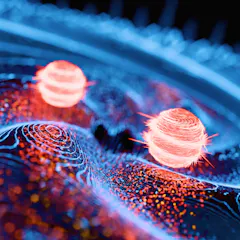
Virtual particles may not be real, but they help physicists track how forces move, and allow for incredibly precise measurements in particle physics.
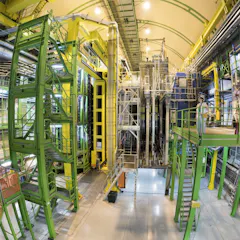
The finding could also open the door to the discovery of new particles.
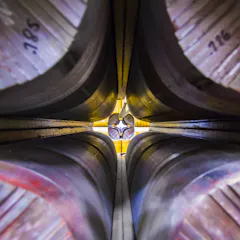
New results resolve the long-standing anomaly of the muon’s magnetic moment – and may offer hints about the nature of dark matter.

The ancient dream of turning lead into gold is now a reality – but it’s not quite what the alchemists might have hoped for.

The proposed Future Circular Collider could answer questions about the nature of the universe – and have practical benefits along the way.
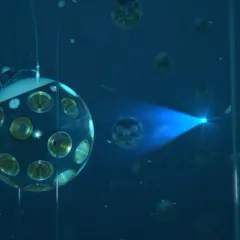
In the search for elusive particles called neutrinos, researchers are stringing thousands of detectors in the depths of the Mediterranean.
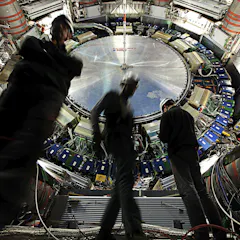
The ATLAS experiment has found quantum entanglement in yet another system: quarks at high energies.

The latest results from the LZ dark matter experiment have drawn a blank – but the elusive particles are running out of places to hide.
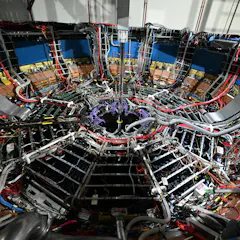
Measurements of 16 ‘antihyperhydrogen’ nuclei may help resolve mysteries of the universe’s exotic matter.
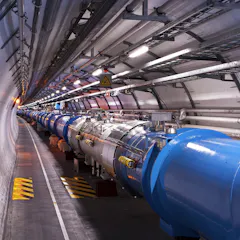
The LHC is back in business for the year, but getting it ready to collect data isn’t always a straightforward process. You can’t just unplug it and plug it in again.

An exciting new experiment is being set up at Yale university in the US.
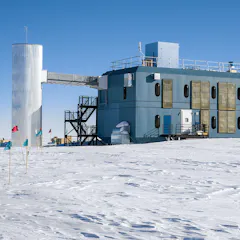
Tau neutrinos are notoriously difficult to spot in detectors like IceCube. But researchers have managed to isolate 7 candidates.
Top contributors
-

Particle physicist, University of Cambridge
-
Head of School for Physics, University of Sydney
-
Post Doctoral Research Associate, Centre for the Subatomic Structure of Matter, Adelaide University
-
Professor of Physics, Head of Department, Lancaster University
-
Professor of Physics, Monash University
-
Professor, Philosophy of Science, The University of Melbourne
-
ARC Research Associate (Centre of Excellence for Particle Physics at Tera Scale), Adelaide University
-
Postdoctoral Fellow in Quantum Physics, University of Colorado Boulder
-
Professor of Nuclear Physics, Mississippi State University
-
Associate Professor of Physics, Durham University
-
Senior Lecturer of Particle Physics, Lancaster University
-
Doctoral Student, College of Community and Public Affairs, Binghamton University, State University of New York
-
Royal Society University Research Fellow and Lecturer in Particle Physics, UCL
-
Senior Lecturer in Particle Physics Informatics, Brunel University of London
-
Research Professor and Director of the International Institute for Accelerator Applications, University of Huddersfield