
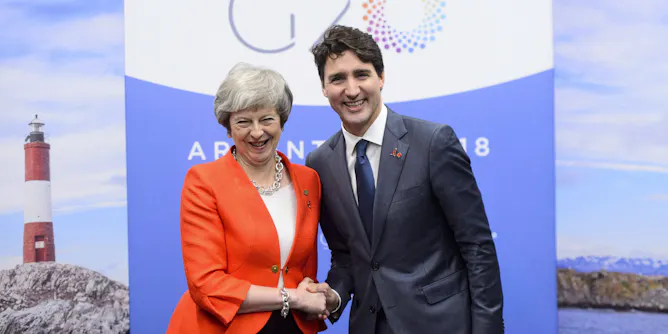
As 2019 dawns, a worldwide circular economy could be created through international trade and trade agreements like the one that could be forged between Canada and the U.K., post-Brexit.
Articles on Circular economy
Displaying 121 - 140 of 154 articles

The internet makes it easier for discarded stuff to land in someone else’s home instead of the dump.

This year’s recycling crisis has prompted the federal government to pledge a move towards an economy in which materials are kept in use for as long as possible. But it still has a long way to go.

Trump’s plan to slap $200 billion more in tariffs on Chinese goods is premised on yesterday’s waste-fueled economy. Tomorrow’s economy is ‘circular.’
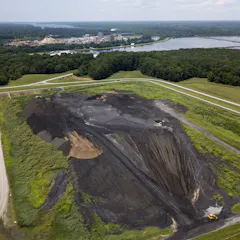
Questions about supplies of rare-earth elements, crucial in high-tech devices, pushed researchers to look to industrial waste for new sources of the key materials.
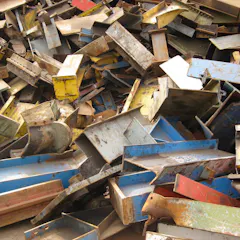
If the US were to stop dumping these valuable metals in landfills and to cease exporting them as cheap scrap, its imports could fall, and there would be less of these metals being made from scratch.

The case of the start-up Phenix shows that the fight to reduce food waste requires a regulatory context that encourages innovation at the level of the business ecosystem.
Under a new target, 100% of Australian packaging will be recyclable, compostable or reusable by 2025. But this is not enough - we also need to ensure that recyclable materials are actually recycled.

The most sustainable phone is the one you already own. But if you’re in the market for a new handset, consider choosing one with replaceable parts to avoid having to replace the whole thing again.

With an ever-increasing cost to extract dwindling raw materials, it’s time to look at cities as urban mines. We’re developing the tools to do that.
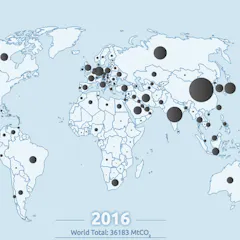
Consistent carbon pricing is a key element in the fight against climate change.

Canada ratified the Paris agreement on climate change, but it hasn’t yet filled the leadership void left by the United States. Time is running out.
Every day brings new calls for sustainability, as humanity’s actual behaviour moves ever further away from it. What can we learn from an obscure Austrian philosopher?
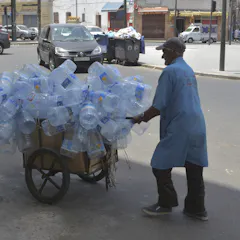
Despite being outcasts in Moroccan society, waste collectors defend their profession as protectors of the environment.

New technologies are developing with exponential velocity, breadth and depth. Their systemic impact is likely to be profound.
CC BY-ND38.5 MB (download)
This episode explores how one person's waste can be another's treasure. We talk to scientists trying to eke something useful out of big piles of rubbish and discuss making the economy more circular.
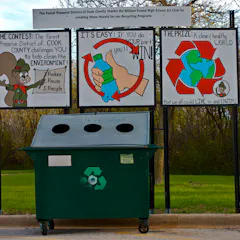
Information is assumed to be key to changing people’s attitudes and behaviour. Sadly this isn’t the case.

There will be huge environmental impact if we keep using raw materials as we did in the 20th century.

Recycling, rental, durability: How three strategies from the “circular economy” can help automobile manufacturers reduce waste and improve profitability, all while helping preserve the environment

Sorry kids, these gift ideas are closer to home.
Top contributors
-

Associate Professor and Research Director, Institute for Sustainable Futures, University of Technology Sydney
-
Associate Professor, Global Management Studies, Toronto Metropolitan University
-
Professor of Technology Management and Circular Economy, Kingston University
-
Senior Lecturer in Urban Planning, School of Architecture and Cities, University of Westminster
-
Senior Lecturer, Auckland University of Technology
-
Lecturer in Circular Economy and Sustainable Transformations, University of Edinburgh
-
Professor, ESCP Business School
-
Reader in Fashion, Marketing and Sustainability, Glasgow Caledonian University
-
Professor, Harvard University
-
Senior Lecturer, School of Property, Construction and Project Management, RMIT University
-
Chair professor - Circular Economy, The University of Melbourne
-
Professor of Applied Environmental Science, University of Southampton
-
Professor of Management, Rochester Institute of Technology
-
Professor, Keevil Institute of Mining Engineering, University of British Columbia
-
Associate Dean and Head of Project Management, RMIT University