
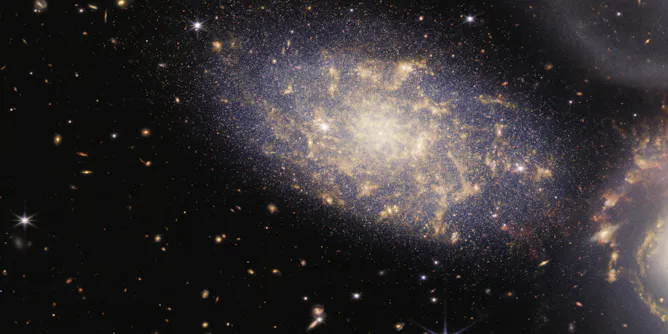
Through direct comparison with images from Hubble, you can start to see the exquisite detail and clarity Webb provides.
Articles on Astronomy
Displaying 361 - 380 of 989 articles
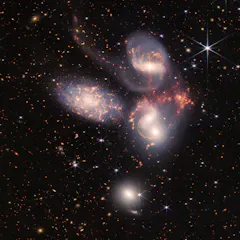
NASA released five new images from the James Webb Space Telescope, revealing incredible details of ancient galaxies, stars and the presence of water in the atmosphere of a distant planet.

Even experts were not prepared for the crispness of the new images from the James Webb space telescope.
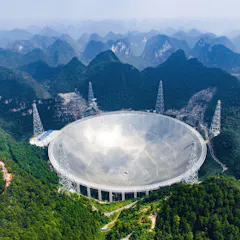
Have astronomers finally found evidence of intelligent found life beyond Earth?
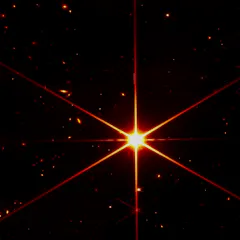
It has taken eight months to test and calibrate all of the instruments and modes of the James Webb Space Telescope. A scientist on the team explains what it took to get Webb up and running.
Astronomers studying fast radio bursts recently discovered one that repeats, has a persistent radio signal and originated in a galaxy much closer than it should have.
The Moon illusion is what makes the Moon look giant when you see it rising over a distant horizon. An astronomer explains what causes this awe-inspiring trick of the mind.
The object has a highly unusually long rotation period, and was found in an area we call the neutron star ‘graveyard’.
Could the Tau Herculid meteor shower put on a spectacular show next week? Only time will tell.

Nuclear isomers are rare versions of elements with properties that mystified physicists when first discovered. Isomers are now used in medicine and astronomy, and researchers are set to discover thousands more of them.

Fanaroff is one of the key individuals responsible for the current growth and strength of astronomy in South Africa.

Sagittarius A* lies in the southern sky, passing directly above South Africa.
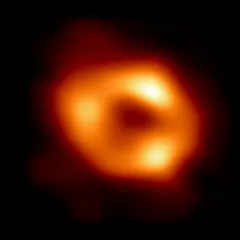
Sagittarius A* is a massive black hole at the center of the Milky Way. Now that astronomers have imaged it, they can begin to learn more about black holes within other galaxies across the universe.
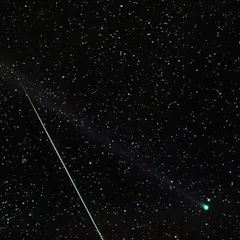
Each year, the Earth runs through a broad river of dust surrounding Comet Halley – giving birth to the spectacular Eta Aquariid meteor shower.

The pulsar PSR J0523-7125 is more than ten times brighter than any other radio pulsar outside the Milky Way.
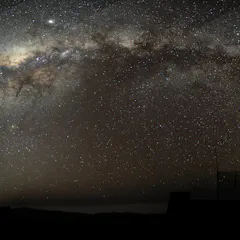
This year, two groups of astronomers plan to send messages containing information about humans and the location of Earth toward parts of space they think may be home to intelligent life.
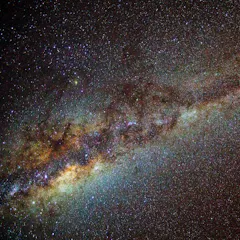
A growing number of satellite ‘mega-constellations’ are being deployed. Will a starry night sky soon be a thing of the past?
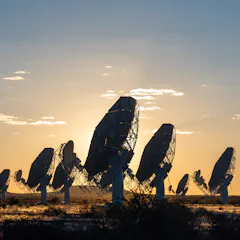
Complementary science will be at the heart of the Square Kilometre Array.
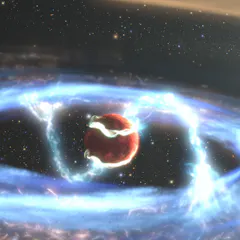
A glimpse of a distant Jupiter-sized exoplanet sheds light on how gas giants form.

The First Astronomers shares the extensive star knowledge of First Peoples worldwide, stretching back millennia to reclaim so-called Western discoveries and highlight the strength of oral traditions.
Top contributors
-

Professor (Astrophysics), University of Southern Queensland
-
Senior Curator (Astronomy), Museums Victoria Research Institute; The University of Melbourne
-
Associate Professor in Astronomy, Monash University
-
University Distinguished Professor of Astronomy, University of Arizona
-
Associate Professor, School of Physics, The University of Melbourne
-
Professor of Astrophysics, University of Sydney
-
Professor, Radio Astronomy, University of Sydney
-
Pro Vice-Chancellor Flagship Initiatives, Swinburne University of Technology
-
Honorary Fellow, Space and Astronomy, CSIRO; Western Sydney University
-
John Curtin Distinguished Professor (Radio Astronomy), Curtin University
-
Postdoctoral Researcher in Radio Astronomy, University of Sydney
-
Lecturer in Astronomy, Nottingham Trent University
-
Senior Lecturer in Physics, Nottingham Trent University
-
Associate Dean of Innovation and Engagement, Swinburne University of Technology
-
Associate Professor, Astronomy, University of Regina