
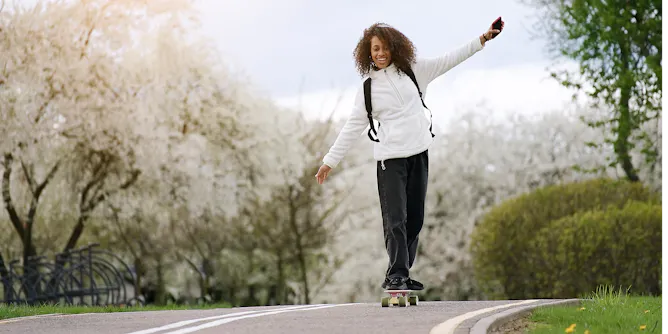
Balancing well is a whole-body experience that develops over time and takes practice to master.
Articles on Walking
Displaying 61 - 80 of 183 articles

Humans can spontaneously fall into rhythms with precision, and across a wide range of tempos. This may be because the same neurological processes that anticipate rhythm are involved with movement.
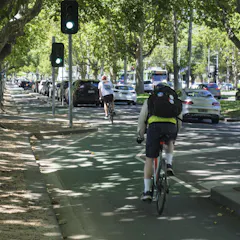
Early in the pandemic, when there was much less traffic on the roads, people took to their bikes. But since then, fewer people are cycling, with rates now lower than in 2011.

Revisions to the CDC’s developmental milestone checklists removed crawling as a skill that babies pick up at a typical age. A biomedical engineer describes how more research may clarify its role.
Cars are getting bigger on US roads, and that’s increasing pedestrian and cyclist deaths. A transport scholar identifies community-level strategies for making streets safer.
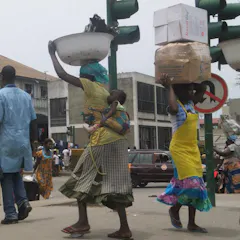
The city of Accra has no plan to tackle pedestrians’ behaviour.
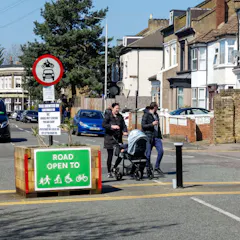
LTNs were introduced to UK cities to create a more pleasant environment for pedestrians and cyclists - but they’ve become controversial.
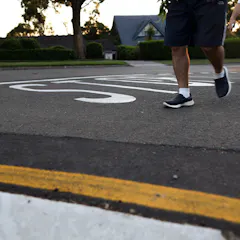
Some councils have installed zebra crossings at selected T-intersections, where they do improve safety. The problem is they also add to the existing confusion at other intersections.
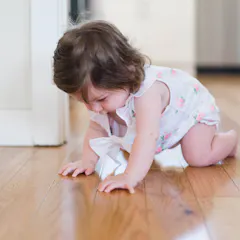
Some babies bottom-shuffle along. Others commando crawl on their tummy. Some babies move hands first with their bent knees following along like they are playing game of leapfrog.
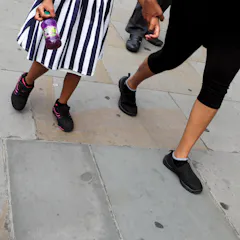
Children do not always need to be independent or unsupervised to gain in autonomy and a sense of control. Just being able to walk around expands their world.

A big reason the idea is gaining momentum globally is that the benefits for the health of individuals, communities and the environment are clear and almost immediate.

Factors such as having supportive family and friends, safer communities, positive school environments and adequate resources, are often associated with more physical activity.

Short, frequent walks throughout the day are key to helping prevent the harmful effects of a sedentary lifestyle.
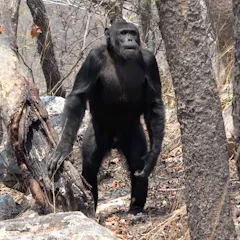
Almost all theories of human bipedalism explain it as a terrestrial adaptation. A new study does not support that view.
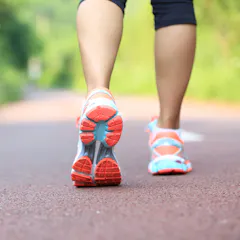
Walking backwards burns more calories and has many other health benefits.
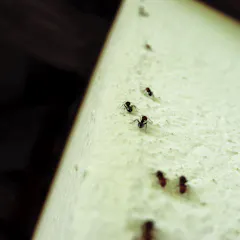
Ant feet are equipped with an array of tools – from retractable sticky pads to claws to special spines and hairs – enabling them to defy gravity and grip virtually any surface.

A comparison of 42 urban areas in New Zealand with 500 towns and cities in the US shows how much better local urban design has to be if we’re serious about reducing reliance on cars.
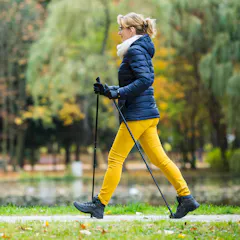
Using poles while you walk can be a great, low-impact way to exercise.
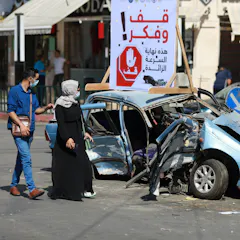
Traffic crashes kill and injure millions worldwide every year and are a major drain on economic development. Improving road safety would produce huge payoffs, especially in lower-income countries.

Walking roots us in new places. It also unlocks memories of those we’ve moved away from.
Top contributors
-

Adjunct Research Fellow, School of Human Sciences, The University of Western Australia
-
Senior Lecturer in Clinical Exercise Physiology, University of East London
-
Honorary Professor of Planning, The University of Queensland
-
Teaching Assistant Professor, University of Pittsburg and Visiting Associate Professor, The University of Osaka, University of Pittsburgh
-
Reader in Exercise and Health Physiology, University of Hertfordshire
-
PhD Candidate, School of Population Health, UNSW
-
Associate Professor in Urban Planning, The University of Queensland
-
Professor of Human Geography, The University of Queensland
-
Distinguished Professor and Director, Urban Futures Enabling Capability Platform, and Director, Healthy Liveable Cities Group, RMIT University
-
Professor of Physical Activity, Lifestyle, and Population Health, University of Sydney
-
Associate professor, UCL
-
Senior Lecturer, University of Environment and Sustainable Development
-
John Rennie Short is a Friend of The Conversation.
Professor Emeritus of Public Policy, University of Maryland, Baltimore County
-
Professor of Transport Technology and Sustainability, Swinburne University of Technology
-
Adjunct Professor, School of Public Health, Curtin University