

Across all jobs – from managers and professionals to labourers – a study found Indigenous workers earn an average of 15.9% less per hour than all workers.
Articles on Gender pay gap
Displaying 1 - 20 of 183 articles

A survey showed the annual median full-time graduate salary for women was $3,700 less than men’s. Research suggests gender bias might be at play.

All-women groups, whether in sports, music or business, are consistently underpaid compared to men. They’re seen as more threatening to the status quo.

Caring is often framed as a burden or challenge, rather than something that’s enjoyable and benefits society.

New data shows mining remains one of Australia’s most unequal industries – but the gender gap isn’t just about pay.

Often, it might just come down to a lack of confidence.

Financial literacy gives women the knowledge, confidence and skills to engage in financial decision-making.

Despite signs of progress, men are still almost twice as likely to be in the highest-earning income bracket.

New Zealand universities are slowly closing the pay gap, but men are still more likely to fill senior leadership roles in the highest pay brackets.

These extra payments are especially high real estate, financial services and other industries.

And part-time work can hit hourly pay by as much as 4%.

The major sticking point is Australia’s highly segregated jobs market by gender.

New analysis reveals just how much “invisible” caring and housework is worth to the economy.

Imagine living in a town where three or more families are competing for a single early learning place.

Two sociologists found that when the pace at which family sizes was shrinking slowed down, starting in the 1990s, progress toward closing the gender pay gap grew sluggish too.

Achieving gender parity could take more than a century. South Africa and Australia show why context matters – and why there’s no single formula for equality.

See how your industry compares to others.

The dispute exposes several fault lines in Canada around work, how we value it and how the law impacts workers.
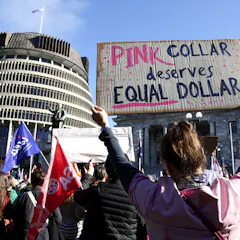
The National Party has always relied on electoral support from women. But that has eroded over time, and pay equity and KiwiSaver changes could hasten the decline.

The public sector shows having a gender balance at senior levels can make a big difference to pay outcomes.
Top contributors
-

Associate Professor in Economics, Queensland University of Technology
-
Associate Professor, Bankwest Curtin Economics Centre, Curtin University
-
Distinguished Professor of Economics, Macquarie University
-
Professorial Fellow, University of Canberra
-
Professor, Human Resource Management, The University of Melbourne
-
Professor of Law, The University of Melbourne
-
Professor of European Politics and Society, University of Bath
-
Associate Professor Leeds University Business School, University of Leeds
-
Lecturer in Economics and Econometrics, Victoria University; Fellow, Motu Economic and Public Policy Research, Te Herenga Waka — Victoria University of Wellington
-
Director of the King's Global Institute for Women's Leadership, Professor of Work and Employment, King's College London
-
Senior Lecturer at York Business School, York St John University
-
Research Project Director at the Department of Economics, Macquarie University
-
Dean of Programs, EM Lyon Business School
-
Professor of Work and Organisation, University of Essex
-
Professor in Work and Organisation Studies, University of Essex