
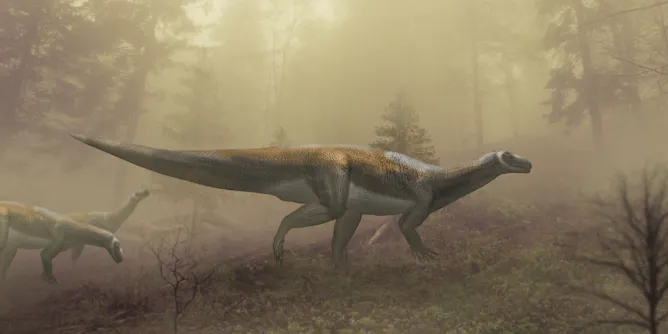
The oldest fossil evidence for dinosaurs in Australia came as a surprise when it was dug out by coal miners working in Ipswich.
Articles on Dinosaurs
Displaying 121 - 140 of 311 articles
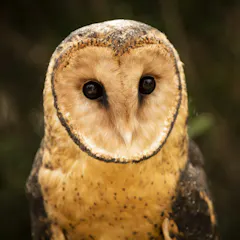
Birds have always been charged with carrying the burden of our feelings, writes Delia Falconer. Yet we’ve never treated these inscrutable, vivacious companions particularly well.
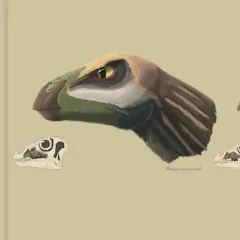
A detailed study of ornithopod jawbones from a single site reveals a high dinosaur diversity in Victoria during the late Early Cretaceous.
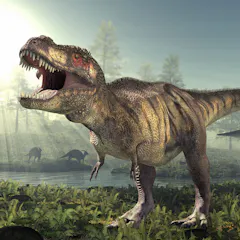
Ever since moviegoers saw the first ‘Jurassic Park,’ millions have wondered if scientists could make a dinosaur in the lab.
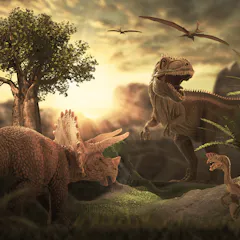
If the asteroid caused the very sudden end of the dinosaurs, a new study shows that their decline had begun 10 million years earlier.

A spectacular series of fossilised footprints from sauropod dinosaurs and other ancient animals opens a window onto life in northeast Australia 95 million years ago.

This is a crucial dinosaur for palaeontologists; the variety of fossils available means researchers can study the species’ growth through its whole life span.
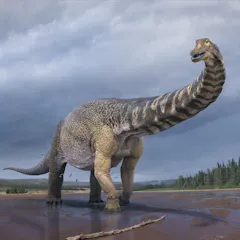
Australotitan was a massive long-necked sauropod estimated to weigh the equivalent of 1,400 red kangaroos.
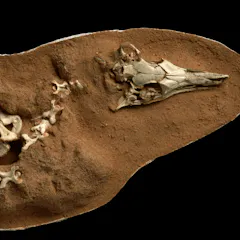
By looking at the eye bones and ear canals of extinct dinosaurs, researchers show that a small ancient predator likely hunted at night and had senses as good as a modern barn owl.
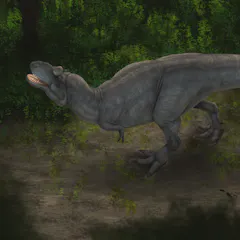
So how accurate is the T. rex’s running speed in that famous Jurassic Park jeep-chase scene?
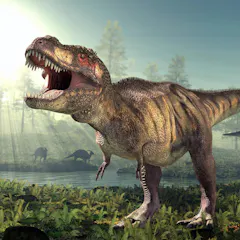
Using the incredible wealth of fossil data and a modern ecological theory, researchers estimated population density for the extinct apex predator.
A transcript of episode 11 of The Conversation Weekly podcast, including an interview on Israel’s foreign policy options following its recent election.
Plus, what Israel’s latest election could mean for its foreign policy. Listen to episode 11 of The Conversation Weekly podcast.
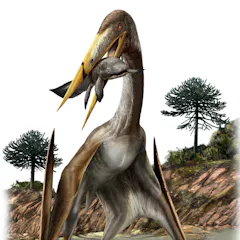
Gigantic flying reptiles had impressive wingspans of up to 12 metres – and a special trick in their necks.

The environmental, cultural and scientific sensitivity of some sites, and rarity of some fossils, means amateur fossil collecting comes with huge risks.
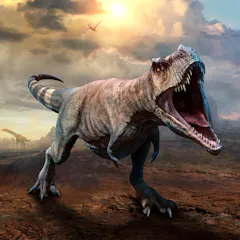
Our new study has found younger tyrannosaurs would have hunted small prey.
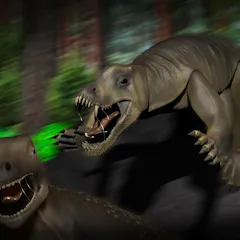
Because of its skeleton’s heavy architecture, scientists have always assumed that Anteosaurus was a rather sluggish, slow-moving animal, only capable of scavenging or ambushing its prey, at best.
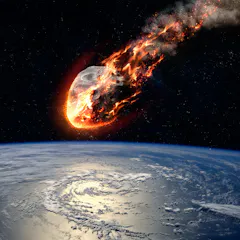
A new study found iridium, an element found in asteroids, in the rocks of the Chicxulub impact crater.
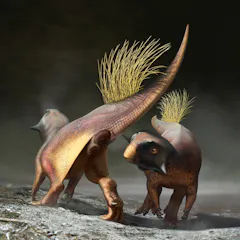
A reconstruction of a dinosaur’s back passage reveals it may have been used for visual communication.
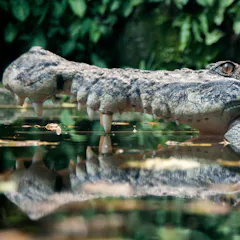
New research shows crocodiles have landed upon an equilibrium state of evolution.
Top contributors
-

Professor of Vertebrate Palaeontology, University of Bristol
-
Chancellor's Fellow in Vertebrate Palaeontology, University of Edinburgh
-
Emeritus Strategic Professor in Palaeontology, Flinders University
-
Senior Research Scientist, South Australian Museum; Flinders University
-
Senior Lecturer in Paleontology and Evolutionary Biology, Life Sciences at the University of Bath, University of Bath
-
Associate professor in Vertebrate Palaeontology, University of the Witwatersrand
-
Research Associate, School of Earth and Planetary Sciences, Curtin University
-
Senior lecturer, University of New England
-
Research Associate, African Centre for Coastal Palaeoscience, Nelson Mandela University
-
Professor, Palaeobiology, University College Cork
-
Palaeontologist, Earth Science Faculty, University of New England
-
PhD; Associate Professor, School of Biological Sciences, The University of Queensland
-
Palaeontologist, University of Southampton
-
Professor of Evolutionary Palaeobiology at the Milner Centre for Evolution, University of Bath
-
Researcher and curator, Jurassica Museum