
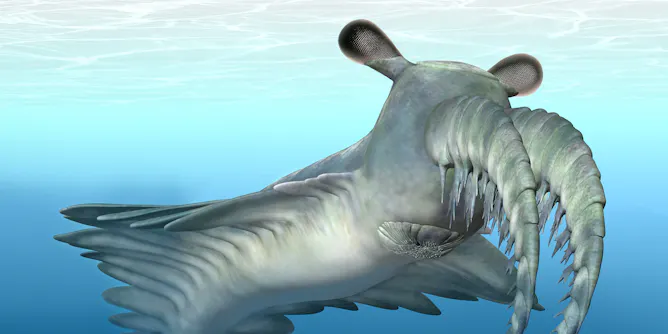
Our study on weird ancient marine animals called radiodonts supports the idea that vision played a crucial role during the Cambrian Explosion, a rapid burst of evolution about 500 million years ago.
Articles on Dinosaurs
Displaying 141 - 160 of 311 articles
66 million years ago, birds survived the calamity that wiped out all prehistoric dinosaurs. But could birds once again evolve into their long lost ancestors?
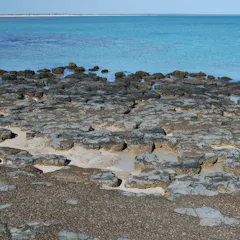
The end-Triassic mass extinction was a cataclysm for the world’s prehistoric species, killed off by volcanoes that altered Earth’s seas and skies. But new research shows it didn’t happen when we thought.
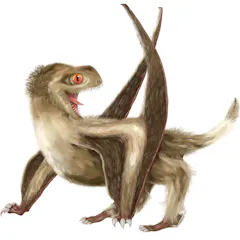
Did feathers evolve in the common ancestor of pterosaurs and dinosaurs? Not everyone is convinced
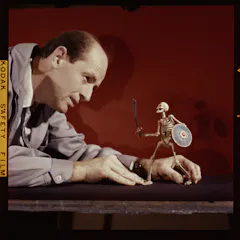
From mythical beasts to extinct creatures, the pioneering special effects work of Ray Harryhausen inspired a generation of zoologists, palaeontologists and ecologists.
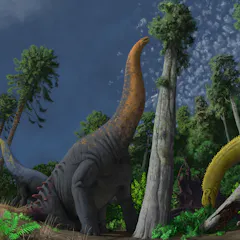
Tooth fossils from NSW have confirmed sauropods weren’t exclusive to Queensland. They’re also providing a first look at how these colossal dinosaurs fed from Australia’s land.
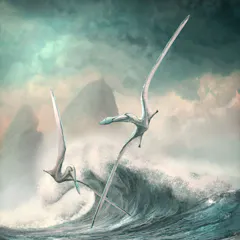
Fossils reveal that dinosaurs’ flying cousins become twice as efficient at flying over 150 million years.
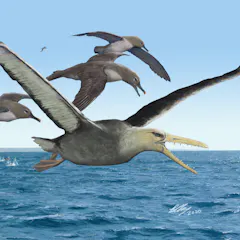
Paleontologists have discovered fossil remains belonging to an enormous ‘toothed’ bird that lived for a period of about 60 million years after dinosaurs.
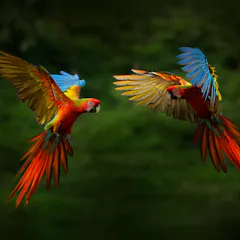
Today’s birds evolved from feathered dinosaurs.
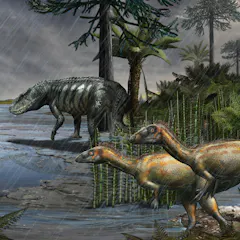
Our new research has discovered how a series of volcanic eruptions 233 million years ago fundamentally changed life on Earth.
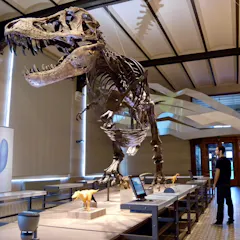
You can gauge a dinosaur’s body mass either by reconstructing it as accurately as possible, or by scaling its leg bones against those of today’s animals. Research shows both methods work well together.
If it weren’t for historical and biological happenstance, few would be eating avocados today.

Human genes are one of the main reasons we can’t grow wings. And even if humans did have wings, they wouldn’t necessarily allow us to fly.
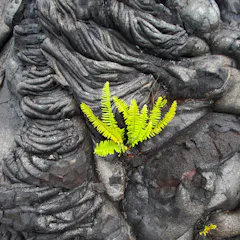
When the dinosaurs went extinct, some species took over the world. Adaptability, not survivability, explains why.
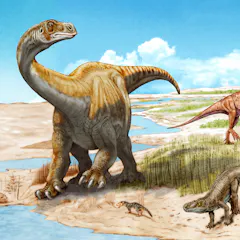
How we identified a new ancestor of the likes of Diplodocus from old bones.
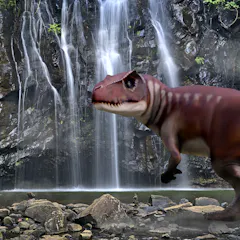
Photos from Queensland coal mines helped researchers discover a missing top predator in the ancient Australian food chain.
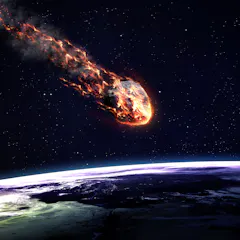
The trajectory of the Chicxulub asteroid led to the most efficient release of gas and projectile rocks – which was disastrous for life on Earth.
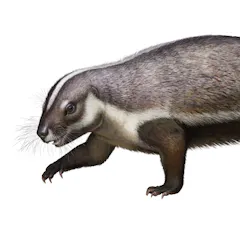
This ancient cat-sized animal lived millions of years ago and had features not found in any of today’s mammals.
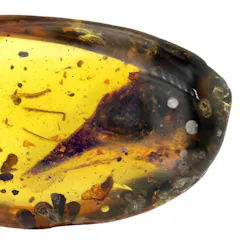
The fossil includes the tiny creature’s original bone and flesh.
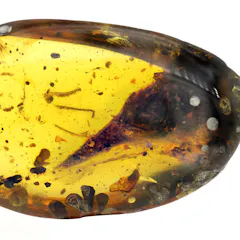
The skull of Oculudentavis, found encased in amber, provides new clues into the transition from dinosaurs to birds and may be smallest of either ever found.
Top contributors
-

Professor of Vertebrate Palaeontology, University of Bristol
-
Chancellor's Fellow in Vertebrate Palaeontology, University of Edinburgh
-
Emeritus Strategic Professor in Palaeontology, Flinders University
-
Senior Research Scientist, South Australian Museum; Flinders University
-
Senior Lecturer in Paleontology and Evolutionary Biology, Life Sciences at the University of Bath, University of Bath
-
Associate professor in Vertebrate Palaeontology, University of the Witwatersrand
-
Research Associate, School of Earth and Planetary Sciences, Curtin University
-
Senior lecturer, University of New England
-
Research Associate, African Centre for Coastal Palaeoscience, Nelson Mandela University
-
Professor, Palaeobiology, University College Cork
-
Palaeontologist, Earth Science Faculty, University of New England
-
PhD; Associate Professor, School of Biological Sciences, The University of Queensland
-
Palaeontologist, University of Southampton
-
Professor of Evolutionary Palaeobiology at the Milner Centre for Evolution, University of Bath
-
Researcher and curator, Jurassica Museum