
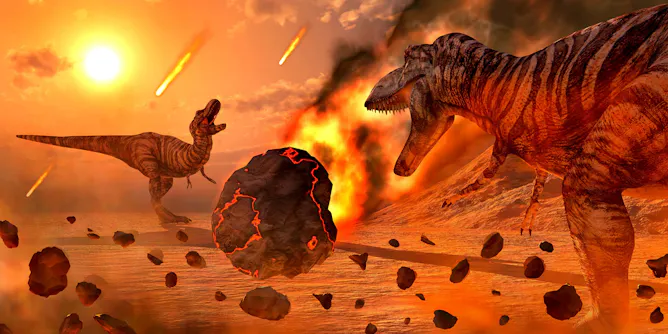
It’s fun to imagine secret dinosaur survivors living today, hidden in a remote corner of Earth. But the truth of who made it through the extinction event 66 million years ago may surprise you.
Articles on Dinosaur extinction
Displaying 1 - 20 of 34 articles

The extinction of the dinosaurs sparked an explosion of bird species, according to the largest-ever study of bird genetics.
Rather than a juvenile of a known species, several fossilized bones represent a new species – and shed light on the question of whether dinosaurs were already in decline before disaster struck.
Studying impact craters can broaden our understanding of the Earth’s evolution and life, as well as its possible future.
A recent BBC documentary examined fossils thought to have been made when an asteroid wiped out the dinosaurs.
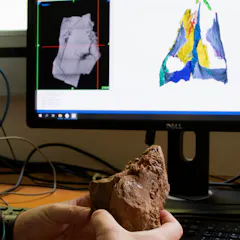
An analysis of the skull suggests the ankylosaur may have had a poorer sense of smell than its counterparts in the northern hemisphere.
A recent study provides additional evidence that the dinosaurs died in June.
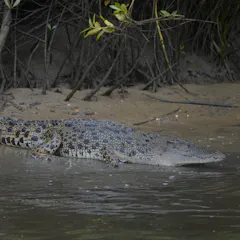
Crocodiles can survive without food for a long time – even up to more than a year – because of how well they can save their energy.
If the asteroid caused the very sudden end of the dinosaurs, a new study shows that their decline had begun 10 million years earlier.
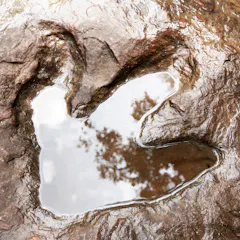
66 million years ago, birds survived the calamity that wiped out all prehistoric dinosaurs. But could birds once again evolve into their long lost ancestors?
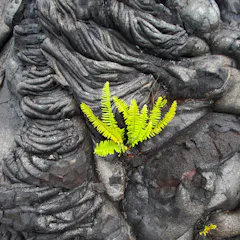
When the dinosaurs went extinct, some species took over the world. Adaptability, not survivability, explains why.
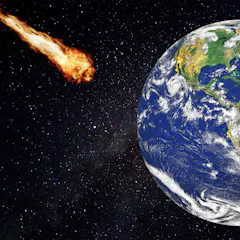
The risks to nature from man-made global warming – and the imperative to act – are clear.
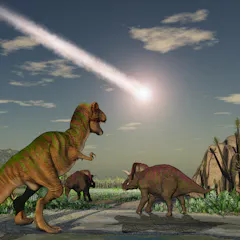
A mass extinction 66 million years ago killed the non-bird dinosaurs, but plants survived.
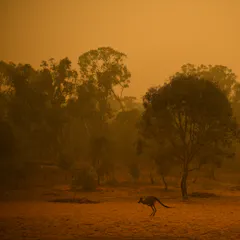
The asteroid that wiped out the dinosaurs sparked global firestorms. On land, only creatures that could evade fire survived
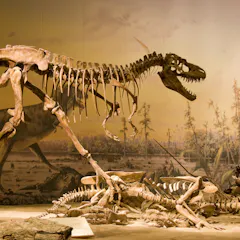
Sometimes the only way to tell the difference between a baby dinosaur and a grown-up one is to find fossils of them both together.
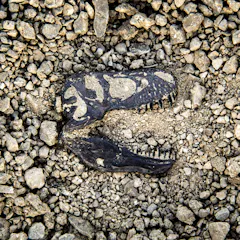
Every cloud has a silver lining – even the debris cloud from an asteroid impact
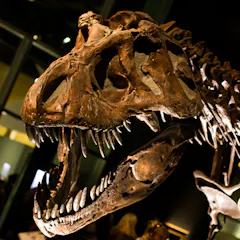
Dinosaurs ruled the Earth for about 180 million years. But around 66 million years ago, a huge rock from outer space (called an asteroid) smashed into the Earth. Then things got worse for dinosaurs.
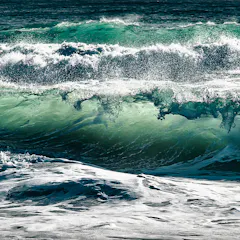
If you’ve never heard of a form of wave called a ‘seiche’ – which can occur in swimming pools during earthquakes – this is your chance to catch up.
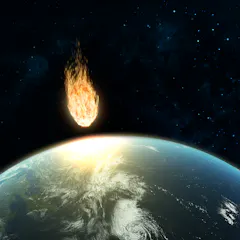
More evidence that the asteroid hit on Earth that marked the end of the dinosaurs could have triggered a deadly increase in volcanic activity.
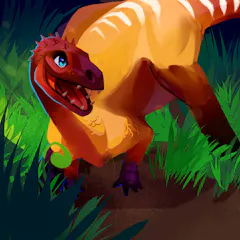
We know of about 900 valid dinosaur species that existed. ‘Valid’ means scientists know the dinosaur from enough of the skeleton bones to feel pretty sure that it differs from other known dinosaurs.
Top contributors
-

Senior Lecturer in Paleontology and Evolutionary Biology, Life Sciences at the University of Bath, University of Bath
-
Professor of Vertebrate Palaeontology, University of Bristol
-
Project Officer – Office of the Queensland Chief Scientist
-
Senior Research Scientist, South Australian Museum; Flinders University
-
Professor in Geophysics and Remote Sensing, Queensland University of Technology
-
Professor of Palaeobiology, University of Birmingham
-
Assistant Professor of Earth Sciences, University of Oregon
-
Professor of Genetics, University of Kent
-
Postdoctoral Associate of Earth Sciences, University of Minnesota
-
Professor of Evolutionary Palaeobiology at the Milner Centre for Evolution, University of Bath
-
Research Associate in Palaeontology, University of Bristol
-
Postdoctoral research fellow, The University of Queensland
-
Professorial Research Fellow, University of Surrey
-
Professor in Particle Cosmology, Lancaster University
-
Emeritus Strategic Professor in Palaeontology, Flinders University