

The tracks are the first to be found in Canada from this time period.
Articles on Cretaceous period
Displaying 1 - 20 of 38 articles
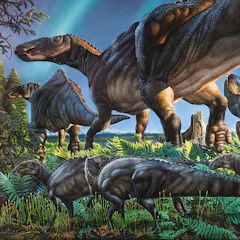
The Arctic was not simply a cold edge of the Cretaceous world, but a place where mammals adapted, diversified, migrated and originated.
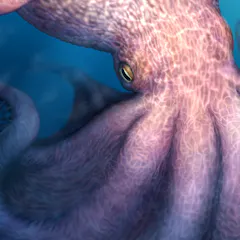
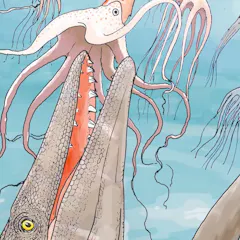
A newly discovered fossil suggests octopuses up to 19 metres long may have hunted in Cretaceous seas.
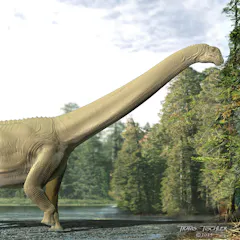
Sauropods were the largest land-living animals of all time. Finding the traces of a sauropod’s last meal is nothing short of extraordinary.
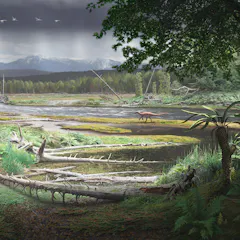
The new study shows what the polar regions might look like in the future as the planet warms.
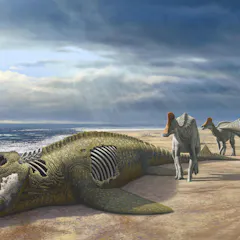
Oceanic dispersal of dinosaurs between Europe and Africa shows how low-probability, high-impact events drive evolution.
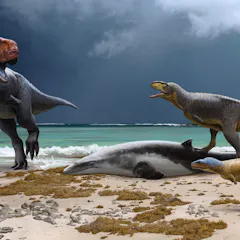
Fossils suggest that as many as three abelisaurid species coexisted in Morocco around 66 million years ago.
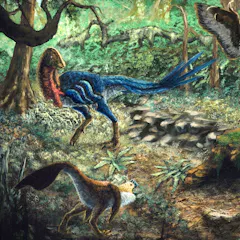
Rather than a juvenile of a known species, several fossilized bones represent a new species – and shed light on the question of whether dinosaurs were already in decline before disaster struck.
Scientists have discovered a new species of mosasaur, a sea-dwelling lizard from the age of the dinosaurs, with strange, ridged teeth unlike those of any known reptile.
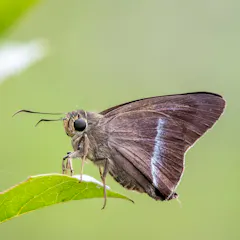
The most detailed evolutionary tree of butterfly species ever created reveals the precise origins of the nectar-sipping gadabouts.
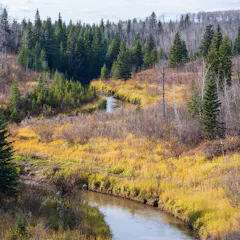
The Wapiti Formation in Alberta is turning out to be a rich site for dinosaur and other fossils. A recent discovery could fill in the gaps about a transition between different ecological communities.
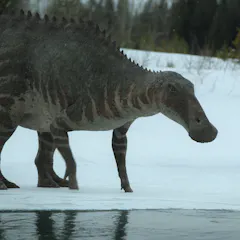
Yes, dinosaurs really did survive in snow – we simulated the Cretaceous climate to prove it.
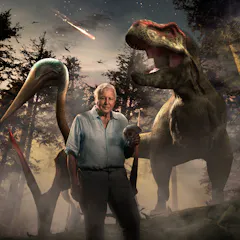
A recent BBC documentary examined fossils thought to have been made when an asteroid wiped out the dinosaurs.
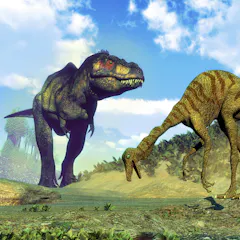
Two recent discoveries in Alberta and Uzbekistan have identified the top predators in those regions during the Cretaceous period. Fossils that had been in storage for years included the jawbones.
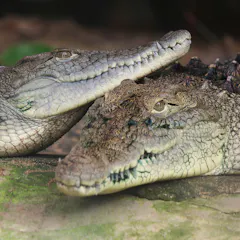
While crocodiles are not native to Canada, fossil traces have been found in northern British Columbia that indicate that during the Cretaceous Period, giant crocodiles roamed.
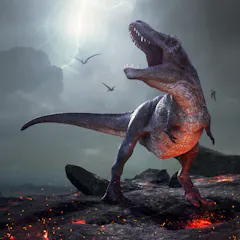
A recent study provides additional evidence that the dinosaurs died in June.
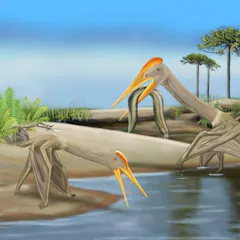
We examined pterosaur jaw fragments from the Moroccan desert to understand more about how these creatures evolved.
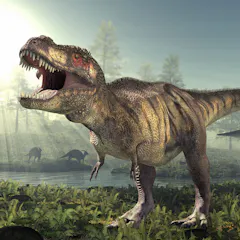
Ever since moviegoers saw the first ‘Jurassic Park,’ millions have wondered if scientists could make a dinosaur in the lab.
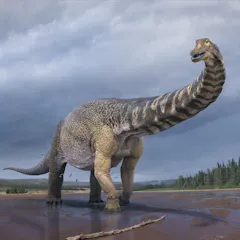
Australotitan was a massive long-necked sauropod estimated to weigh the equivalent of 1,400 red kangaroos.

The recent discovery of fragments of a jaw fossil show that at one point, herbivorous reptiles evolved highly complex and efficient teeth.
Top contributors
-

Senior Lecturer in Paleontology and Evolutionary Biology, Life Sciences at the University of Bath, University of Bath
-
Professor of Vertebrate Palaeontology, University of Bristol
-
Research Associate, School of Earth and Planetary Sciences, Curtin University
-
Professor Emeritus, Earth Sciences, Western University
-
Research Associate, African Centre for Coastal Palaeoscience, Nelson Mandela University
-
Professor of Vertebrate Palaeontology, University of Alberta
-
Research Fellow, School of Earth Sciences, University of Bristol
-
Professor, Vertebrate Palaeontology, University of Alberta
-
Ph.D. Student in Paleoecology, Oklahoma State University
-
Technical Specialist in Earth Sciences, University of Bristol
-
Academy Professor of Paleontology, The Ohio State University
-
Associate Professor, Australian National University
-
1851 Research Fellow, University of Bristol & Honorary Research Fellow, University of Manchester, University of Manchester
-
Principal Research Fellow Applied Palaeontology & Palaeotourism, CQUniversity Australia
-
Senior Research Assistant (Palaeontology), Queensland Museum