
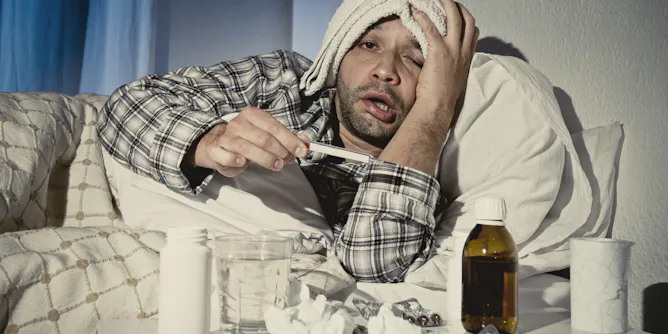
Stay away from viruses in the early morning – and in winter.
Articles on Circadian rhythms
Displaying 121 - 140 of 155 articles

Eighty percent of North Americans can no longer see the Milky Way at night. But the problem with light pollution isn’t just about stargazing.
Saturated fats are linked to metabolic disorders and heart disease. That may be because thes fats make some cells lose track of time, causing inflammation.
CC BY-ND31.9 MB (download)
A podcast on time: telling it, perceiving it, doing it and travelling through it.

New research suggests disrupted sleep patterns could have more impact on some measures of women’s performance than men’s.
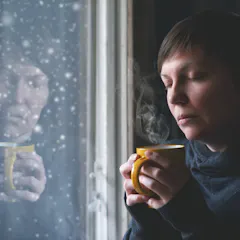
It might be that teaching people to reframe their thoughts about winter can help them overcome seasonal affective disorder year after year.
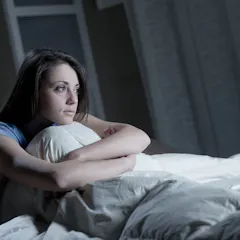
What your sleep patterns may say about your risk of developing mental illness.
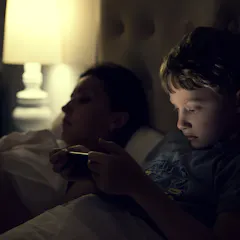
Is electricity making us sleep less? A new study on sleep in preindustrial societies suggests the answer is no. But it misses a big point: people in preindustrial societies spend more time in darkness than we do.
How does one prove that shift work causes breast cancer, as the authors of the new study claim? A cancer epidemiologist explains how scientists weigh evidence to figure out what causes cancer.
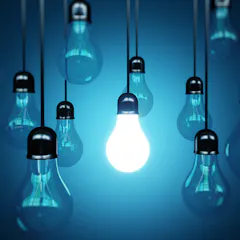
Today, most of us get too little light during the day and too much at night for our circadian rhythm to function at its best.
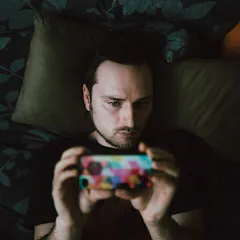
While many of these devices, especially e-readers, seem harmless enough, the light they emit may affect our sleep patterns and leave us feeling tired the next day.
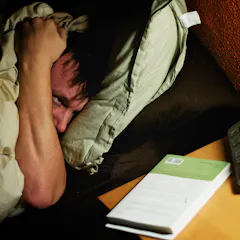
We all have a poor night’s sleep from time to time: those nights when you lie awake for hours trying desperately to go to sleep but can’t stop worrying about tomorrow. Or when you repeatedly wake up throughout…
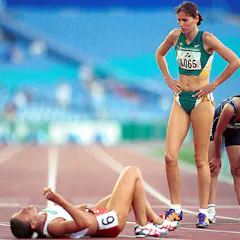
Athletic performance can vary over the course of the day by up to 26%, depending on the athlete’s circadian rhythm, according to research published in the journal Current Biology. The study illustrates…
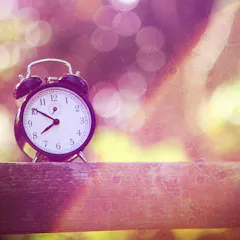
It’s 6.30am and after a long holiday break, your alarm clock is insistently telling you it’s time to get out of bed. For many people – me included – the automatic reaction is to hit the snooze…
It’s that time of year again - the end of daylight savings and the beginning of the dark season. While many of us look forward to seasonal festivities, millions can also expect feelings of depression…
The amount of sleep adults need has once again come under the spotlight, with a recent Wall Street Journal article suggesting seven hours sleep is better than eight hours and the American Academy of Sleep…
Long flights across many time zones often leave us feeling fatigued, sleepy, irritable and generally out of sorts. And it’s not just because of poor sleep on the plane and dehydration from the altitude…

Satellite images of the earth provide a striking picture of our planet during the hours of darkness. From space, the world at night appears as an intricate mass of tiny points of light, clustered into…
Jet lag is a discomfort many of us will have experienced in the days following a long-haul flight across time zones. Mathematicians in the US may have a jet-lag cure in the form a new app called Entrain…
Daylight saving time ends this weekend in most states and territories (barring Queensland, Western Australia and the Northern Territory), meaning we’ll turn our clocks back by one hour on Sunday morning…
Top contributors
-

Professor, School of Medicine, University of Connecticut
-
Emeritus Professor of Psychology, Adelaide Institute for Sleep Health, Flinders University
-
Director, Appleton Institute, CQUniversity Australia
-
Associate Professor, Physiology of Circadian Rhythms, Institute for Molecular Bioscience, The University of Queensland
-
Professor of Neurology and Pediatrics, Vanderbilt University
-
Associate Professor of Neurology, University of Pittsburgh
-
Professor (Assoc), School of Pharmacy and Biomolecular Sciences (PBS), RCSI University of Medicine and Health Sciences
-
Professor of Chronobiology and Integrative Physiology, University of Surrey
-
Personal Chair in Nutrition, The Rowett Institute, University of Aberdeen
-
Conjoint Senior Lecturer, School of Medicine and Public Health, University of Newcastle
-
Research fellow, The University of Queensland
-
Associate Professor of Physical & Biological Sciences, University of California, Santa Cruz
-
Professor of Endocrinology, University of Oxford
-
Postdoctoral Research Officer, University of Surrey
-
Professor and Director, Centre for Mental Health, Swinburne University of Technology