
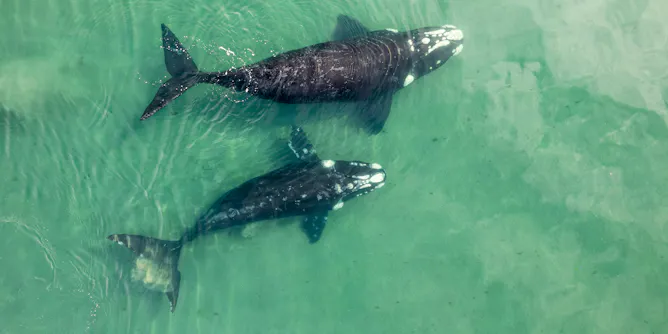
This reproductive slow down seems closely linked to climate-driven changes in the remote Southern Ocean.
Articles on Whales
Displaying 21 - 40 of 202 articles
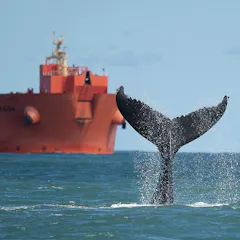
Despite Brazil’s recent expansions of protected areas, research shows that the favorite habitats of whales and dolphins are still threatened by human activities.

The highly social lives of many marine mammals brings many benefits. But it also comes with a hidden cost.

The sex and age of an animal turn out to be stronger predictors than habitat for higher PFAS levels, suggesting they accumulate over a lifetime.
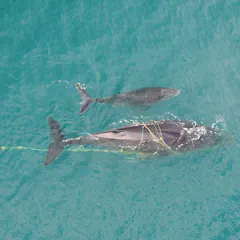
Australian scientists have noticed a rise in the number of whales getting entangled in ropes and fishing lines. Rescuing them is a job for experts.
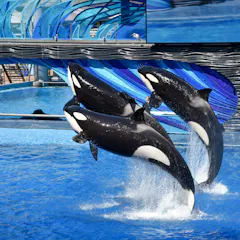
Marineland’s decline reflects a growing debate about the ethics of keeping animals in captivity, and what the future of zoos and aquariums should look like.

The link between feeding and breeding makes whales a living barometer of ocean health.

The loss of one iconic species, sunflower sea stars, unleashed a voracious eater of seagrass habitats and upended the coastal ecosystem. But the response has opened new business opportunities.
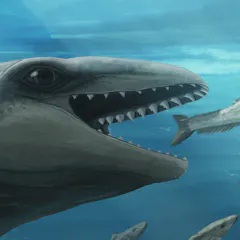
If alive today, these tiny whales would be as iconically Australian as kangaroos.
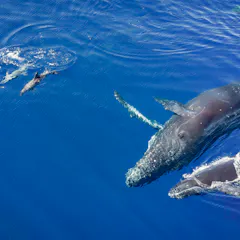
The findings reshape our understanding of how social marine mammals interact across species.
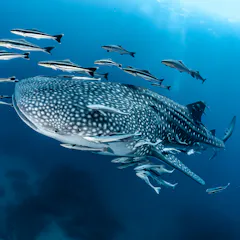
Almost 400 scientists from around the world came together to understand the movements of large marine mammals, using 30 years of satellite tracking data.
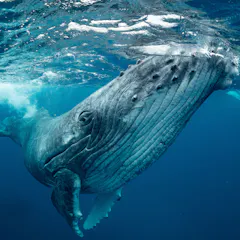
Their carcasses and faeces are also important to the ocean.
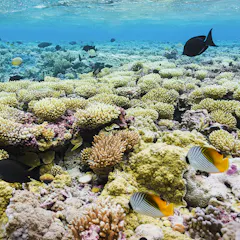
America’s marine protected areas help fish populations thrive. Trump’s plan to open them to industrial fishing may ultimately harm the fishing industry itself.
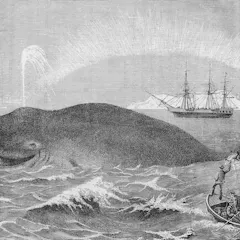
New research shows that when the whaling industry in the US produced more products, the proportion of slaves also declined in the 1700s and 1800s.
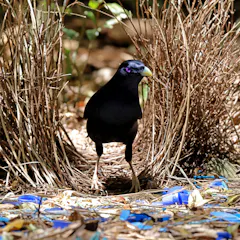
Without being able to get into the heads of animals, it’s hard to say for sure. But instances of pig painters, whale crooners and bird sculptors certainly make it seem plausible.
Researchers identified statistically coherent patterns in whale song that may be a signature of cultural learning.
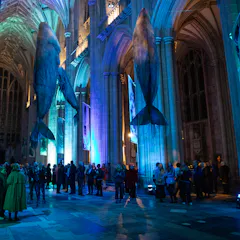
A new immersive art installation highlights the effects humans have on ocean ecosystems, and whales in particular.
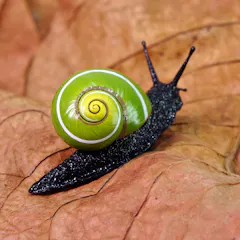
Although animals can’t use human language, art is beyond words. As Edward Hopper wrote, ‘If I could say it in words there would be no reason to paint.’
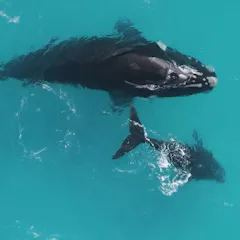
These marine mammals are still feeling the effects of whaling. For most species, it may be another 100 years before there are enough old whales for scientists to confirm their lifespans.
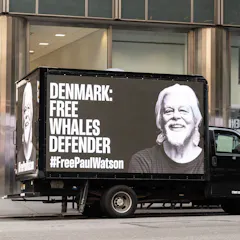
Japan’s whaling practices are in the spotlight following the arrest of activist Paul Watson. Are they a deeply rooted cultural tradition or a lucrative economic activity?
Top contributors
-

Whale Scientist and Lecturer, Faculty of Science and Engineering, Macquarie University
-
Research Fellow in Marine Science and Manager Whales & Climate Program, Griffith University
-
Curator of Vertebrates, Museum of New Zealand Te Papa Tongarewa
-
Adjunct Professor, Institute for Marine and Antarctic Studies, University of Tasmania
-
Professor Evolution & Ecology, UNSW
-
Reader in Biology, University of St Andrews
-
Honorary Professor at Bangor University; Director of Sea Watch Foundation, Bangor University
-
Adjunct Research Associate, Monash University
-
Senior Curator, Vertebrate Palaeontology, Museums Victoria Research Institute
-
Senior Researcher in Marine Biology, Aarhus University
-
Lecturer, UWA Oceans Institute, The University of Western Australia
-
Antarctic Law Researcher, Institute for Marine and Antarctic Studies and the Antarctic Climate and Ecosystems CRC, University of Tasmania
-
Associate Professor, School of Science, Edith Cowan University
-
Professor of Ocean Sciences, University of California, Santa Cruz
-
Lecturer in Ecology, Scotland's Rural College