

Preparing for an uncertain future is less about predicting which jobs will survive than developing skills that allow people to adapt as work changes.
Articles on UK Schools
Displaying 1 - 20 of 288 articles

Trauma informed care shifts approaches from ‘what is wrong with this person’ to ‘what does this person need?’

Inclusion is often treated as a self-evident term.

Having to move home and school can mean disrupting trusted adult relationships and the loss of access to established support.
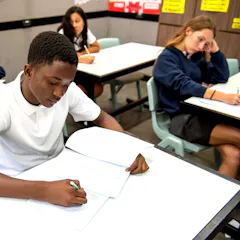
The new proposals shift to a single core modern language, only required at secondary school in the 11-14 age range.

The results for the UK nations are mixed.

Pisa should be seen as a warning light, rather than a diagnosis of what is wrong with Welsh education.

Teachers have gained some skills, but the GPS test is not an effective means of helping pupils become better writers.

Rest matters, but it cannot indefinitely compensate for working conditions that repeatedly deplete staff.

Schools provide a link between generations in a local area.

Schools already treat some life skills, such as swimming, as essential.

It isn’t clear that these bases are the answer to providing inclusive education for children and young people with special educational needs and disabilities.

Children receive support from their partner throughout the session, with their teacher monitoring the interactions in the class.

Children are already thinking about power and whose voices get heard.

Boys want to change the narrative, and education is vital in helping them.

Cookies, traybakes and pizza were very popular, and daily specials and fruit were not.

School trips offer rich learning experiences, but autistic children are not always able to access them fully.

A teacher described always having to be ready for an inspection as ‘intolerable’.

A number of challenges remain with embedding additional learning needs reforms across Wales.

Being a boy who expresses themselves can be a risky enterprise.
Top contributors
-

Professor of Education and Public Policy, Durham University
-
Associate Professor at the Health Services Management Centre, University of Birmingham
-
Professor of Early Childhood and Primary Education, UCL
-
Rosalind Hollis Professor of Education for Social Justice, University of Hull
-
Associate Professor, School of Education, Durham University
-
Professor of Education Research, School of Education, University of Birmingham
-
Professor of Education, Sheffield Hallam University
-
Assistant Professor of Behavioural Science, Warwick Business School, University of Warwick
-
Research Fellow in Social Sciences, Nottingham Trent University
-
Lecturer in Education, Swansea University
-
Associate Pro Vice Chancellor for Student Inclusion and Professor of Learning and Teaching in Higher Education, University of East Anglia
-
Director, Nottingham Institute of Education, Nottingham Trent University
-
Professor of Sociology of Education, UCL
-
Associate Professor of Education Policy, Nottingham Trent University
-
Senior Lecturer in Psychology in Education, University of Bristol