
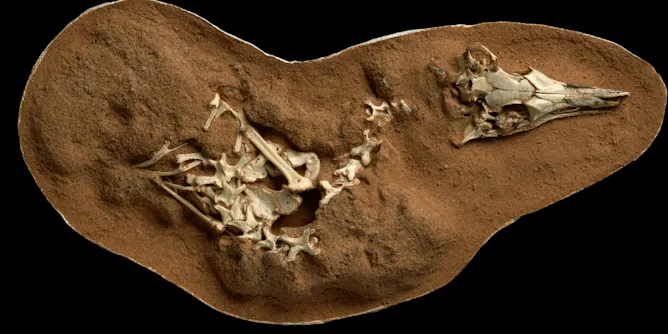
By looking at the eye bones and ear canals of extinct dinosaurs, researchers show that a small ancient predator likely hunted at night and had senses as good as a modern barn owl.
Articles on Predators
Displaying 81 - 100 of 156 articles

Plus a new technique to protect birds from predators – using fake smells. Listen to episode 10 of The Conversation Weekly podcast.

A parent’s or grandparent’s stressful experiences change how their offspring behave. And it turns out that moms’ experiences produce different changes in kids than dads’.
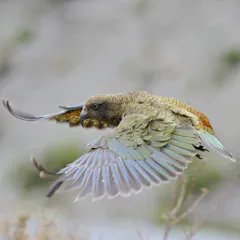
Climate change has long been dismissed as a significant stress to New Zealand’s native wildlife, but research shows it exacerbates existing threats such as introduced predators and habitat loss.
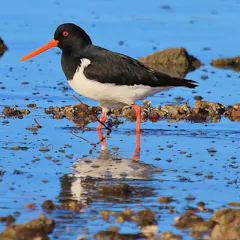
When scientists first thought to deceive predators with bird smells, the idea seemed crazy. But after seeing how fake news messes with the minds of both humans and animals, it now makes sense.
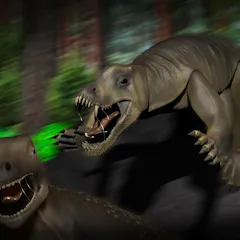
Because of its skeleton’s heavy architecture, scientists have always assumed that Anteosaurus was a rather sluggish, slow-moving animal, only capable of scavenging or ambushing its prey, at best.
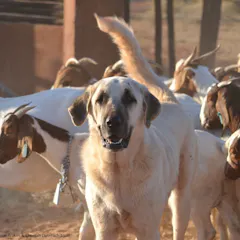
Livestock guarding dogs are considered a non-lethal method for farmers to control wild predators.
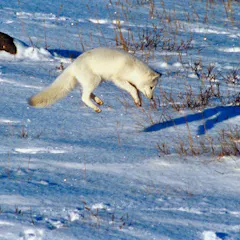
Arctic foxes have a few special talents that help them sneak up on unseen prey and pounce.
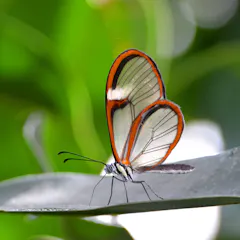
Transparency is an evolved characteristic of some species to help them survive, even when predators are staring directly at them.
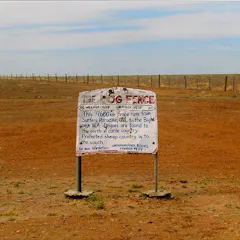
Millions of miles of fences crisscross the Earth’s surface. They divide ecosystems and affect wild species in ways that often are harmful, but are virtually unstudied.
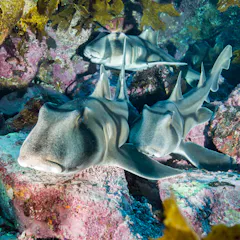
Even within a species, animals will suffer climate change differently. For sharks, it pays to live in warmer waters.
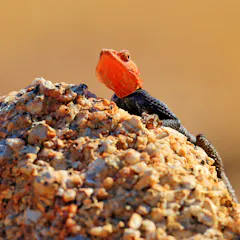
By eliminating the less fit individuals over time, predation can drive the population to increasing fitness in terms of survival and reproductive success.
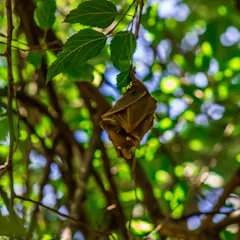
Investigating different factors influencing the behaviour of South African bat species contributes to our understanding of these understudied animals.
Some skinks have been known to kill their babies – but one remarkable species goes to any lengths to save them.
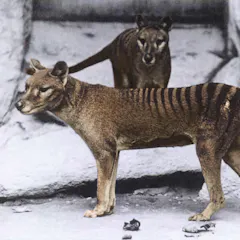
The “Tasmanian tiger” was hunted to extinction based on its perceived size as a predator big enough to take sheep. But it seems this was just a tall tale, and the thylacine weighed just 16.7kg.
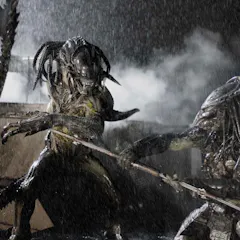
Anti-black violence exists against the backdrop of the political and cultural dehumanization of Black people. How did this happen and where do we go from here?
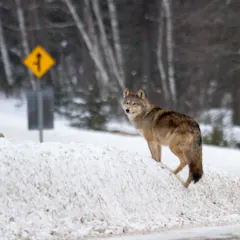
A recovery plan for the threatened Algonquin wolf should have been in place two years ago. Recent amendments to the Endangered Species Act mean the Algonquin wolf faces an uncertain future.
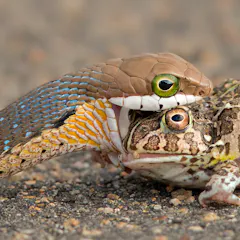
Social media has proved to be a helpful source of observations of snakes feeding. Knowing more about their diet is useful because it’s linked to their venom biochemistry.
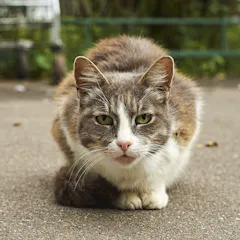
Framing cats as responsible for declines in biodiversity is based on faulty scientific logic and fails to account for the real culprit – human activity.
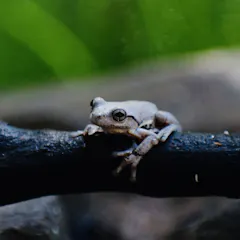
Wildlife can smell and hear a fire coming, and have developed novel ways to evade it. But they must watch out for cunning predators rushing in for a feed.
Top contributors
-

Professor in Wildlife Ecology and Conservation, School of Life & Environmental Sciences, Deakin University
-
Honorary Research Fellow, University of Sydney
-
Associate Professor, Global Ecology, University of Sydney
-
Associate professor in Vertebrate Palaeontology, University of the Witwatersrand
-
Professor in Ecology, Charles Sturt University
-
Discovery Early Career Research Fellow, University of Sydney
-
Professor Emeritus in Terrestrial Ecology, University of Sydney
-
Professor, Murdoch University
-
Associate Professor of Behavioural Ecology, Curtin University
-
ARC Future Fellow, Queensland University of Technology
-
Research Fellow in Canid and Wildlife Genomics, UNSW
-
Professor, School of Biological Sciences, Monash University
-
Future Fellow in Ecology, Queensland University of Technology
-
Senior lecturer, UNSW
-
Senior Lecturer in Psychology, CQUniversity Australia