
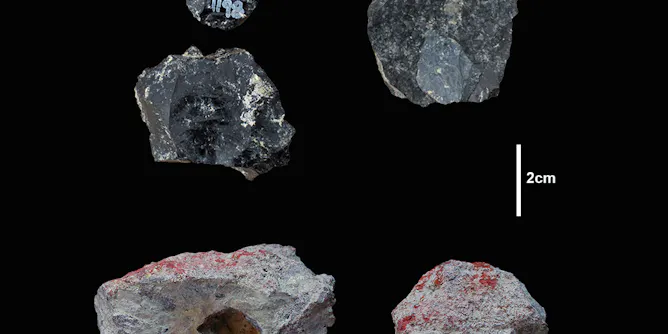
Scientists have discovered sophisticated tools in Kenya that are much older than expected.
Articles on Human evolution
Displaying 161 - 180 of 237 articles

New tools add to an emerging view of the past as a turbulent “Game of Thrones” style scenario, with distinct early human ancestors living in Eurasia before Homo sapiens arrived.
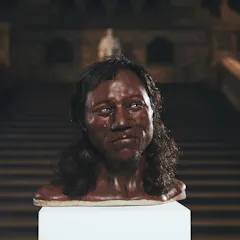
The first British people were black – and other interesting findings made possible by genomic sequencing.

New discoveries are changing archaeologists’ ideas about the origins of our own species and our migration out of Africa. This fossil pushes Homo sapiens’ African exodus date back by 50,000 years.

The story of where humans come from is growing as new evidence – and new methods of analysis – emerge all the time.

The very existence of kindness and altruism seems to contradict Darwin’s theory of evolution. So how could kind behaviour have evolved?
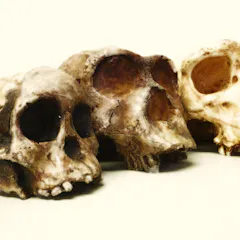
Recent research suggests that humankind’s origins lay outside of Africa. This is the nature of science: a paradigm that cannot be questioned on a regular basis becomes a dogma.
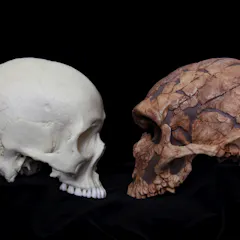
Maeve, age 8, has a question that has stumped many scientists over the years. And that’s because it’s a surprisingly tricky question to answer. It depends a bit on what you mean by ‘person’.

Latest development in ‘Crete feet’ find serves as a reminder of the challenges facing dig sites.
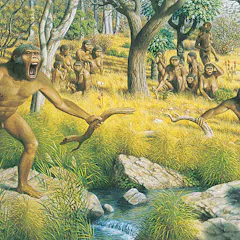
Experts are intrigued by 5.7m-year-old footprints from Crete but argue we cannot yet know for sure whether they come from a human ancestor.
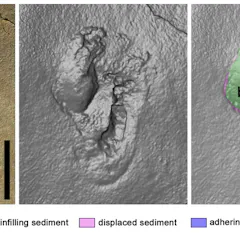
A new study can’t rule out the possibility that human ancestors lived on Crete at the same time as they evolved in Africa.
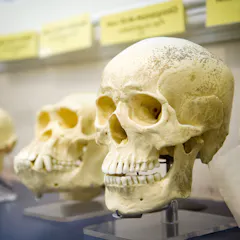
Larger brains lead to a broader social network.
Our huge brains help maintain complex social relationships, suggests research.
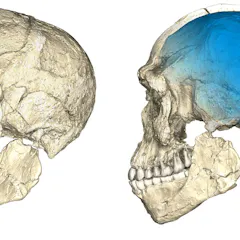
New paired research papers have pushed back by 100,000 years the time frame in which humans (Homo sapiens) are thought to have lived in Africa.
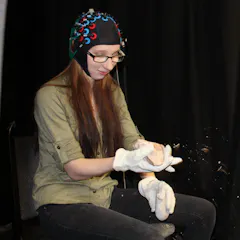
We can’t observe the brain activity of extinct human species. But we can observe modern brains doing the things that our distant ancestors did, looking for clues about how ancient brains worked.

A century-old case of scientific fraud illustrates how hard it is to untangle the truth when access to new discoveries is limited.

Cats evolved in hot desert regions where there were lots of small animals to eat. So they evolved feet that are perfect for pouncing on prey, climbing, scratching and jumping from great heights.

New research on Indonesian fossils reveals clues to an ancient expansion out of Africa.

How do scientists figure out when evolutionary events – like species splitting away from a common ancestor – happened? It turns out our DNA is a kind of molecular clock, keeping time via genetic changes.
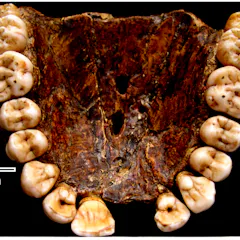
Anthropologists gather clues about how our ancient ancestors lived from their teeth. What will future anthropologists make of us based on the fossilized pearly whites we’ll leave behind?
Top contributors
-

Honorary Associate Professor, UNSW
-
Professor of Earth System Science, UCL
-
Emeritus Strategic Professor in Palaeontology, Flinders University
-
Professor of Archaeology and Biological Anthropology, School of Social Science, The University of Queensland
-
Director, ARC Centre of Excellence for Australian Biodiversity and Heritage (CABAH), University of Wollongong
-
Associate Professor of Archaeology, Griffith University
-
Director, Australian Research Centre for Human Evolution, Griffith University
-
Professor in Geochronology and Geochemistry, Southern Cross University
-
Wood Jones Professor of Anthropological and Comparative Anatomy, Adelaide University
-
Postdoctoral fellow, Australian National University
-
Group Leader, Genomics and Bioinformatics, Australian Centre for Ancient DNA, Adelaide University
-
Senior Lecturer in Paleontology and Evolutionary Biology, Life Sciences at the University of Bath, University of Bath
-
Research Fellow in Biological Anthropology, Monash University
-
Jenny Graves is a Friend of The Conversation.
Distinguished Professor of Genetics and Vice Chancellor's Fellow, La Trobe University
-
Scientia Professor of Evolution, UNSW