
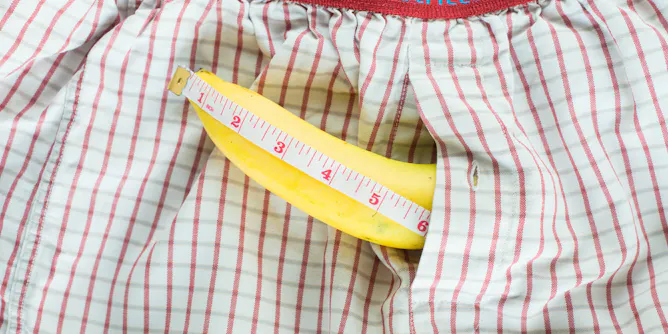
We have the penis of a monogamous primate yet our body sizes suggest our ancestors slept around a lot.
Articles on Human evolution
Displaying 181 - 200 of 237 articles

The way early humans learned to handle food could explain why the majority of people today are right handed.
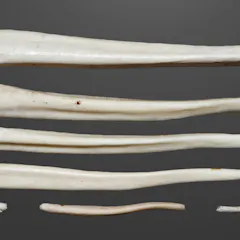
New research uncovers the role of the primate baculum and may explain why humans don’t have one.
Scientists have long believed that our distant cousins are the placoderms, and ancient group of armoured fish. But a new study is casting doubt on that view.

Realizing that others’ minds hold different thoughts, feelings and knowledge than your own was thought to be something only people could do. But evidence is accumulating that apes, too, have ‘theory of mind.’
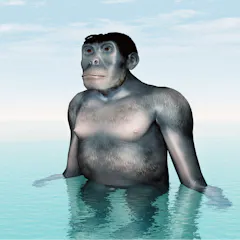
David Attenborough’s latest BBC documentary indulges wishful thinking over evidence.
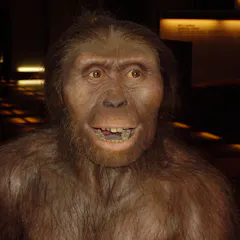
Why being human can’t be traced back to hunting, fire or any other single event.

The level of carbon dioxide in the atmosphere is rising faster than at any point in the past 55 million years.
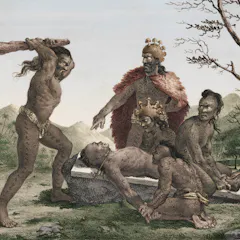
Human sacrifice seems horrifying and costly. But there might be a reason so many early human societies practiced it.
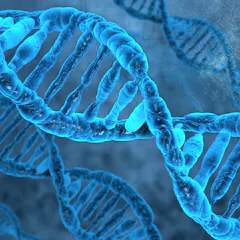
How has a retrovirus survived intact within the human genome for millennia, and how has it affected us?

New excavations at an Indonesian cave have pushed back the time the ‘hobbits’ disappeared to about 50,000 years ago.

It helps society function when people punish selfish acts, even at a personal cost. A new theory suggests third-party punishment also confers some benefits on the punisher.

For human groups to grow from small, intimate communities to the huge interconnected societies we know now, people needed to be willing to cooperate with strangers. Religion might have played a big role.

The discovery of the world’s oldest jewellery at the Blombos Cave in South Africa has resulted in a paradigm shift in our understanding of human evolution.
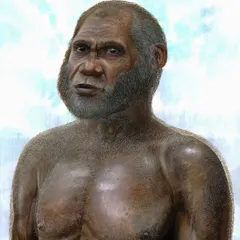
A new study is rewriting our understanding of archaic humans and how they may have interacted with early humans.

Author and ecologist Paul Ehrlich told Q&A that humans, on average, have associated with only about 150 other people for millions of years. Is that right?
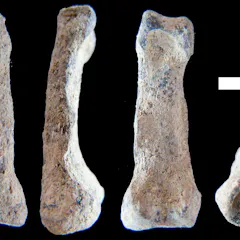
The discovery of the oldest modern human-like pinkie bone suggests that hands emerged very early in human evolution.

The science about our special senses - vision, smell, hearing and taste - offers fascinating and unique perspectives on our evolution. Yet it remains patchy; we know surprisingly little for example about…
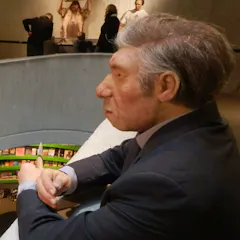
Ditching the testosterone meant humans were able to develop cooperative culture.
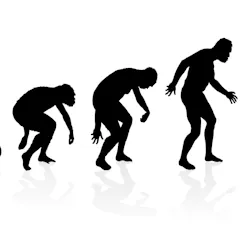
The challenge we face after a century of extraordinary discoveries is pinning down the lineage and mapping the evolutionary route through which we as human beings got here.
Top contributors
-

Honorary Associate Professor, UNSW
-
Professor of Earth System Science, UCL
-
Emeritus Strategic Professor in Palaeontology, Flinders University
-
Professor of Archaeology and Biological Anthropology, School of Social Science, The University of Queensland
-
Director, ARC Centre of Excellence for Australian Biodiversity and Heritage (CABAH), University of Wollongong
-
Associate Professor of Archaeology, Griffith University
-
Director, Australian Research Centre for Human Evolution, Griffith University
-
Professor in Geochronology and Geochemistry, Southern Cross University
-
Wood Jones Professor of Anthropological and Comparative Anatomy, Adelaide University
-
Postdoctoral fellow, Australian National University
-
Group Leader, Genomics and Bioinformatics, Australian Centre for Ancient DNA, Adelaide University
-
Senior Lecturer in Paleontology and Evolutionary Biology, Life Sciences at the University of Bath, University of Bath
-
Research Fellow in Biological Anthropology, Monash University
-
Jenny Graves is a Friend of The Conversation.
Distinguished Professor of Genetics and Vice Chancellor's Fellow, La Trobe University
-
Scientia Professor of Evolution, UNSW