
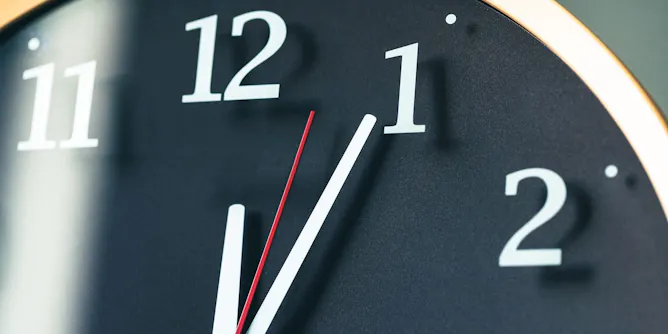
If you think about leap years, it may seem like humans have a very odd way of measuring time. Sometimes, timekeepers even have to add extra seconds to clocks.
Articles on History of science
Displaying 1 - 20 of 157 articles

Particle accelerators aren’t just for testing the Standard Model. They’re also used to diagnose and treat disease and study world history.

If science teachers embrace history as a lens for teaching complex accounts of science, we open possibilities for more socially relevant classrooms.

Thoreau’s work as a pioneering physical scientist is almost invisible in popular culture, according to a geologist and Thoreau historian.

The Trump administration fired the entire board that oversees the National Science Foundation, raising an age-old question about the separation of science and state.

When I talk about my anthropological fieldwork, many Americans are shocked to learn that “living on a nuclear test site” is even a logical statement.

Ancient thinkers struggled to tell facts from falsehoods just like we do – and their strategies are still relevant today.
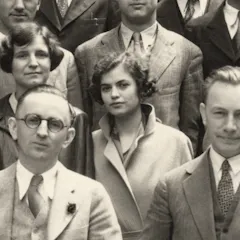
In the 1930s, this quantum mechanical pioneer faced obstacles that still confront women in physics today.

Science has always been part of a marketplace of ideas, where claims vie for audiences, resources and belief, and where power, persuasion and status shape which ideas are heard, trusted or forgotten.

Radio astronomy opened up the universe for scientists. They could map new elements across galaxies and also search for signals from extraterrestrial civilizations.
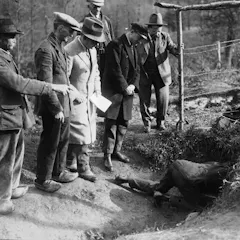
A century-old French archaeological scandal was sensationalized in the press at the time – but responsible scientists also relied on careful reporting to get the truth out.
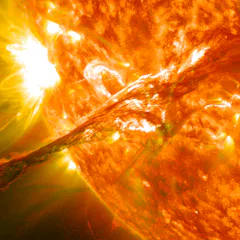
From communications outages to a brush with nuclear war, solar events like flares and coronal mass ejections have shaped human history.
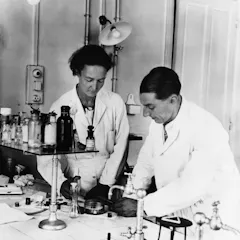
Marie Curie’s daughter Irene continued her family’s Nobel legacy by discovering artificial radioactivity.
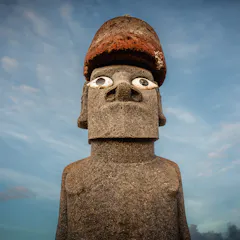
Cancer. Diabetes. Aging itself. Rapamycin’s potential to treat an array of diseases has been a source of scientific fascination. But many aren’t aware of its origins – and its complicated legacy.
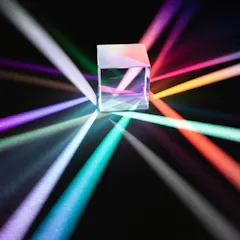
19th-century Irish physicist William Rowan Hamilton’s pioneering work contained hints of the enigmatic wave–particle duality that governs the universe.

Materials science might seem very technical, but as a scientific discipline, it has led to many shifts in society over the past few centuries.
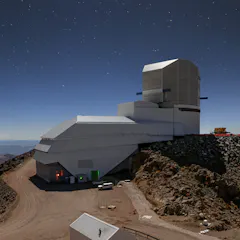
Vera C. Rubin’s research into stars in galaxies led to the modern understanding of dark matter.
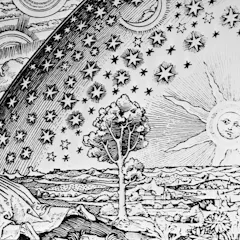
In the 19th century, astronomers could see Mars through telescopes, but not clearly. Some used their imaginations to fill in what the blurry images couldn’t convey.
The tools that feminist science studies have developed are critical to the sciences because they ask new questions, and develop new methodologies.

Today, people use complex computing networks to search for prime numbers with millions of digits. But early mathematicians were running these calculations by hand.
Top contributors
-

Chancellor's Professor of Medicine, Liberal Arts, and Philanthropy, Indiana University
-
Professor of Nuclear Physics, Michigan State University
-
Professor of Natural Philosophy in the Department of Physics, University of York
-
Associate Professor of Science, Technology and Society, Rochester Institute of Technology
-
Professeur émérite, chercheur en physique des particules, spécialiste des neutrinos, Université Paris Cité
-
Assistant Professor of Physics, Rutgers University - Newark
-
Associate Professor in Experimental Psychology (Perception), University of Oxford
-
Professor in Philosophy of Science, Durham University
-
Lecturer in South Asian History, University of Reading
-
Professor in High Medieval History, Durham University
-
Visiting Lecturer of History, Georgia State University
-
Distinguished Professor of Physics and Astronomy, Purdue University
-
Professor of Advanced Technology Transitions, Arizona State University
-
Professor of Science Communication and Chemistry, University of Hull
-
Timothy J. Jorgensen is a Friend of The Conversation.
Director of the Health Physics and Radiation Protection Graduate Program and Professor of Radiation Medicine, Georgetown University