
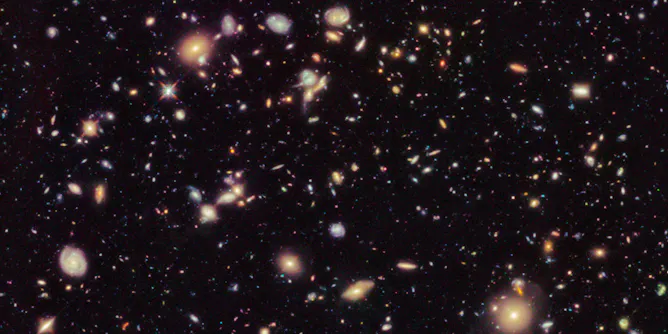
A new telescope aims to figure out what became of the universe’s original atoms once the first stars began to shine.
Articles on Galaxies
Displaying 121 - 137 of 137 articles
Hundreds of images of thousands of galaxies have given astronomers one of the most detailed galaxy studies ever compiled.
What’s particularly exciting about “first light” images from South Africa’s MeerKAT radio telescope is that they prove Africa is a rising star in the world of astronomy.
Galaxies are supposed to be the place where new stars are formed. So what causes some to stop this stellar production line?
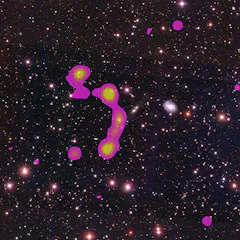
The find by citizen scientists of at least 40 galaxies in a cluster more than a billion light years away is the astronomical equivalent of finding a needle in a haystack.
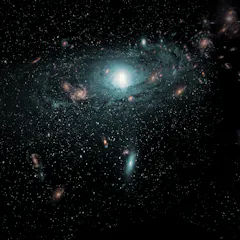
Something mysterious is pulling our Milky Way through space at a much faster rate than expected. So what could it be?
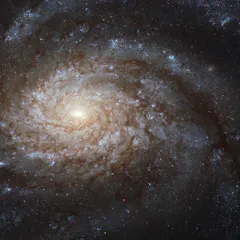
Extragalactic astrophysicists want to know how and why galaxies stop forming stars, change their shape and fade away. With help from citizen scientists, they’re figuring it out.
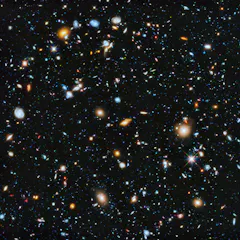
Telescopes are getting larger and larger as astronomers are hoping to get a good view of the most distant objects in space. But, it turns out, bigger isn’t always better.
CC BY-ND45.4 MB (download)
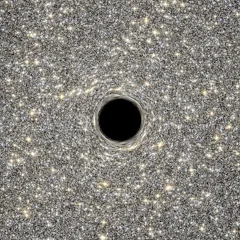
Tanya Hill speaks with Meg Urry about distant galaxies and the supermassive black holes that lurk in their centres.

A giant golden mirror is on the brink of opening up a glimpse of the very first galaxies to be formed.
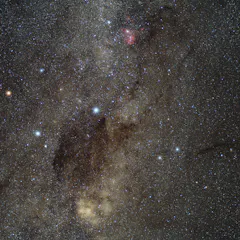
The next decade will be an exciting one for Australian astronomy, as we probe the heavens for answers to age old questions.

It’s National Science Week and this year the annual citizen science project run by ABC Science is astronomy-themed. No guesses for knowing that I’m excited about that! It’s also a nod to 2015 being the…
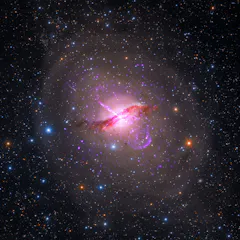
Dwarf galaxies are the most abundant galaxies in the universe yet little is known about how they behave, and the impact of larger neighbours.
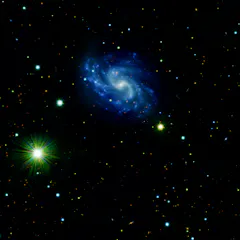
Our universe’s most exciting days are well behind us, with new research showing the universe is now slowly but surely dying.
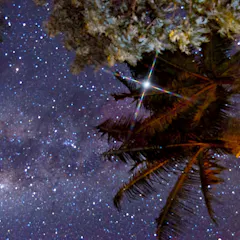
Astronomers can tell a whole lot more about a star or a galaxy if they break up the visible light in a rainbow of colours.
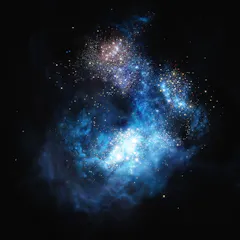
Astronomers have spotted the earliest known stars in the universe, belonging to a class of chemically pure stars that may never have been seen before.
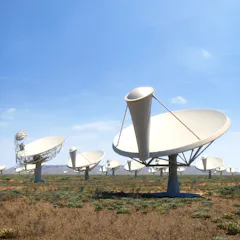
The Square Kilometre Array is the world’s largest telescope – what will it do and how does it work?
Top contributors
-

Associate Professor in Astronomy, Monash University
-
Professor of Astrophysics and Royal Society University Research Fellow, University of Hertfordshire
-
Senior Curator (Astronomy), Museums Victoria Research Institute; The University of Melbourne
-
Post-doctoral researcher in Astrophysics, University of the Western Cape
-
Honorary Fellow, Space and Astronomy, CSIRO; Western Sydney University
-
Senior research scientist, CSIRO
-
Associate Dean of Innovation and Engagement, Swinburne University of Technology
-
University Distinguished Professor of Astronomy, University of Arizona
-
Professor of Astronomy, Liverpool John Moores University
-
Professor and Director of the Centre of Excellence for Data Science, AI and Modelling, University of Hull
-
Professor (Astrophysics), University of Southern Queensland
-
ARC DECRA Fellow in Astronomy, University of Sydney
-
Professor, The University of Queensland
-
ARC DECRA Fellow in Astronomy, University of Sydney
-
SKA Postdoc in Observational Cosmology, University of the Western Cape