
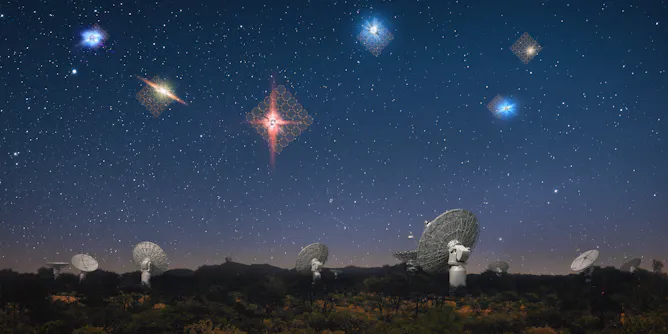
Perhaps precisely because they are so elusive, Fast Radio Bursts have received a lot of attention in the years since their discovery.
Articles on Galaxies
Displaying 101 - 120 of 137 articles
There are probably more than a million planets in the universe for every single grain of sand on Earth. That’s a lot of planets. My guess is that there probably is life elsewhere in the Universe.

We are in the Milky Way. If you travelled on an extremely fast spaceship for more than two million years, you would reach our neighbour, the Andromeda galaxy. All other galaxies are even further away.
Pretty much as soon as we understood what galaxies were, we realised they are all moving away from each other. And the ones that are further away are moving faster. In short, the universe is expanding.
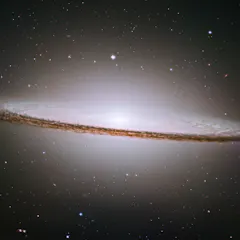
As galaxies get older they get rounder, and fall victim to the middle-aged spread that catches many of us humans here on Earth.

Bigger galaxies tend to dominate the smaller, when the two collide. But the pending battle between our Milky Way and the Andromeda galaxy might be a much fairer fight than we previously thought.
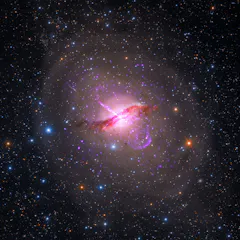
Strangely behaving galaxies force scientists to rethink whether the universe really is uniform.
Massive, far distant galaxies contain 100 times more gas than we thought possible.
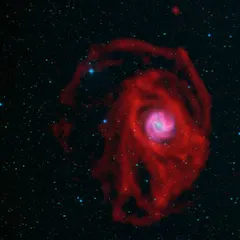
A precursor to the Square Kilometre Array- the MeerKAT telescope - is being built right now and remarkable progress has been made in the last 12 months.
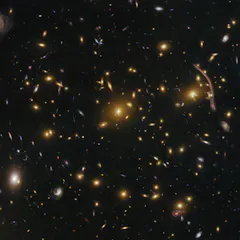
Galaxies evolve in mysterious way. But a new study offers a fresh approach to understand them.
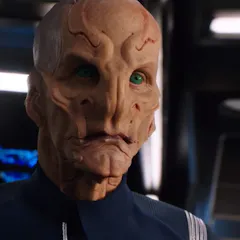
Star Trek: Discovery explores our corner of the block – just a fraction of the galaxy. Some stars are better candidates for intelligent alien life, and it may not be anything like we imagine.
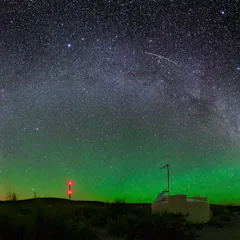
Scientists say they now know that high energy cosmic ray particles that bombard Earth are coming from outside our galaxy. But the actual source still remains a mystery.
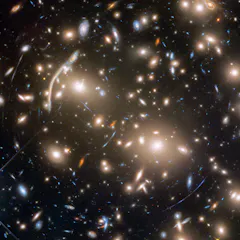
The first reliable measure of the 3D shape of galaxies and their rotation helps to shed light on their history.
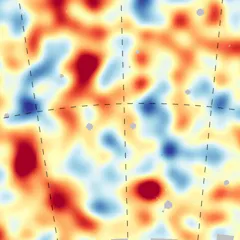
We still can’t see the dark matter thought to make up about a quarter of the universe, but at least now we have a map of its structure.

What caused the Big Bang is still a mystery. And that’s just one of the many unanswered questions, in spite of everything we do know about the birth of the Universe.
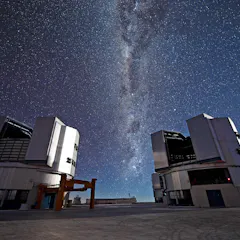
Australia’s new partnership with the European Southern Observatory will give our astronomers access to much bigger telescopes.
People used to think that when they looked up at the night sky, they were seeing all of space. Then American astronomer Edwin Hubble found out something so amazing, NASA named a telescope after him.

The recipe book for galaxy formation may need to be rewritten after the discovery of a massive galaxy that stopped making new stars early in the Universe’s history.
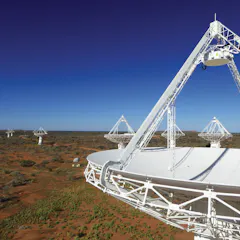
After months of running in test-mode, the Australian Square Kilometre Array Pathfinder telescope is now gathering data at an incredible rate to give us a new look at how our universe works.
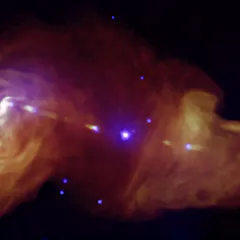
It’s difficult to get jets - powerful, lightning fast particles - to give up their secrets. The new Square Kilometre Array radio telescope could hold the key to solving jets’ mysteries.
Top contributors
-

Associate Professor in Astronomy, Monash University
-
Professor of Astrophysics and Royal Society University Research Fellow, University of Hertfordshire
-
Senior Curator (Astronomy), Museums Victoria Research Institute; The University of Melbourne
-
Post-doctoral researcher in Astrophysics, University of the Western Cape
-
Honorary Fellow, Space and Astronomy, CSIRO; Western Sydney University
-
Senior research scientist, CSIRO
-
Associate Dean of Innovation and Engagement, Swinburne University of Technology
-
University Distinguished Professor of Astronomy, University of Arizona
-
Professor of Astronomy, Liverpool John Moores University
-
Professor and Director of the Centre of Excellence for Data Science, AI and Modelling, University of Hull
-
Professor (Astrophysics), University of Southern Queensland
-
ARC DECRA Fellow in Astronomy, University of Sydney
-
Professor, The University of Queensland
-
ARC DECRA Fellow in Astronomy, University of Sydney
-
SKA Postdoc in Observational Cosmology, University of the Western Cape