
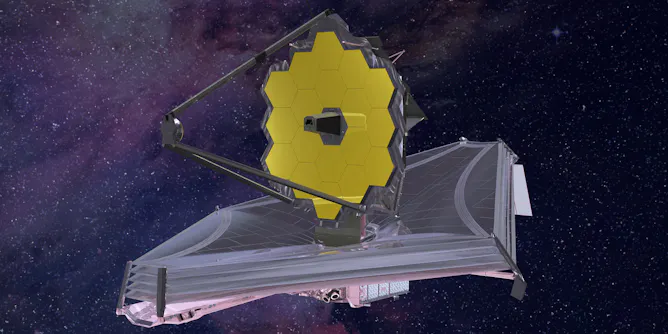
It will be a nail-biting wait as scientists launch and deploy the most complex observatory ever built.
Articles on Galaxies
Displaying 61 - 80 of 137 articles
Studying the extreme environment of the Virgo Cluster — which comprises thousands of galaxies — helps us learn what factors can affect and start or stop star formation.
We have to look back to the Big Bang to find out.
Tracing the cosmic origin of toothpaste, scientists got a glimpse into the surprising chemistry of early galaxies.
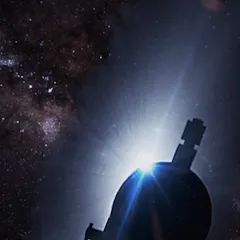
Such a mission could be developed soon, allowing astrophysicists to take selfies of the solar system and use the Sun’s gravity as a lens to peer deep into space.
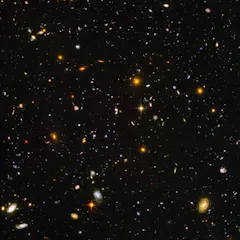
The James Webb Space Telescope is set to launch into orbit in December 2021. Its mission is to search for the first light to ever shine in the universe.
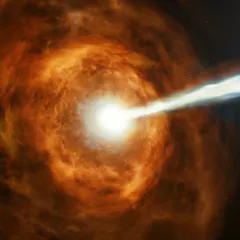
Did we observe the most distant gamma ray burst yet seen, or was it something closer to home?
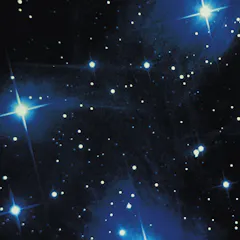
Scientists have a good estimate on the staggering number of stars in the universe.

Technology is allowing astronomers to study and analyse galaxies in far more detail than was previously possible.
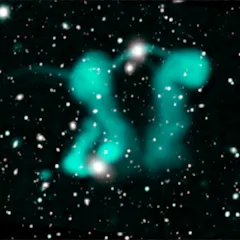
Australia’s ASKAP radio telescope probes the Universe more deeply than ever before, revealing unseen features of the cosmos.

Astronomers have taken a close-up look at the jets of plasma streaking away from a supermassive black hole - one of the strangest and most energetic features of galaxies.
Billions of galaxies are in the universe, with billions of stars in every galaxy. Could billions of planets be out there too?
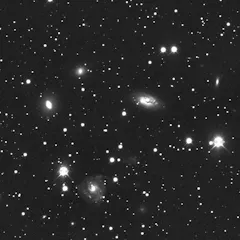
More than 60 images capturing huge expanses of sky are sent to us from Chile. Within them we can see thousands of bright spots. What do we find when we look closer?
Astronomers know a lot about what’s in outer space – and think it’s possible it never ends.
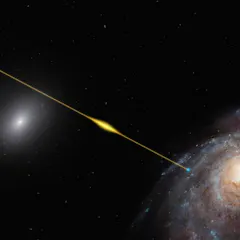
Fast radio bursts are the focus of a young and fascinating field of astronomy. Researchers just released data on more than 500 new bursts, quadrupling the total number of detected events.
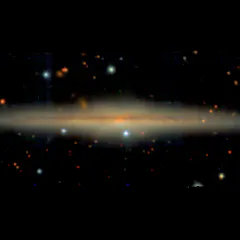
A galaxy 320 million light-years away has a surprisingly similar structure to the Milky Way, suggesting our galaxy isn’t as unique as it once seemed to astronomers.
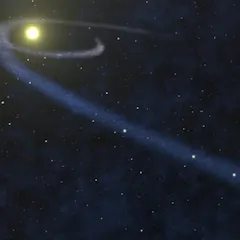
Thanks to the discovery of five twinkling galaxies in a rare alignment, astronomers have been able to calculate — for the first time — the properties and geometry of an invisible gas cloud in space.
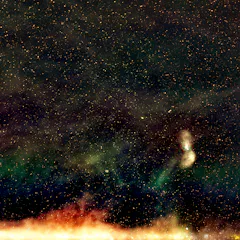
Some of the baby radio galaxies found may not be ‘babies’ at all. Rather, they may be ‘angsty teens’, rapidly growing into adults much faster than researchers had anticipated.
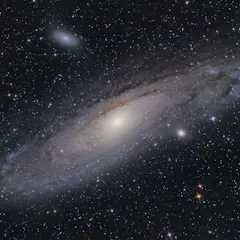
These results might lead us to revise our understanding of how galaxies stop forming their stars.
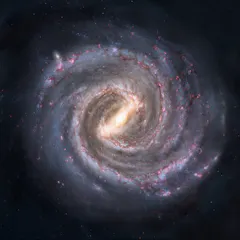
A new method suggests we should aim to detect dark matter haloes by tracing galactic gas.
Top contributors
-

Associate Professor in Astronomy, Monash University
-
Professor of Astrophysics and Royal Society University Research Fellow, University of Hertfordshire
-
Senior Curator (Astronomy), Museums Victoria Research Institute; The University of Melbourne
-
Post-doctoral researcher in Astrophysics, University of the Western Cape
-
Honorary Fellow, Space and Astronomy, CSIRO; Western Sydney University
-
Senior research scientist, CSIRO
-
Associate Dean of Innovation and Engagement, Swinburne University of Technology
-
University Distinguished Professor of Astronomy, University of Arizona
-
Professor of Astronomy, Liverpool John Moores University
-
Professor and Director of the Centre of Excellence for Data Science, AI and Modelling, University of Hull
-
Professor (Astrophysics), University of Southern Queensland
-
ARC DECRA Fellow in Astronomy, University of Sydney
-
Professor, The University of Queensland
-
ARC DECRA Fellow in Astronomy, University of Sydney
-
SKA Postdoc in Observational Cosmology, University of the Western Cape