
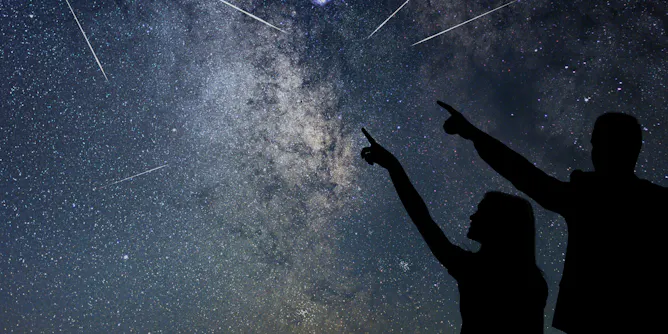
COVID-19 may have messed up school and shut down a lot of entertainment venues. But you can still brighten things up by doing a little stargazing at night, an astronomer says.
Articles on Galaxies
Displaying 81 - 100 of 137 articles
Dark energy is probably a sea of constant energy in empty space itself, according to new research.
Cosmologists had only been able to find half the matter that should exist in the universe. With the discovery of a new astronomical phenomenon and new telescopes, researchers just found the rest.
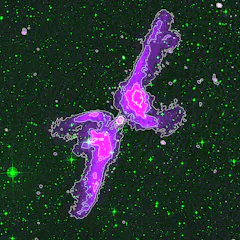
Like a cosmic butterfly in the sky, radio galaxy PKS 2014-55 was observed by CSIRO researchers with the Australian SKA Pathfinder telescope.
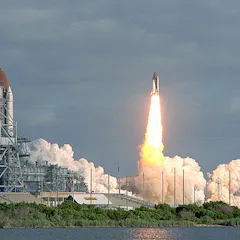
Thirty years ago the Hubble Space Telescope began snapping photos of distant stars, providing a time machine that has taken astronomers back to when the universe was less than a billion years old.

New research using the Hubble Space Telescope reveals that galaxies may be forming at faster rates than previously believed.
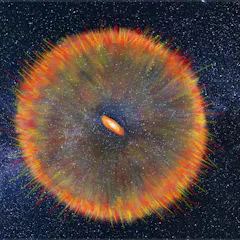
This observation means astronomers can now develop and test theories that explain how high-mass stars gain their mass.
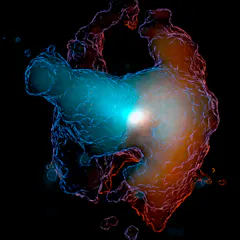
New research shows how chemical elements mix in the universe. Without this process, you wouldn’t be here.
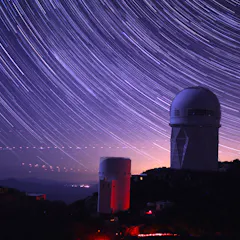
Will we have to rewrite Einstein’s theory of gravity? The DESI experiment could find out.
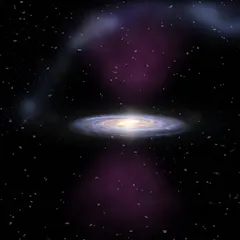
New research shows the supermassive black hole at the centre of the Milky Way spat out an enormous beam of radiation 3.5 million years ago
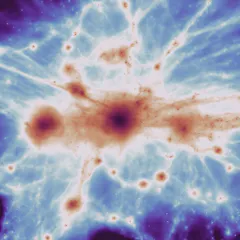
Maps of the long filaments of gas that hold the universe together may one day help us trace and unveil ‘dark matter’.
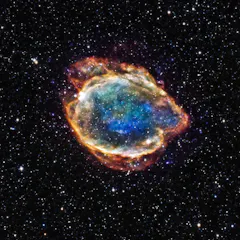
The rate of the universe’s expansion is in dispute. But a new kind of measurement offers hope.
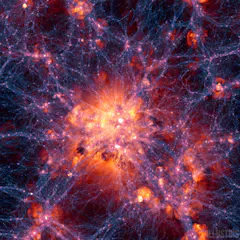
Why do astronomers believe there’s dark matter when it cannot be directly detected? Let’s look at the evidence, and see what dark matter’s presence means for our universe.
The diameter of the Milky Way is a billion billion kilometres.
The Milky Way’s disc of stars becomes increasingly warped and twisted the further away they are from the galaxy’s centre.
New research suggests we may be able to forget about dark matter if we tweak the laws of gravity according to imaginary bubbles in space.
Life could exist in another solar system in a different part our galaxy. Or in another galaxy far away. We don’t have the perfect technology yet to study such far away places but we’re still trying.
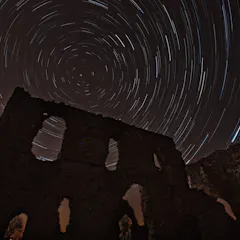
When you look up at the vastness of space you can see hundreds, thousands and even millions of years into the past.
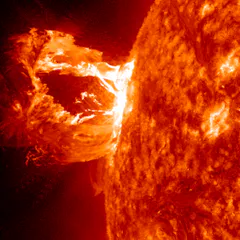
At the end of the day, the problem is that no-one on Earth wants nuclear waste stored near them, and it’s not safe or cost-effective to blast it into space.
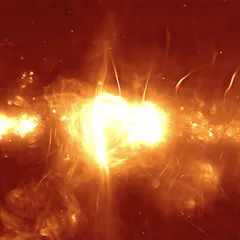
A black hole is an object with such a strong gravitational pull that nothing, not even light, can escape from it.
Top contributors
-

Associate Professor in Astronomy, Monash University
-
Professor of Astrophysics and Royal Society University Research Fellow, University of Hertfordshire
-
Senior Curator (Astronomy), Museums Victoria Research Institute; The University of Melbourne
-
Post-doctoral researcher in Astrophysics, University of the Western Cape
-
Honorary Fellow, Space and Astronomy, CSIRO; Western Sydney University
-
Senior research scientist, CSIRO
-
Associate Dean of Innovation and Engagement, Swinburne University of Technology
-
University Distinguished Professor of Astronomy, University of Arizona
-
Professor of Astronomy, Liverpool John Moores University
-
Professor and Director of the Centre of Excellence for Data Science, AI and Modelling, University of Hull
-
Professor (Astrophysics), University of Southern Queensland
-
ARC DECRA Fellow in Astronomy, University of Sydney
-
Professor, The University of Queensland
-
ARC DECRA Fellow in Astronomy, University of Sydney
-
SKA Postdoc in Observational Cosmology, University of the Western Cape