
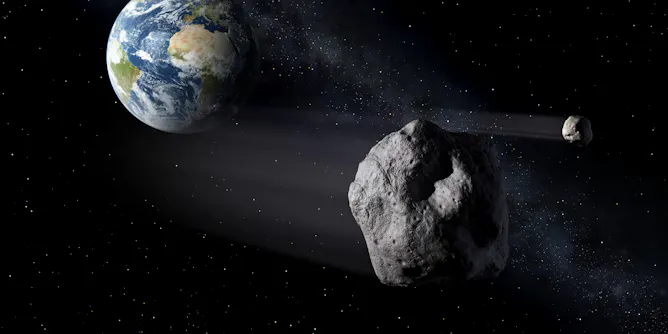
In mid-February, asteroid 2024 YR4 was spotted and originally believed to have a 3.1 per cent of hitting Earth in 2032. Further calculations revealed this was not the case.
Articles on Earth
Displaying 41 - 60 of 242 articles
At the very beginning of its history, Earth was dry. How did it become a blue planet? A new theory could provide an answer.
A rocket needs to overcome the force of gravity to leave Earth behind.
The dinosaurs went extinct on Christmas Day.
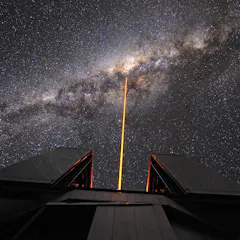
The discovery helps explain a long-running cosmic mystery about why some stars hurtle through space much faster than others.
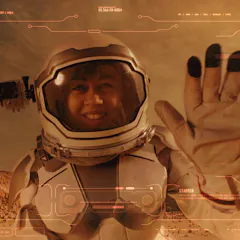
Could humans expand out beyond their homeworld and establish settlements on the planet Mars? The idea of settling the red planet has been around for decades. However, it has been seen by sceptics as a…
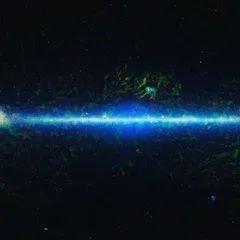
Once the Wide-field Infrared Survey Explorer couldn’t survey widely anymore, NASA scientists switched gears and began using the spacecraft for planetary defense.
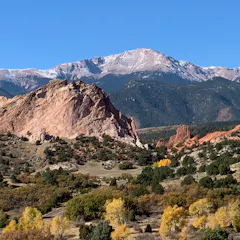
Geologists found evidence in the way enigmatic sandstones called Tava formed in the Rocky Mountains hundreds of millions of years ago.
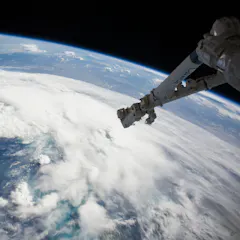
It’s all about perspective: The higher you go, the more you can see the curve.
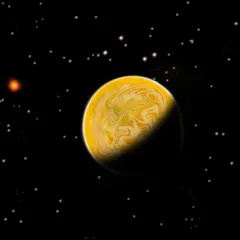
Astronomers have detected possible signs of gases released by volcanic activity.

Comet Tsuchinshan-ATLAS is one of 2 comets from the Oort Cloud passing by Earth in October 2024.
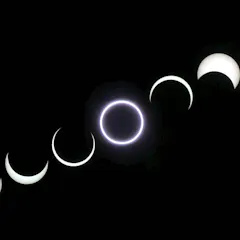
Argentina and Chile will see the ‘ring’, but other regions will see a partial eclipse.
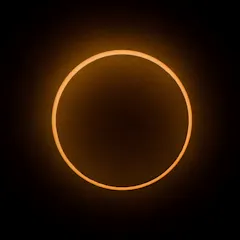
Parts of South America, the Pacific and Antarctica are under the path of an annular eclipse.
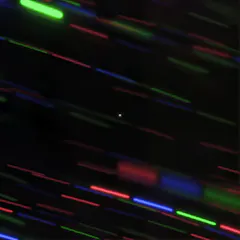
A large space rock will be temporarily captured by Earth’s gravity throughout October and November.
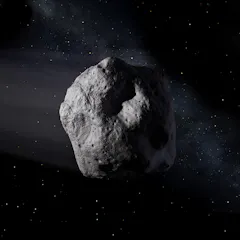
This month, they spotted just the ninth asteroid to be detected before impact with Earth.
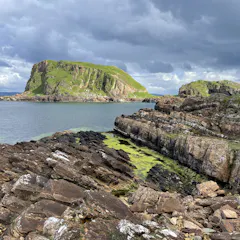
The islands’ rocks record the first stage of a huge freeze that would eventually cover the Earth in ice.
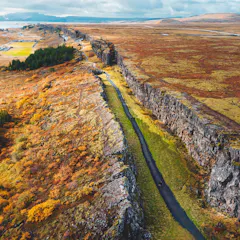
The first time Earth’s geologic record – information found inside rocks – has been used to create an animation of this kind.
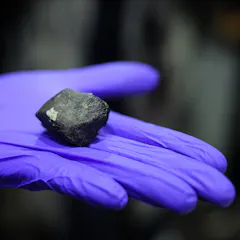
Meteorites contain a wealth of information about the origins of our solar system, helping us to understand their, and even Earth’s, origin and evolution.

The SpaceX-backed mission has no professional astronauts aboard.
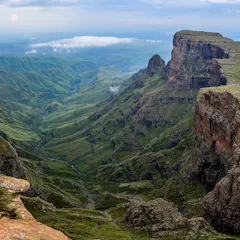
Motion deep in the Earth called a mantle wave can lift up the toughest parts of our planet.
Top contributors
-

Postdoctoral research associate, University of Oxford
-
Professor (Astrophysics), University of Southern Queensland
-
Senior Lecturer in Physics, Nottingham Trent University
-
Teaching Professor of Astronomy & Astrophysics, Penn State
-
Professor of History, University of Lancashire
-
Associate Dean of Innovation and Engagement, Swinburne University of Technology
-
Associate Professor of Earth and Planetary Sciences, University of Tennessee
-
Associate Professor in Archaeology and Space Studies, Flinders University
-
Cosmochimiste, chargée de recherche CNRS au Centre de Recherches Pétrographiques et Géochimiques (CRPG) de Nancy, CNRS, Université de Lorraine
-
PhD Candidate, University of Southern Queensland
-
Associate Professor, School of Physics, The University of Melbourne
-
Professor of Geophysics, University of Rochester
-
Professor of Astronomy, Vanderbilt University
-
Imperial College Research Fellow, Imperial College London
-
Postdoctoral Research Associate, Department of Geoscience, University of Wisconsin-Madison