

Fitness trackers often privilege steps over strength, rest and context, which can leave some users with a distorted view of health.
Articles on 10,000 steps
Displaying 1 - 20 of 22 articles
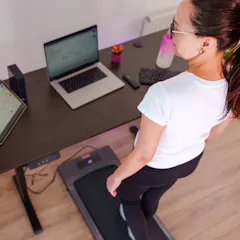
Yes, there is evidence changing your desk set up can help with fat loss, improving cholesterol, blood pressure and metabolism. But try this before you buy.
People hitting 7,000 daily steps had a 47% lower risk of dying prematurely than those managing just 2,000 steps.

While the figure of 10,000 steps a day has become a popular benchmark, new research finds we might not need to take quite so many strides to cut our chances of an early death.

A new study finds huge benefit in taking just 7,000 steps a day. Which may come as a relief to those who never quite make it to 10,000.

Connecting health apps to health care can enable better care for patients with chronic diseases, and it has the potential to lower skyrocketing US health spending.

But more intense exercises – such as weightlifting – are still important for health and fitness.

Even half the amount of steps shows health benefits.

You might feel you’ve failed after ‘only’ recording 9,000 steps when your goal was 10,000. In reality, 9,000 steps might be an achievement. Is it time to ditch specific goals in favour of open goals?

We’ve got 6 tips and a tailored exercise program to help you keep active at home during the coronavirus pandemic.

Moving daily is essential to keeping ourselves healthy.

Many of us are programmed to aim for 10,000 steps a day. This target is not right for everyone – but we can all benefit from setting step goals to increase our activity.

All Australians aged 13-17 are encouraged to do 60 minutes of physical activity a day.

An ultra-marathon runner and exercise physiologist describes what it’s like to take part in an ultra-endurance event, and the consequences it had on his body.

A new study has found breaking old and forming new habits is key in keeping weight off.

If you sit all day at work, then cancer, diabetes, heart disease and death are the likely outcomes. A cardiologist explains how the simple act of counting can reverse this evolutionary trend.

Walking has been proven to reduce the risk of heart disease, bowel and breast cancers, osteoporosis and diabetes. New data shows it also reduces the need for hospital care.

Monday – start diet. Tuesday – break diet! Wednesday – plan to start again next Monday. Sound familiar?

The US Surgeon General last week issued another call to action to get his nation walking. Faced with the fact that 50% of the US adult population (a statistic replicated in other western countries) suffers…

Fitness devices like Fitbit set an automatic goal of 10,000 steps a day. But this isn’t the magic threshold some make it out to be.
Top contributors
-

Laureate Professor in Nutrition and Dietetics, University of Newcastle
-
Reader in Exercise and Health Physiology, University of Hertfordshire
-
Lecturer in Health Pedagogy, University of Tasmania
-
Research associate, University of California, Los Angeles
-
Director of UWA Centre for Software Practice, The University of Western Australia
-
Associate Professor of Digital Health, Monash University
-
Associate Professor of Medicine and Senior Scientist, Toronto Rehabilitation Institute, University of Toronto
-
Group Leader, Baker Heart and Diabetes Institute
-
Wendy Brown is a Friend of The Conversation.
Professor of Human Movement Studies, The University of Queensland
-
Reader in Clinical Exercise Physiology, Liverpool John Moores University; University of Liverpool
-
Research Fellow, Iverson Health Innovation Research Institute, Swinburne University of Technology
-
Professorial Research Fellow: Physical Activity and Health, CQUniversity Australia
-
Research Associate, School of Sports Science, Exercise and Health, The University of Western Australia
-
Professor of Supply Chain and Business Analytics, Binghamton University, State University of New York
-
Senior Lecturer in Personal Devlopment, Health and Physical Education, University of New England