

Over the past 12 months, the federal government has approved multiple fossil fuel projects and cut climate science funding.
Articles on Science funding
Displaying 1 - 20 of 163 articles
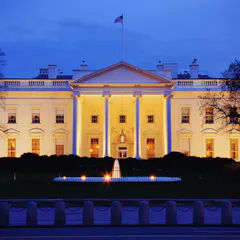
A new White House science strategy, laid out in a report titled Science: A New Golden Age, challenges an 80-year-old model that made the US the global scientific leader.

Beyond deprioritizing scientific merit, the Trump administration’s proposal also restricts researchers’ ability to share their findings and collaborate with each other.

If we want to be reminded what real damage to a science system looks like, we only need to glance across the Atlantic.
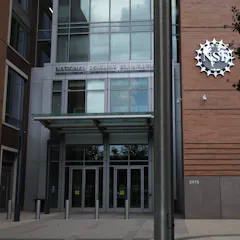
As the National Science Foundation starts giving out fewer grants, people worldwide will potentially lose out from potential research findings that could help improve their lives.

What do US researchers make of all the Trump administration science-related policy changes? A survey of 280 academic scientists asked them.

Scientific innovation has been driving US economic growth for decades. Losing that edge means losing access to the technologies and brainpower that come with it.

When the Trump administration took aim at higher education and the scientific research enterprise, a university dean had to figure out on the fly how to support scientists and their work at his school.
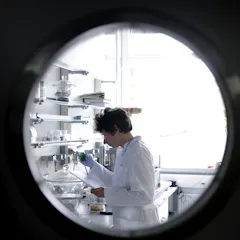
US science lost a great deal in 2025, including tens of billions of dollars of federal funding, entire research agencies and programs, and a generation of researchers.
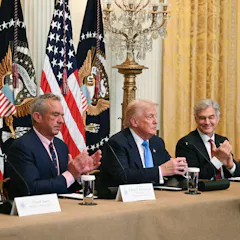
The Trump administration is rewriting the 80-year-old American social contract for science research.

The federal government is more likely to fund curiosity-driven basic research, while industry is more likely to support research that has a clearer eventual payoff.

As the US cuts science funding and international cooperation, Australia and other countries see a chance to capitalise on this American brain drain.
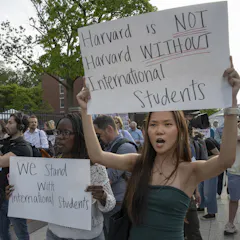
Many of the world’s best and brightest STEM researchers have long moved to the US. But now that brain gain is at risk of reversing to become a brain drain, with science funding and visas in chaos.

A scholar reveals the ins and outs of how research gets funded, including the checks and balances that ensure high scientific standards and financial integrity at every stage of a grant’s lifecycle.
New Zealand trails far behind other wealthy countries in research funding and strategy. This inhibits the innovation that could drive a more productive economy.
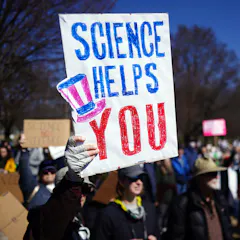
Stories from the front line of the US government’s attack on federal science funding. Listen to The Conversation Weekly podcast.
Since 1971, the US has led the world in funding cancer research and developing new treatments that have driven down death rates. This may soon no longer be the case.

The National Institutes of Health has been integral to scientific progress in treating countless human diseases. Without its support, patients will ultimately pay the price.

From HIV treatments to school desegregation, research into topics now considered DEIA have benefited Americans throughout history.

The jury’s out on whether the US is still at the top of global science. Proposed cuts to major agencies could mean completely ceding that title.
Top contributors
-

Secretary for Science Policy at the Australian Academy of Science, and Senior Deputy Vice-Chancellor, UNSW
-
Chair, The Conversation Media Group
-
Laureate Professor of Mathematics, University of Newcastle
-
Senior Lecturer, Australian National Centre for the Public Awareness of Science, Australian National University
-
Adjunct Professor, University of Sydney
-
Associate Professor (hon) at the Centre for Public Awareness of Science, Australian National University
-
Distinguished Professor, Australian National University
-
University Distinguished Professor of Astronomy, University of Arizona
-
Senior Research Associate in Health Services Research, UCL
-
Emeritus professor, Australian National University
-
Professor and Deputy Vice-Chancellor (Research), University of Sydney
-
Lecturer in Science and Technology Policy, University of Manchester
-
Professor of Experimental Physics and Master of Churchill College, University of Cambridge
-
Research Scientist, The University of Queensland
-
Professor of Innovation, Science and Technology Policy, The University of Melbourne