

AI fluency implies a deep and critical understanding of emerging AI concepts and applications to equip students to innovate and create alongside AI systems.
Articles on post-secondary study
Displaying all articles

Even when grades rise, we shouldn’t assume that every rise is unearned or indefensible. The full picture is messier than that.

A transactional approach to including international students risks Canadians never getting to know the people who come to study with their full and complex lives.

Urban and regional music scenes that anchor and enliven communities don’t simply survive on talent; they depend on the institutions and infrastructure that sustain them.

Failure in higher education can be a powerful teacher, but only when students have the support, time and agency to process it.

Ensuring higher education remains a space for ethical decision-making means incorporating at least five principles into forms of assessment.
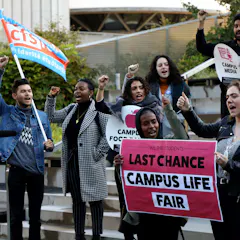
Possible changes around university admissions and student fees catalyzed by Ontario’s Bill 33 will depend on how universities interpret the rules and whether they make equity a clear policy priority.

AI has generated enormous challenges in post-secondary education. It also offers potential for citizenship education, if handled properly.

Former youth in care deserve equitable educational opportunities. Better longitudinal data is needed around how youth and adults successfully transition to and complete post-secondary education.

A course exemplifies one way group collaboration to address the climate crisis can begin: with each person identifying key moments in their engagement, and contributing this to a larger ‘river’ model.

Who belongs at university? Fostering connections between a downtown campus and families facing social, cultural and economic barriers can begin early with literacy and community-building programs.

International students frequently face challenges finding suitable places to live. Instead of blaming them, the government should be helping them.

Globally, mothers’ educational status has a greater influence over the level of education their children attain today than was the case for people born mid-century.

All instructors, regardless of the field, can promote mental health both by sharing specific resources and by designing accessible and flexible courses.

Ontario’s changed university funding formula, which forces institutions to rely on high student tuition for niche programs, is putting some northern institutions in precarious financial situations.

A national framework to address and prevent sexual and gender-based violence at post-secondary institutions includes a tool to guide responses to victims, alleged perpetrators and the community.

Understanding complex and contextual differences in grading across cultures and countries is important. Only in doing so can we interpret student achievement based on grades in a fair and valid way.

Educators need to carefully consider ChatGPT and issues of academic integrity to move toward an assessment system that leverages AI tools.
Top contributors
-

Associate Dean, School of Graduate Studies & Professor, Faculty of Education, Queen's University, Ontario
-
Professor, School of Gender, Sexuality and Women's Studies, York University, Canada
-
Deputy Vice-Chancellor, Education, Murdoch University; Professor of Measurement, Assessment and Evaluation, Murdoch University
-
Professor, Department of Psychology, MacEwan University
-
Assistant Professor, Frazer Faculty of Education, Ontario Tech University
-
Associate Professor in Sociology, UCL
-
Associate Professor, Teaching; School of Public Health and Social Policy, University of Victoria
-
Professor and Director of Assessment and Evaluation Group, Queen's University, Ontario
-
Associate Professor of Social Work, Associate Member, Interdisciplinary Studies, Faculty of Liberal Arts and Professional Studies, York University, Canada
-
Associate Professor of Sociology, University of British Columbia
-
Visiting professor, Harvard University
-
Associate Professor, School of Interdisciplinary Science, McMaster University
-
Doctoral candidate, Higher Education Leadership, Western University
-
Assistant Professor, Faculty of Education, Simon Fraser University
-
Psychologist and Faculty Member, Toronto Metropolitan University