
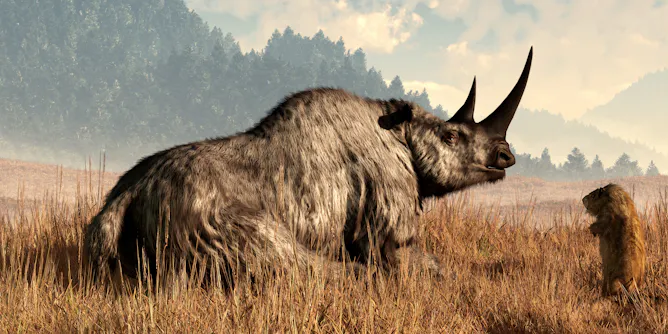
Many huge animals went extinct surprisingly recently. When they died, their ecological role was lost with them.
Articles on Pleistocene era
Displaying all articles

Researchers reexamining fossils identified telltale marks made by human ancestors cutting meat from bones. The discovery pushes back the date hominins started living in Europe by 200,000 years.
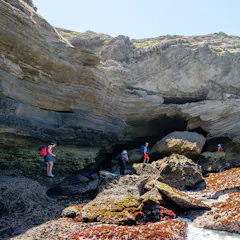
South Africa is home to some remarkable geoheritage.

The scarcity of bat fossils is more than a palaeontological puzzle: it has implications for bat conservation strategies today.

Ancient microbes likely produced natural products their descendants today do not. Tapping into this lost chemical diversity could offer a potential source of new drugs.

Human tracks registered in aeolianites - cemented dune surfaces - are rare at a global level.
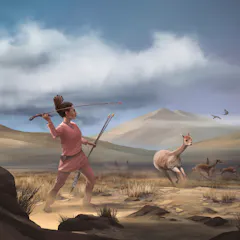
New research is challenging the hypothesis that men did the hunting in prehistoric societies.
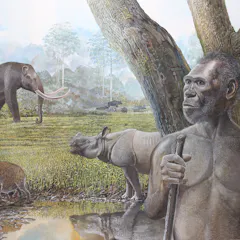
Several theories have suggested either humans, climate change or both drove megafauna extinctions in Southeast Asia. Our newest work suggests otherwise.

While crocodylian fossil swim traces have been described from other continents, to the best of our knowledge the examples we describe are the first such reptilian swim traces from Africa.
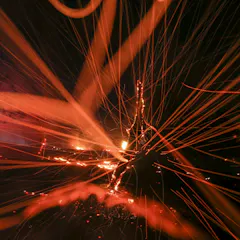
The Earth may be entering an era in which natural and human-generated fire together are reshaping the planet.
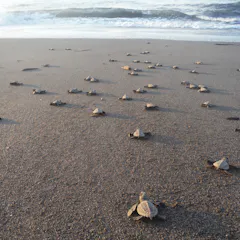
These trackways preserve an incredibly brief moment in time. More importantly, they tell us about ancient climates, and how turtle breeding ranges have changed over the millenia
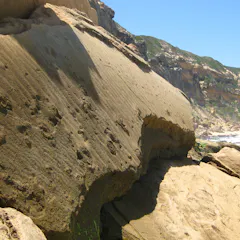
Trackways made by vertebrates during the Pleistocene era, dating back to between 36 000 and 140 000 years helps with research into ancient animals.
Top contributors
-

Research Associate, African Centre for Coastal Palaeoscience, Nelson Mandela University
-
Professor of Geology, University of Colorado Denver
-
Professor of Bioorganic Chemistry and Paleobiotechnology, Friedrich-Schiller-Universität Jena
-
Research Group Leader, Max Planck Institute of Geoanthropology
-
Biodiversity Coordinator, Wilderness, University of the Witwatersrand
-
Honorary Research Fellow, UCL
-
Postdoctoral Researcher in Archaeogenetics, Max Planck Institute for Evolutionary Anthropology
-
Associate Professor of Anthropology, Harvard University
-
Emeritus Professor of Life Sciences, Arizona State University
-
Research Scientist and Museum Educator, Smithsonian Institution
-
Associate Professor of Anthropology, Ohio University
-
Senior Scientist at the Emil Racoviță Institute of Speleology, Academia Română
-
Professor, Palaeontology, Griffith University
-
Professor of Zoology and Joint Head of Department of Biology, University of Oxford