
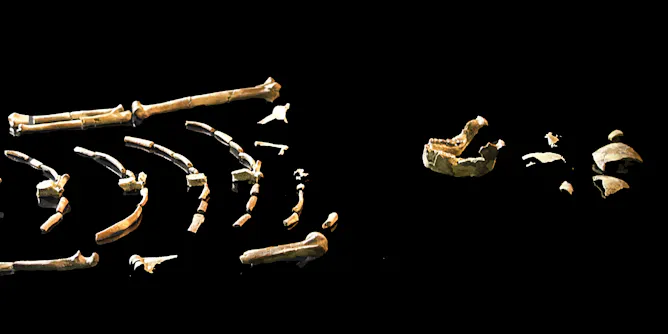
More than any other ancient relative, Lucy has challenged us to think deeply about what it means to be human.
Articles on African fossils
Displaying all articles

The discovery points to a long evolutionary history in north Africa, much earlier than modern Homo sapiens.
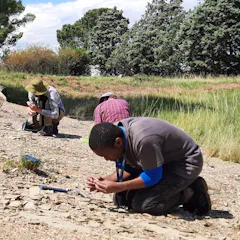
New insect treasures are almost certainly just waiting to be found by future palaeonentomologists.

The scarcity of bat fossils is more than a palaeontological puzzle: it has implications for bat conservation strategies today.
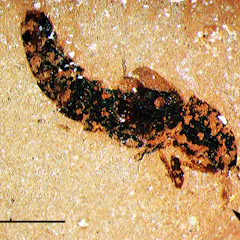
This is one of the first fossil rove beetles ever discovered on the continent and in the southern hemisphere more broadly.

The sculpture might have begun with tracing a blue stingray specimen in the sand.
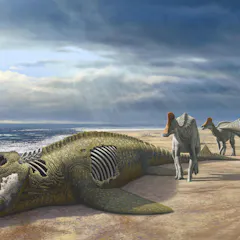
Oceanic dispersal of dinosaurs between Europe and Africa shows how low-probability, high-impact events drive evolution.
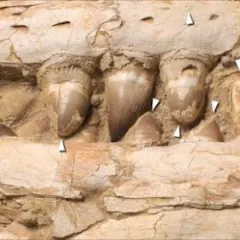
Fossils of a giant killer mosasaur have been discovered, alongside the fossilised remains of its prey.

While crocodylian fossil swim traces have been described from other continents, to the best of our knowledge the examples we describe are the first such reptilian swim traces from Africa.
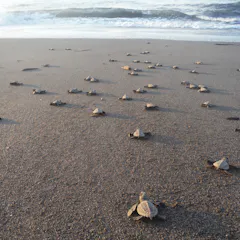
These trackways preserve an incredibly brief moment in time. More importantly, they tell us about ancient climates, and how turtle breeding ranges have changed over the millenia
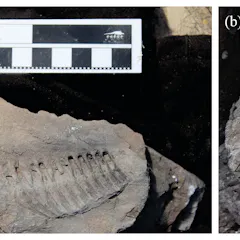
Geomythology can be a powerful way to inspire more people on the continent to become interested in Africa’s palaeoscience.
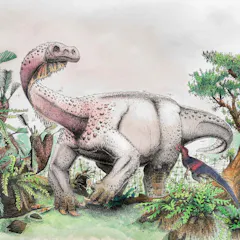
Five major finds this year adds to our understanding of evolution and ancient life history.

South Africa’s fossils can step out of the shadows of being undated and undateable.

Palaeontological finds offer a compelling and profound way to think about our place in nature.
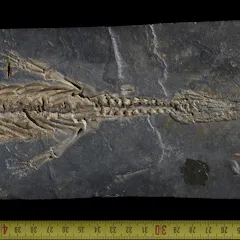
Ancient indigenous people often collected fossil shells, teeth and bones that have provided critical clues about human origins.
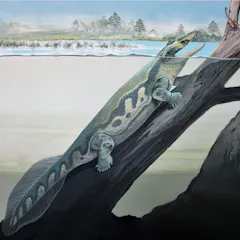
The discovery of two separate fossils tetrapod species proves that they lived all over the world by the end of Devonian.

A study has found that a local event rather than a global shift in climate caused the mass extinction in South Africa.
Plants, in their fossil forms, can reveal a great deal about past environments and climates.
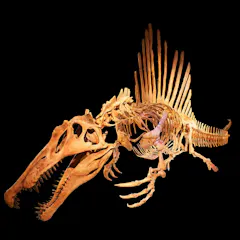
You might recognise Spinosaurus, from Jurassic Park 3, but did you realise it is 100% an African dinosaur?
Top contributors
-

Research Associate, African Centre for Coastal Palaeoscience, Nelson Mandela University
-
Biodiversity Coordinator, Wilderness, University of the Witwatersrand
-
Associate professor in Vertebrate Palaeontology, University of the Witwatersrand
-
Senior Lecturer
-
Senior Lecturer in Paleontology and Evolutionary Biology, Life Sciences at the University of Bath, University of Bath
-
Professor of Geology, University of Colorado Denver
-
Emeritus Chief Scientist, NRF-SAIAB, National Research Foundation
-
Postdoctoral researcher, Analytical, Environmental and Geo- Chemistry, Vrije Universiteit Brussel
-
Chercheur en Préhistoire et conservateur principal des Monuments et Sites, Institut national des Sciences de l'Archéologie et du Patrimoine in Rabat
-
Honorary Professor, Department of Genetics, Evolution and Environment, UCL; Natural History Museum Abu Dhabi
-
Associate professor, University of Cape Town
-
Professor of Earth System Science, UCL
-
PhD student, Botany, Rhodes University
-
Palaeontologist, Rhodes University
-
Palaeontologist, Albany Museum (supported by the Millennium Trust and the DSI-NRF Centre of Excellence in Palaeosciences, the NRF and the NSCF), Rhodes University