
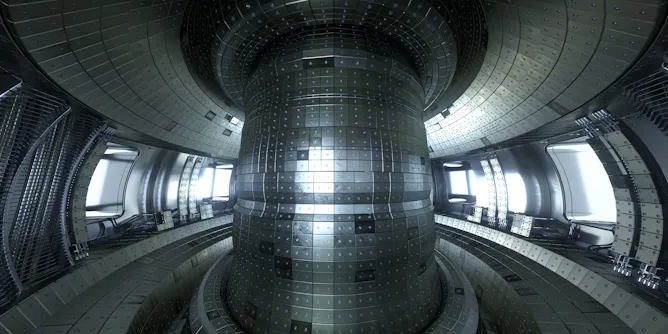
Nuclear fusion may power post-carbon societies – but it won’t save us from climate change.
Articles on Physics
Displaying 341 - 360 of 592 articles

High speeds, the threat of dangerous crashes, the excitement of the crowd – and the laws of physics on full display. A physicist explains the science of NASCAR.

Recent changes to the ball seem to be juicing hitters’ stats. But could other factors, like the climate and advanced analytics, also be playing a role?
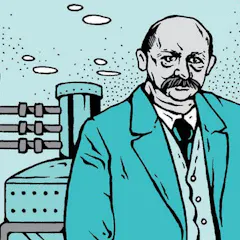
How was superconductivity discovered? It all began in April 1911, in a Dutch laboratory…
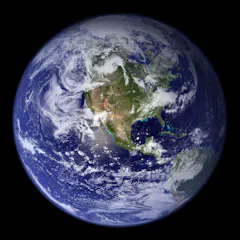
All the buildings and the cars and the restaurants, and the phones and even everything that’s inside of you… it all started with an exploding star, billions of years ago.

Even fridge magnets have magnetic fields approximately 200 times stronger than Earth’s.

A physicist reflects on the show’s made-up Nobel Prize-winning theory of ‘super asymmetry’ along with how the series showcased authentic science and role models for future STEM students.
Most people are familiar with lasers. But what about a laser made with sound rather than light? A couple of physicists have now created one that they plan to use for measuring imperceivable forces.
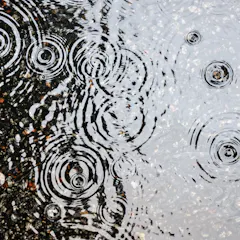
Why does the impact of rain in a puddle look different from when it falls elsewhere, like in a lake or the ocean? A ‘puddle equation’ dives deep into the secret math of ripples.
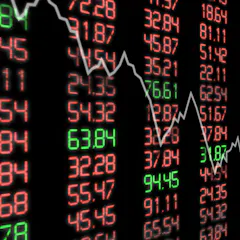
Thanks to new trading technology, sudden steep falls may become more common. A new program uses the principles of fluid dynamics to try to predict crashes before they happen.
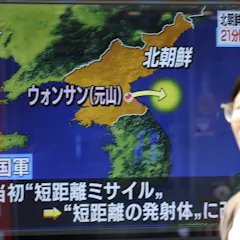
North Korea is a major military threat to the US and its Asian allies, but exactly how powerful are its nuclear weapons? An earth scientist explains why it’s hard to answer this question.
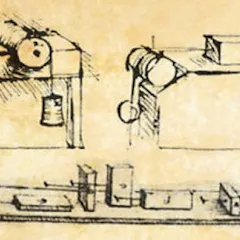
Once called ‘the most important subject no one has heard of’, tribology is now a key part of the fourth industrial revolution.
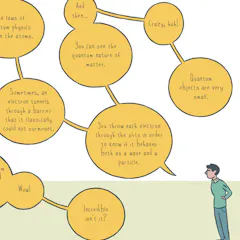
Quantum physics and its mysteries… And what if this supposedly incomprehensible science weren’t so difficult for non-scientists to understand?
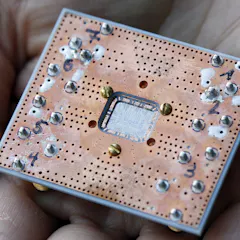
Computers were once considered high-end technology, only accessible to scientists and trained professionals. Today, almost everyone has one. Will quantum computing follow the same path?

Things get weird at the quantum level and now we know they can happen really fast when a particle pushes through an almost insurmountable barrier.
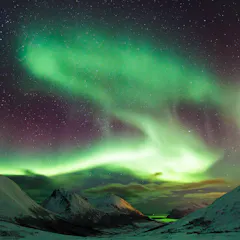
The northern lights might look like magic, but they can actually be explained by science – here’s how.
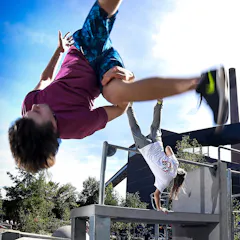
Run, leap, scramble…it’s parkour! Science can help you run up walls more efficiently, and chose the best way to land from a height.
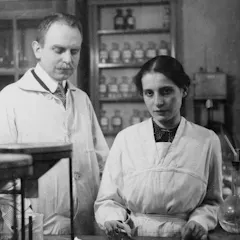
Left off publications due to Nazi prejudice, this Jewish woman lost her rightful place in the scientific pantheon as the discoverer of nuclear fission.
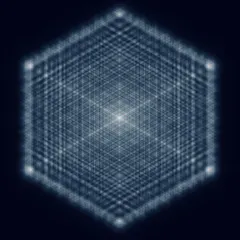
Nature can produce fractals, computers can, too. Could light be a fractal? The answer is yes.

At this year’s Australian Open you’ll see players moving sideways on the Plexicushion surface – which is specially designed to allow players to slide. It’s safer for the players and fun to watch.
Top contributors
-

Professor, Philosophy of Science, The University of Melbourne
-
Professor of Nuclear Physics, Michigan State University
-
University Distinguished Professor of Astronomy, University of Arizona
-
Professor of Engineering Practice, Purdue University
-
Post Doctoral Research Associate, Centre for the Subatomic Structure of Matter, Adelaide University
-
Physicien, Professeur des Universités, Université Paris-Saclay
-
Professor of Astrophysics, University of Sydney
-
Emeritus Professor, ARC Centre of Excellence for Gravitational Wave Discovery, OzGrav, The University of Western Australia
-
Principal Lecturer of Physics and Astronomy, Clemson University
-
Professor of Physics, Penn State
-
Lecturer, The University of Queensland
-
Senior Lecturer in Physics, University of New England
-
Professor, University of Sydney
-
Professor of Mechanical and Aerospace Engineering, North Carolina State University
-
Professor of Physics and Astronomy, Rochester Institute of Technology