
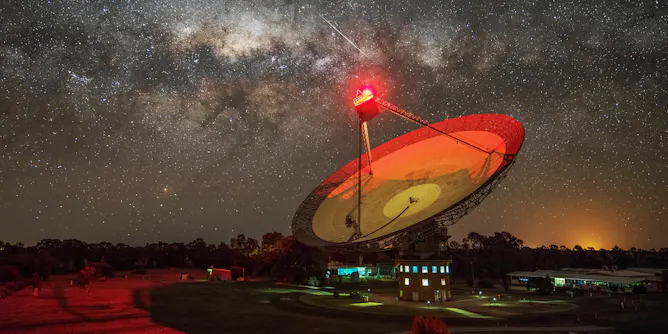
‘Project Phoenix’ was initiated by small research organisation known as the SETI Institute. But it was lucky to get off the ground.
Articles on Parkes Radio Telescope
Displaying all articles
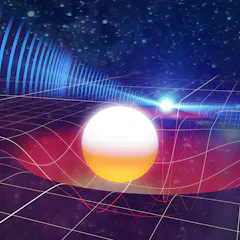
Neutron stars contain some of the universe’s most exotic states of matter – but there’s no easy way to peek inside.
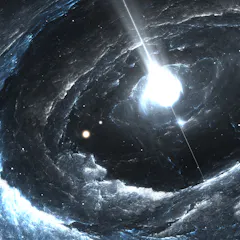
Magnetic fields billions of light years away offer clues to the nature of intense flashes from the sky known as fast radio bursts.
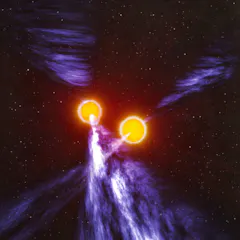
Astronomers watched a pair of pulsars for 16 years to test the theory of general relativity, which has stood unchallenged for over a century.
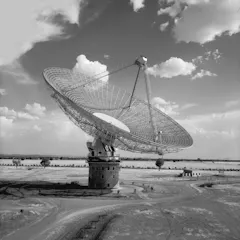
After six decades during which it tracked lunar missions, spotted distant pulsars and quasars, and even expanded our concept of the size of the Universe, the Parkes telescope is still going strong.
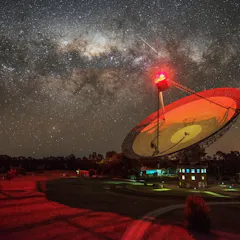
Astronomers hunting extraterrestrials were excited to discover an intriguing signal, but closer inspection has revealed it wasn’t aliens.
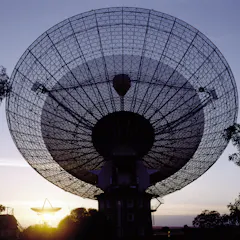
Australian astronomers are part of a prize-winning team that was the first to pinpoint the location of a fast radio burst. But there is much we still don’t know about these mysterious bursts.
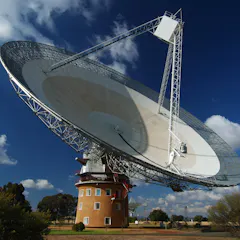
The Dish in Parkes is scanning the southern Milky Way, searching for alien signals
The Conversation50.7 MB (download)
Today we hear about the Parkes radio telescope's role in the search for alien life. Our guide is the irrepressible John Sarkissian, the scientist who's had his eye on The Dish since childhood.
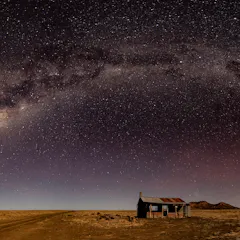
‘The size, the grandeur, the peacefulness of being in the dark’: what it’s like to study space at Siding Spring Observatory
The Conversation, CC BY54.3 MB (download)
Three hours north-east of Parkes lies a remote astronomical research facility, unpolluted by city lights, where researchers are trying to unlock some of the biggest questions about our Universe.
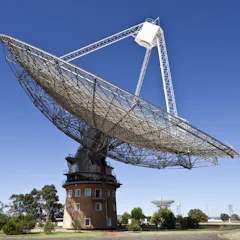
The Universe is mind-bogglingly large and with the latest technology, the search is only just starting to heat up.
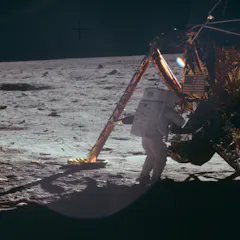
When Neil Armstrong stepped on to the Moon 50 years ago this month, Australians saw the images first. Australia even defied bad weather to bring the historic images to the world.
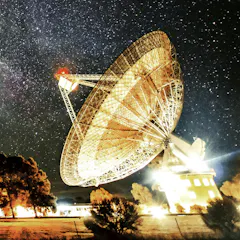
In mid 1967, PhD student Jocelyn Bell at Cambridge University was helping to build a telescope. She went on to discover a little bit of “scruff” - the first evidence of a pulsar.
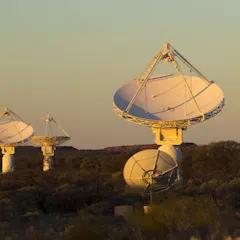
Technology is driving a revolution in the way radio astronomers study the universe, and it could lead to new discoveries.
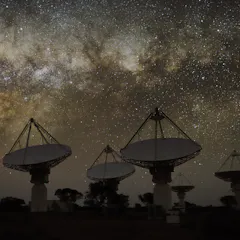
It used to take weeks to find any of these mysterious signals from deep in space but when the new telescope started looking it found one within days. Then another.
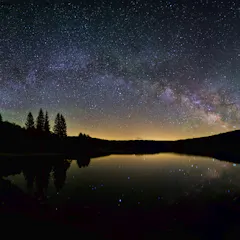
Astronomers are making new discoveries about our galaxy thanks to a more detailed map of the Milky Way.

You can’t just buy a radio telescope receiver off the shelf. So CSIRO has been hard at work building receivers for the world’s largest telescopes using the very latest technology.
Top contributors
-

Operations Scientist, CSIRO
-
CSIRO Fellow, CSIRO Space and Astronomy, CSIRO
-
Astronomer, CSIRO
-
Senior research fellow, Curtin University
-
Senior research scientist, CSIRO
-
Director of Astronomy and Space Science, CSIRO
-
Associate Professor of Astrophysics, Curtin University
-
Associate Investigator, ARC Centre of Excellence for Gravitational Waves (OzGrav), and Professor in Astrophysics, Swinburne University of Technology
-
Postdoctoral Researcher, Pulsar Timing and Gravitational Waves, Swinburne University of Technology
-
PhD candidate Department of Physics and Astronomy, West Virginia University
-
Professor, Swinburne University of Technology, Swinburne University of Technology
-
Professor, Western Sydney University
-
Senior lecturer, Macquarie University
-
CSIRO
-
Associate Professor of Astronomy, Macquarie University