
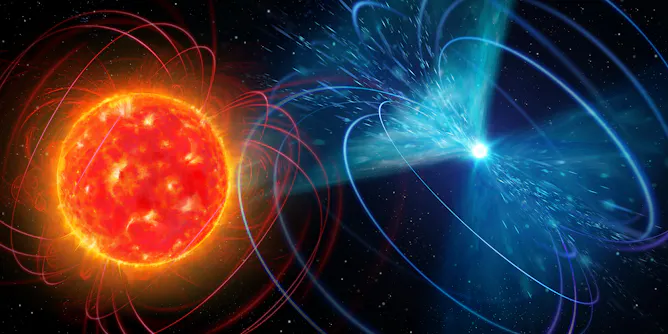
Radio pulses repeating every minute-to-hour have puzzled astronomers, but a new paper in Nature Astronomy might finally shed some light.
Articles on Pulsars
Displaying 1 - 20 of 26 articles
For the first time, astronomers have measured the plasma layers of a shock wave surrounding a pulsar.
The slowest ‘cosmic lighthouse’ ever found challenges our understanding of how neutron stars work.
A new effort to map the rumblings in spacetime caused by enormous black hole collisions paints a surprisingly loud and lopsided picture of the universe.
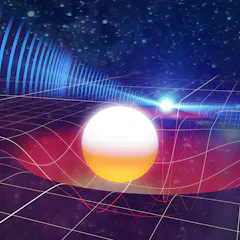
Neutron stars contain some of the universe’s most exotic states of matter – but there’s no easy way to peek inside.
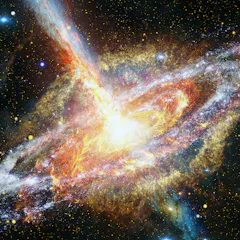
A slowly flickering source of radio waves that changes over time might be a neutron star or a white dwarf – but its behaviour doesn’t quite fit any of our theories.
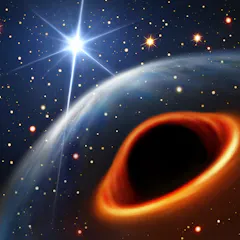
It’s too heavy to be a neutron star and too light to be a black hole. So what is it?
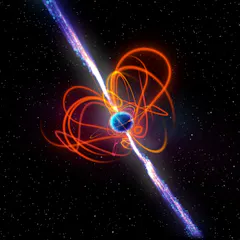
Astronomers have detected a long-running source of slow, repeating radio pulses that can’t be explained by current theories – but it’s probably not aliens.

By timing radio pulses from an array of galactic pulsars, scientists see hints of gravitational waves from supermassive black hole pairs in a breakthrough that may reveal hidden details of galaxy evolution.
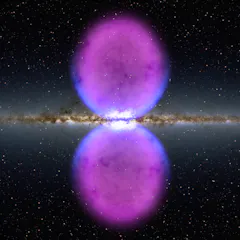
A glowing blob in the sky known as “the cocoon” may be caused by pulsars in the Sagittarius dwarf galaxy.

The pulsar PSR J0523-7125 is more than ten times brighter than any other radio pulsar outside the Milky Way.
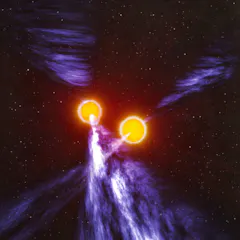
Astronomers watched a pair of pulsars for 16 years to test the theory of general relativity, which has stood unchallenged for over a century.
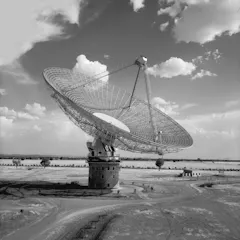
After six decades during which it tracked lunar missions, spotted distant pulsars and quasars, and even expanded our concept of the size of the Universe, the Parkes telescope is still going strong.

Fluctuating radio waves that appear to come from near the heart of the Milky Way are a new puzzle for astronomers.

The Arecibo radio telescope has collapsed but its amazing discoveries will live on.
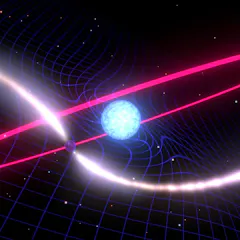
One of Einstein’s weirder predictions is that massive, spinning objects exert a drag on space-time itself. Now an orbiting pair of unusual stars has revealed this effect in action.
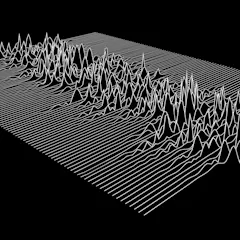
When you look at the squiggly lines on Joy Division’s famous album cover, you’re seeing a record of lightning in outer space.
The little-known Rossi X-ray Timing Explorer spacecraft was like a Geiger counter for the universe, listening to black holes and zombie stars.
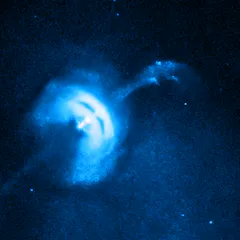
Pulsars are rapidly rotating neutron stars and some of them are know to have a “glitch”, and astronomers have captured one as it hapened.
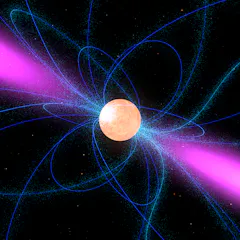
Studying mysterious neutron stars could uncover the secrets of exotic physics – and a way to navigate the stars.
Top contributors
-

Postdoctoral Researcher, Pulsar Timing and Gravitational Waves, Swinburne University of Technology
-
Professor, Radio Astronomy, University of Sydney
-
Professor of Physics, University of Wisconsin-Milwaukee
-
Senior Lecturer in Astrophysics, University of Sydney
-
Radio Astronomer, Curtin University
-
SKA-Low Senior Commissioning Scientist and Adjunct Associate Professor, Curtin Institute of Radio Astronomy, Curtin University
-
Associate Professor, Heriot-Watt University
-
Associate professor, University of Southampton
-
Professor, Swinburne University of Technology, Swinburne University of Technology
-
Professor, UCL
-
Lecturer In Pulsar Astrophysics, University of Manchester
-
CSIRO
-
ARC Laureate Fellow, Swinburne University of Technology
-
Professor of Astrophysics, University of Manchester
-
Professor of Astronomy, UMass Lowell