
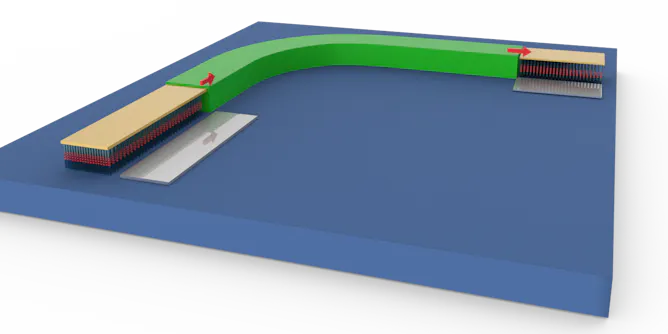
As electronic transistors get tinier, they approach a point at which they won’t be able to get smaller. How can we keep shrinking our devices, and making them more powerful at the same time? Light.
Articles on Electronics
Displaying 61 - 80 of 92 articles
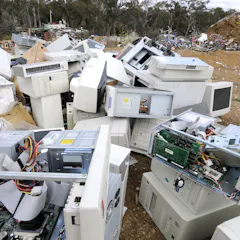
Australia is among the world’s top ten users of electronic and electrical products. But our systems for recycling the resulting ‘e-waste’ fall a long way short of other rich nations.

Imagine if your smartphone was built into your arm. Flexible organic electronics could one day make artificial skin displays a reality.

Molybdenum disulphide, hexagonal boron nitride and other materials yet to be discovered will be used to build the electronics of the future.
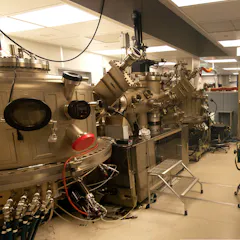
As we reach the limits of what can be done with silicon, the search for new and improved superconductors is on.

Displays you can roll up and put in your pocket are routinely touted as the next advance in screen technology. So why don’t we have them in our homes yet?

As the components in electronic devices are shrinking to the nanoscale, even a single atom out of place can disrupt their function. But this also presents an opportunity to make them even better.

When silicon circuits shrink too small to handle electrons, the future of electronics is spintronics.

Silicon isn’t the perfect semiconductor, it’s just the one we’re using. How can we ensure our electronics keep get getting faster in the face of silicon’s natural physical limits?

The US$17 million prize pool at The International Dota 2 Championships shows how much the industry has grown over the past decade.

Who says scientists aren’t artistic? A team of researchers have done some amazing kirigami work, an ancient Japanese paper art, using graphene.

Electronic engineers are emerging as important contributors to understanding of the workings of the human brain. There is a rapidly growing intersection between electronic engineering and neuroscience…
Low frequency vibrations could power small electronic devices indefinitely. Researchers have designed an aluminium nitride-based…
One evening when I was young, my father confiscated my radio because he said I was playing it too loud (I wasn’t). Fortunately, I had a bunch of broken down receivers in my room, so I built a new one…
American researchers have found a new solvent to safely turn semiconductors, which are materials that conduct their own energy…
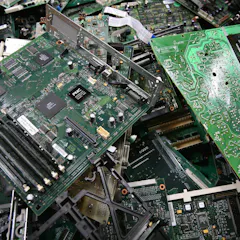
The manufacture of electrical and electronic equipment is one of the fastest growing industries in the world, fuelled by increased consumption and by the equipment’s relatively short lifespan. As a result…

So serious are the effects of air pollution on human health - the WHO recently categorised it as carcinogenic, responsible for 223,000 deaths a year worldwide - that it is easy to neglect its wider impact…
By combining two materials - transparent conductive indium tin oxide and rubber-like silicone - researchers have found a…
Researchers at the Australian National University have improved energy storage technology inside electronic devices. They…
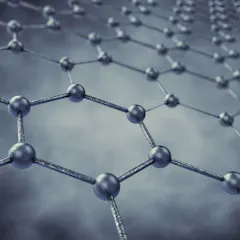
Graphene, a single layer of carbon atoms, is being touted as the material that could change how electronics are made. But it’s difficult to make graphene in forms needed for electronics. Now, researchers…
Top contributors
-

Reader in Theoretical and Computational Condensed Matter Physics, University of Edinburgh
-
Associate Professor of Physics and Electronics, Hunan University
-
Professor of Physics, Clemson University
-
PhD Candidate, Queen's University Belfast
-
Assistant Professor in Nanoscience, University of British Columbia
-
Professor, Department of Computer Science, University of Surrey
-
John M. Thompson Chair in Information Technology and Innovation and Professor, Western University
-
Professor in Nanoelectronics, University of York
-
PhD candidate in Atomic Imaging, University of British Columbia
-
Research Scientist in Computer Science and Engineering, Nanyang Technological University
-
Associate Professor of Electrical and Computer Engineering, Binghamton University, State University of New York
-
Associate Professor of Electrical and Computer Engineering, Tufts University
-
Assistant Professor of Electrical and Computer Engineering, The Ohio State University
-
PhD candidate in Materials Engineering, Monash University
-
Professor/Head of Aviation, CQUniversity Australia