
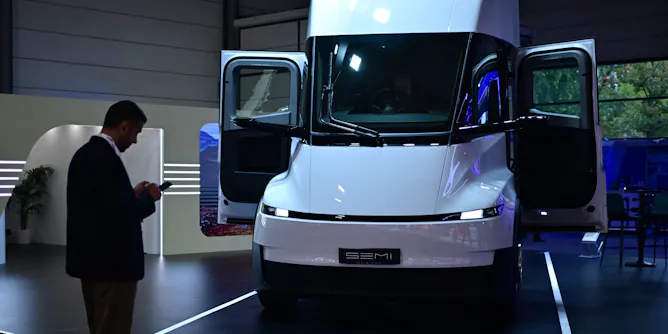
Smaller electric trucks are already on Australian city streets. As battery prices fall, bigger trucks will become viable – especially if there’s no driver.
Articles on Electric vehicles (EVs)
Displaying 1 - 20 of 474 articles
Chinese EVs are approaching the price of older used petrol vehicles. That could disrupt a whole support industry, from gas stations to mechanics and dealers.
BYD is suddenly our second-highest selling car brand. Four key factors are behind its rapid ascent.

As hundreds of thousands more EVs hit Australian roads, is our charging infrastructure up to scratch?
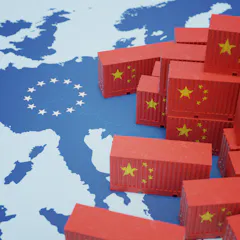
The US and China have extended their trade truce till January. Meanwhile, EU-China export/import imbalances persist with sticking points, including voluntary export curbs and industrial policy reform.
Seven months into the US conflict with Iran, with no clear end in sight, the global oil market has now largely exhausted the safety measures that exist to keep a lid on petroleum prices.
Connected vehicles can be hacked, posing risks for safety and privacy.

How big policy areas like crime, education, transport and energy have changed.

Tighter regulation and careful planning will ensure our public chargers actually work.

In less than six months, China will start phasing in a world-first ban on hidden car door handles. A US ban may be next. So what’s happening in Australia?
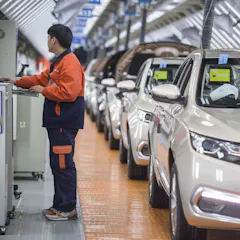
In response, Australia must strengthen standards around data security, vehicle safety and battery recycling.
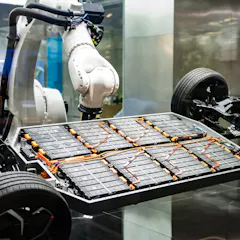
Australia stopped keeping detailed data on its vehicle fleet after the domestic car industry ended. That’s becoming an issue.
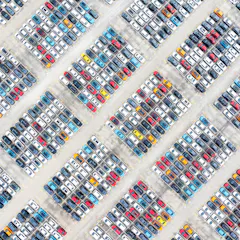
China’s rise to EV dominance may seem sudden – but it’s the result of more than 20 years of state investment.
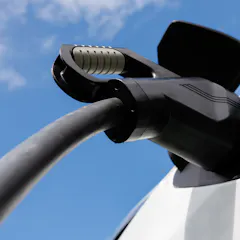
Australia’s EV transition is gathering pace – but fixing gaps in the public charger network will be essential for the shift to continue.
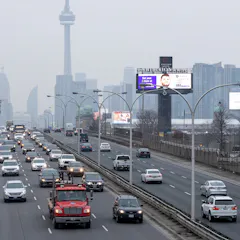
Resilient urban mobility can be created by giving people options that ensure they can still move around when a shock affects one form of transportation.
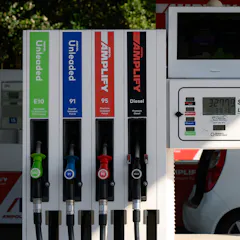
A more radical reform package would include a road user charge.
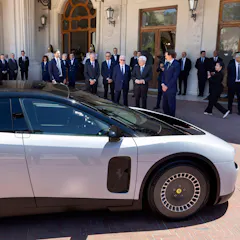
The critical question is not whether the Luce succeeds as a product, but whether it succeeds as a Ferrari.
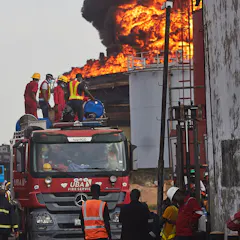
Wealthy nations will need to help fund clean energy, green industrial growth and mineral processing.
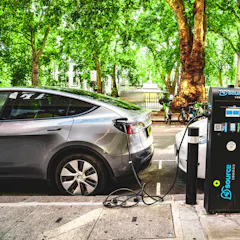
Australia’s 20 million domestic cars – and almost all heavier vehicles – will eventually be electric. We need to prepare for this.
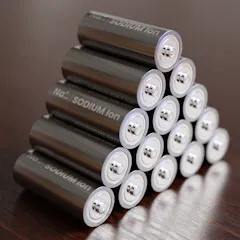
Sodium-ion batteries use more abundant raw materials but don’t currently perform as well as those made with lithium.
Top contributors
-

Professor of Transport Technology and Sustainability, Swinburne University of Technology
-
Senior Lecturer in Operations and Supply Chain Management, Anglia Ruskin University
-
E-Mobility Research Fellow, The University of Queensland
-
Professor, School of Economics, The University of Queensland
-
Professorial Fellow, University of Canberra
-
Adjunct Professor of Transport, University of Technology Sydney
-
Lecturer, School of Electrical Engneering and Computer Science, The University of Queensland; The University of Western Australia
-
Professor of Sustainability, Curtin University
-
Senior Lecturer, Griffith Business School, Griffith University
-
Senior Research Fellow, Collaboration on Energy and Environmental Markets, UNSW
-
Research Associate, Institute of Coding, Coventry University
-
Professor of Business and Sustainability, Cardiff University
-
Professor in Supply Chain and Freight Innovation, Swinburne University of Technology
-
Professor of Civil and Environmental Engineering, Rice University
-
Associate Professor and Principal Fellow in Urban Risk and Resilience, The University of Melbourne