
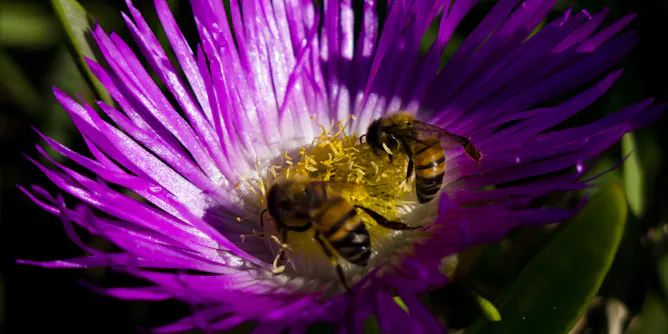
To learn about how humans, animals and insects experience vision illusions, we had to find a way to ask bees what they saw.
Articles on Bees
Displaying 201 - 220 of 296 articles
While bee sting deaths are rare, bees cause more hospitalisations than any venomous creature.

Pollination in South Africa’s ecosystems is extremely complex. However new advances such as pollen metabarcoding help us understand interactions between pollinators and pollen.

Elephants have the highest count of olfactory receptor genes of any species tested to date. This suggests that they may be the best smellers in the animal kingdom.
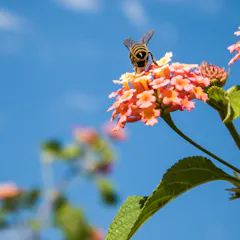
New research shows bees see a blue halo around flowers thanks to nanostructures on its petals.
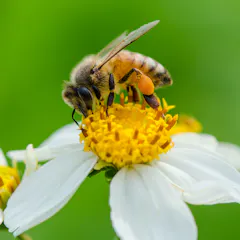
Urban bees deal with what’s known as “habitat patches,” discontinuous patches of green like gardens, parks and ravines. Green roofs could offer relief to bees dealing with habitat fragmentation.
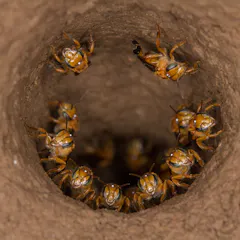
New research shows stingless bees will assassinate their queen if she makes the wrong royal match.
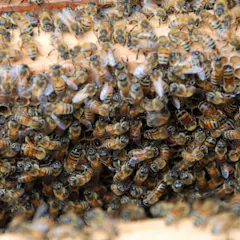
Bees sting other animals, including humans, when they think there might be a threat to their hive. But Evie, age 8, wonders if bees ever accidentally sting other bees.
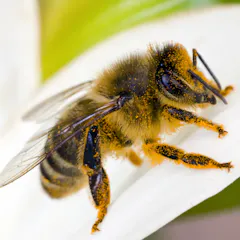
Bees and home security cameras use the same complex techniques to monitor their environments.
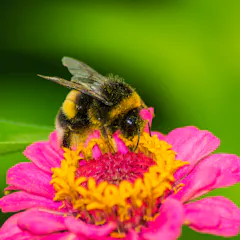
Exposure to neonicotinoids could lead to fewer bumblebee colonies, less pollination, and ultimately to population extinctions.
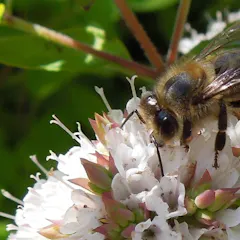
Garden pollinators can turn their noses up at the flowers human eyes find most beautiful.
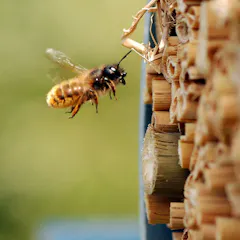
Here’s how to take the sting out of these harmful pesticides.
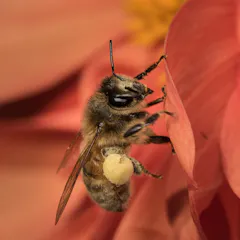
Extra “eyes” on top of bee heads help them see colours the same way under all light conditions. And it’s an approach that could help us design better cameras.

Beekeeping cannot depend on a single forage source. This makes the business of ensuring bees have what they need to stay healthy a precarious business.
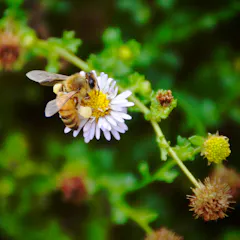
It’s a decade since US beekeepers first noticed that their bees were mysteriously dying. Now we know much more about Colony Collapse Disorder, raising hopes that we can turn bees’ fortunes around.

Small animals are the fabric of the world around us. Without them everything would crumble.
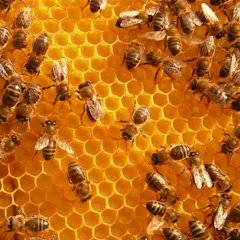
Every new batch of bees needs the equivalent of eight hectares of lavender fields to prosper.
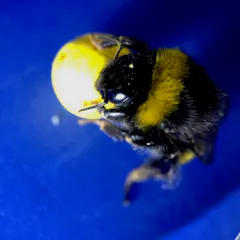
They shoot, they score … if there’s a sugary reward at the end of it.

Collecting pollen takes a surprising amount of teamwork.
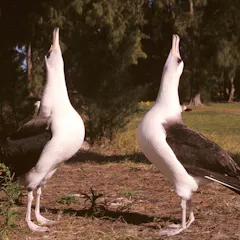
Planet Earth’s bears have nothing on these critters.
Top contributors
-

Associate Professor, Department of Physiology, Monash University
-
Research Fellow, School of Biological Sciences, Monash University
-
Lecturer in Ecology, University of New England
-
Researcher and analyst, Monash University
-
Senior Research Associate in Entomology, Lancaster University
-
Adjunct Research Fellow, Curtin University
-
Lecturer in Biological Sciences, University of Wollongong
-
Associate Professor in Entomology, University of Sydney
-
Lecturer, School of Life and Environmental Sciences, University of Sydney
-
Professor, School of Natural Sciences, Macquarie University
-
Centre Manager & Industry Liaison Officer ARC ITTC Centre for Fruit Fly Biosecurity Innovation, Macquarie University
-
Senior Ecologist, University of Sydney
-
Professor of Quantum Physics and Australian Research Council Future Fellow, RMIT University
-
Emeritus Professor of Apiculture, University of Sussex
-
Professor of Biology (Evolution, Behaviour and Environment), University of Sussex