
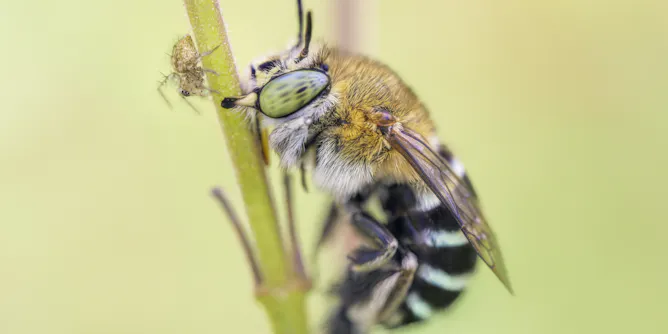
Some of the most impressive visual performances measured in a new study came from rarely studied, solitary species.
Articles on Honeybees
Displaying 1 - 20 of 161 articles

The honeybee-killing Varroa mite is marching across the country, as two experts explain.
Current pesticides are already failing – but science points to a way forward.

The same busy foraging that makes bees vital pollinators could also turn them into Trojan horses for a serious fungal disease threatening native forests.
The accusations you might have heard about nonnative honey bees aren’t backed up by evidence. In fact, there are plenty of ways bees make the world a better place.

Queen bees typically imported from regions with warmer climates are not well-suited to cold Canadian winters and exhibit higher rates of diseases like chalkbrood.
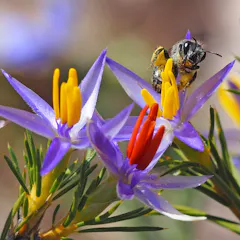
If the governments of Australia can invest millions into the honeybee industry, they surely have the resources to support native pollinators.
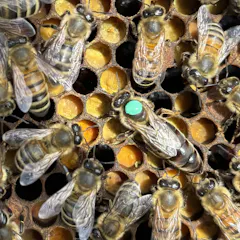
New research shows that virus infections change the queen’s pheromone, which may lead to a grim demise.
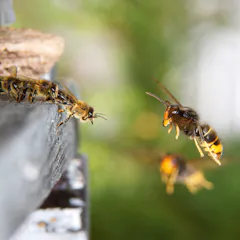
The hornet invasion threatens honeybees, other pollinators and all native insects with no natural defences. Eradication attempts hinge on fast action by everyone.

The wild cousins of beehive honeybees are disappearing – here’s why that matters.
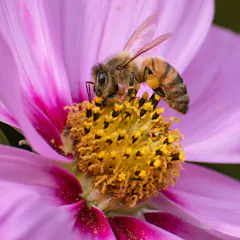
The tropi mite spreads faster, kills colonies more quickly, and is harder to control with existing methods.

Traditional methods for controlling Varroa mites are becoming less effective, but AI-enabled non-invasive methods could help improve detection and keep bees safe.

Fever isn’t necessarily a bad thing − it’s actually a useful response to infections.

Varroa mites and small hive beetles are threatening Australian honey producers. Here’s how backyard beekeepers, and everyday honey lovers, can help.

Did you know you have a ‘mental number line’, from smallest to largest? Turns out, so do bees.

Honeybees can act as a key ally in pollution monitoring efforts across Canada.

New research highlights the flaws of pesticide regulation.
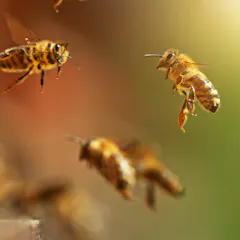
New study shows man made hives leak substantially more heat than the tree cavities of wild honey bees.
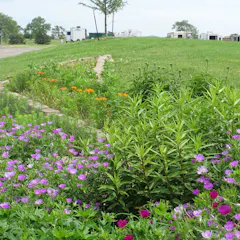
NoMowMay is a catchy concept, but it doesn’t provide the food that native North American pollinators need or lasting support for them.
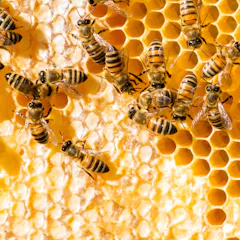
What makes us human? Greek and Roman thinkers were preoccupied with this question. And some of their observations of animals foreshadowed recent findings in the behavioural sciences.
Top contributors
-

Associate Professor, Department of Physiology, Monash University
-
Research Fellow, School of Biological Sciences, Monash University
-
Researcher and analyst, Monash University
-
Lecturer in Ecology, University of New England
-
Associate Professor in Entomology, University of Sydney
-
Lecturer, School of Life and Environmental Sciences, University of Sydney
-
Professor, School of Natural Sciences, Macquarie University
-
Associate Professor of Biology, Tufts University
-
Professor of Quantum Physics and Australian Research Council Future Fellow, RMIT University
-
Senior Research Associate in Entomology, Lancaster University
-
Lecturer in Biological Sciences, University of Wollongong
-
Ph.D. Candidate, School of Environment and Forest Sciences, University of Washington
-
Scientist, South African National Biodiversity Institute
-
Emeritus Professor of Apiculture, University of Sussex
-
Researcher in Mechanical Engineering, University of Leeds